
Cloud PBX vs Traditional PBX: Which Phone System Is Right for Your Business?
When businesses evaluate their communication infrastructure, the debate around Cloud PBX vs Traditional PBX sits at the center of nearly every conversation. The phone system a company chooses directly impacts day-to-day operations, team collaboration, customer satisfaction, and long-term costs. With rapid advancements in internet technology and remote work becoming a permanent fixture for many organizations, understanding the difference between these two systems has never been more important.
This guide walks you through everything you need to know so you can make a confident, informed decision for your business.
What Is a Traditional PBX System?
A traditional PBX, or Private Branch Exchange, is an on-premises telephone system that routes calls within an organization and connects to the public telephone network. It relies on physical hardware installed at your business location, including servers, wiring, switchboards, and desk phones.
Historically, traditional PBX systems were the standard for businesses of all sizes. They offered reliable internal call routing, extensions, voicemail, and conferencing capabilities. Since all the hardware lives on-site, businesses had full control over the system and did not rely on an internet connection for basic functionality.
Key characteristics of Traditional PBX:
Traditional PBX systems use copper wire-based infrastructure to handle voice calls. They require dedicated hardware installed and maintained on-site. Upfront capital investment is typically significant. A specialized IT team or technician is needed for maintenance and upgrades. Physical desk phones are connected directly to the system.
What Is a Cloud PBX System?
A Cloud PBX, also called a hosted PBX or virtual PBX, delivers all the features of a traditional phone system but through the internet rather than physical hardware. Instead of owning and maintaining servers on-site, businesses subscribe to a service where the provider hosts and manages all the infrastructure remotely.
Calls are transmitted using Voice over Internet Protocol (VoIP) technology, converting voice signals into digital data packets that travel over your internet connection. This approach allows employees to make and receive calls from virtually anywhere using softphones, mobile apps, or internet-enabled desk phones.
Key characteristics of Cloud PBX:
Cloud PBX systems operate entirely through a stable internet connection. There is no need for on-site servers or extensive physical hardware. Businesses pay a predictable monthly subscription per user. The service provider handles all maintenance, updates, and security. Employees can connect from any location using any compatible device.
Cloud PBX vs Traditional PBX: Core Differences Explained
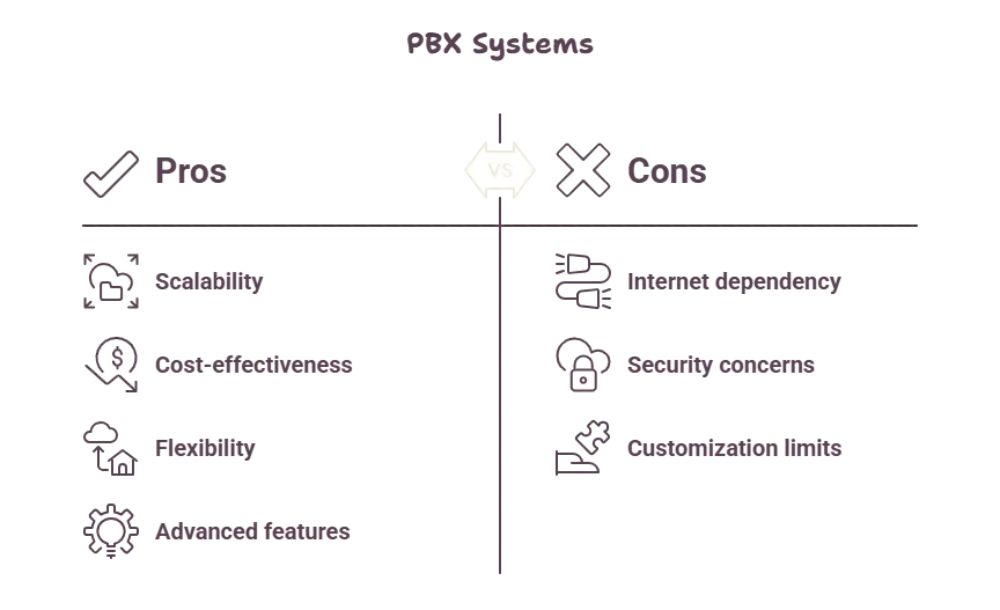
Setup and Installation
One of the most immediate differences between Cloud PBX vs Traditional PBX lies in how each system is set up.
Traditional PBX requires purchasing and installing physical hardware. This process can take weeks or even months and often requires bringing in specialized technicians. For businesses moving into a new office or scaling rapidly, this timeline can be a significant bottleneck.
Cloud PBX, by contrast, can be up and running in a matter of hours or days. Since the infrastructure is hosted off-site, businesses simply need an internet connection, compatible devices, and user credentials. There is no construction or wiring required, and the provider handles all the backend configuration.
Cost Structure
The cost structure is one of the most decisive factors in the Cloud PBX vs Traditional PBX comparison.
Traditional PBX demands a high upfront capital investment. Businesses must purchase hardware, pay for installation, hire or retain IT staff, and budget for regular maintenance and hardware replacements. As the system ages, repair costs tend to increase, and adding new lines or features often requires purchasing additional equipment.
Cloud PBX operates on an operational expenditure model. Businesses pay a monthly subscription fee per user, which typically includes all features, updates, and support. There are no large upfront costs, and scaling the system up or down requires simply adjusting the subscription. This predictable cost model makes budgeting far more straightforward.
Scalability and Flexibility
Key points on scalability:
Cloud PBX scales instantly with your team size. Adding a new employee means adding a user license, often done in minutes through an admin dashboard. Removing users is equally simple, making it ideal for businesses with seasonal fluctuations or rapid growth phases.
Traditional PBX scalability is limited by physical infrastructure. Adding lines or extensions requires purchasing additional hardware and scheduling installation, which introduces delays and costs. Downsizing is equally problematic because the hardware remains regardless of how many users are actually using it.
For growing businesses or those with unpredictable staffing needs, Cloud PBX offers a clear advantage in agility.
Reliability and Uptime
Traditional PBX systems, when properly maintained, can be highly reliable since they do not depend on internet connectivity. Power outages aside, the system works independently of external network conditions, which can be a benefit in areas with unstable internet.
Cloud PBX reliability has improved dramatically with the widespread availability of high-speed broadband. Reputable cloud providers maintain multiple redundant data centers, meaning that even if one server goes down, calls are automatically rerouted through another. However, a poor or interrupted internet connection at the business’s location can affect call quality.
Businesses in areas with consistently strong internet access will find Cloud PBX extremely reliable. Those in regions with unreliable connectivity may still benefit from the physical consistency of a traditional system or a hybrid approach.
Features and Advanced Capabilities
This is where Cloud PBX vs Traditional PBX differences become most apparent for modern businesses.
Traditional PBX systems offer a solid set of features including call routing, voicemail, hold music, and internal extensions. However, adding advanced features often requires purchasing additional hardware modules or third-party software, adding both cost and complexity.
Cloud PBX typically includes a rich suite of modern features as standard within the subscription:
Auto attendants and intelligent call routing are available without additional hardware. Voicemail-to-email and voicemail transcription enhance productivity. Call recording and real-time analytics give managers valuable insights. Video conferencing and team messaging are often bundled into the platform. Integration with CRM platforms, helpdesk software, and productivity tools is straightforward. Mobile apps allow employees to use business numbers from personal devices seamlessly.
These features are regularly updated by the provider, meaning businesses automatically benefit from new capabilities without needing to upgrade hardware.
Maintenance and IT Burden
Maintaining a traditional PBX places ongoing responsibility on the business. Hardware can fail, software requires patching, and the system may need specialist attention for even minor issues. For small and medium businesses without a dedicated IT team, this can be a significant operational burden.
Cloud PBX shifts virtually all maintenance responsibility to the service provider. Software updates are applied automatically, security patches are handled server-side, and technical support is available from the provider’s team. Internal IT staff are freed to focus on other priorities rather than managing phone system infrastructure.
Remote Work and Mobility
The modern workforce increasingly operates outside a traditional office environment. This is one area where the difference between Cloud PBX vs Traditional PBX is most pronounced.
Traditional PBX ties users to physical phones at specific desk locations. Remote work workarounds, such as call forwarding, exist but are often clunky and limited. Employees working from home or traveling may struggle to maintain seamless communication through a traditional system.
Cloud PBX was designed with mobility in mind. Employees can use their business number from a smartphone, laptop, tablet, or any internet-connected device, regardless of where they are in the world. This makes Cloud PBX the natural choice for distributed teams, hybrid work environments, and businesses with traveling staff.
Security Considerations
Traditional PBX systems are generally considered secure in that they operate within a closed, on-premises network with limited external exposure. Physical access is typically required to tamper with the hardware.
Cloud PBX security depends heavily on the provider’s infrastructure and the business’s own network hygiene. Reputable providers invest significantly in encryption, access controls, compliance certifications, and data protection. Businesses should evaluate a provider’s security credentials carefully, including end-to-end call encryption, two-factor authentication, and regulatory compliance where relevant to their industry.
Which System Is Right for Your Business?
Choosing between Cloud PBX vs Traditional PBX ultimately comes down to your specific business context.
Cloud PBX is likely the better fit if your team is growing quickly, works remotely or across multiple locations, wants predictable monthly costs, needs a feature-rich platform with minimal IT overhead, or values easy integrations with business software.
Traditional PBX may still serve well if your organization has an existing, well-maintained system with years of life remaining, operates in an area with unreliable internet, or has very specific compliance requirements that favor on-premises infrastructure.
Many businesses transitioning from traditional systems are choosing Cloud PBX as their default upgrade path because it aligns with how modern work actually functions.
Frequently Asked Questions
Is Cloud PBX suitable for small businesses?
Absolutely. Cloud PBX is particularly well-suited for small businesses because it eliminates large upfront hardware costs, requires no specialized IT staff to manage, and scales easily as the team grows. Small teams can access enterprise-grade features at a fraction of the cost of a traditional system.
Can a Cloud PBX system work without a reliable internet connection?
Cloud PBX depends on a stable internet connection for call quality. If your internet connection is unreliable, call quality may suffer. Many businesses mitigate this by using a dedicated internet circuit for voice traffic or by enabling mobile data failover so calls continue even if the primary connection drops.
How difficult is it to migrate from Traditional PBX to Cloud PBX?
The migration process is generally straightforward with proper planning. Most Cloud PBX providers offer number porting so existing business numbers can be transferred. The provider typically supports businesses through setup, device configuration, and staff training to ensure minimal disruption during the transition.
Is Cloud PBX more secure than Traditional PBX?
Both systems can be made highly secure with proper measures in place. Traditional PBX has a smaller attack surface due to its closed network. Cloud PBX from a reputable provider includes encryption, access controls, and regular security updates. The key is choosing a provider with strong security credentials and ensuring your own network is properly protected.
What happens to my Cloud PBX service if the provider experiences an outage?
Established Cloud PBX providers build redundancy into their infrastructure through multiple data centers and automatic failover mechanisms. In the event of a localized outage, calls are rerouted to backup systems automatically. Many providers also offer mobile app continuity so employees can continue receiving and making calls even during a service disruption at the primary data center level.










Post Comment