
5G and VoIP: How Faster Networks Are Transforming Business Calls
5G and VoIP are changing the way people talk, meet, and work. Voice calls no longer rely on old phone lines. They travel as data over the internet, and 5G gives that data a faster and smoother route.
The result is clearer calls, fewer drops, and more freedom to work from anywhere. In this guide, you will learn how 5G and VoIP work together, where they help most, and how to get ready.
What Is VoIP?
VoIP stands for Voice over Internet Protocol. It converts your voice into small digital packets and sends them across the internet to the person you are calling.
Because VoIP uses data networks, it supports much more than simple calls. Video meetings, instant messaging, voicemail to email, and screen sharing all run on the same connection.
The quality of every VoIP call depends on the network underneath it. A weak or crowded connection leads to echoes, delays, and broken audio.
What Is 5G?
5G is the fifth generation of mobile network technology. It is built to move more data, respond faster, and connect far more devices at the same time than earlier generations.
For voice and video, this means a mobile connection that behaves much more like a strong fixed line.
Key Features of 5G
Three features matter most for communication.
- Speed: Large amounts of data move quickly, which supports HD voice and video.
- Low latency: The delay between sending and receiving data drops sharply, so conversations feel natural.
- Capacity: Busy areas can handle many users without slowing down.
Network slicing is another useful feature. It lets providers reserve a dedicated portion of the network for important traffic, such as business calls.
How 5G and VoIP Work Together
VoIP needs a network that is stable, fast, and responsive. 5G delivers exactly that. When the two combine, calls become more reliable on the move and more flexible in the office.
Lower Latency Means Natural Conversations
Latency is the small delay between speaking and being heard. When it is high, people talk over each other and conversations feel awkward.
5G reduces this delay, so VoIP calls feel closer to speaking face to face. This is especially valuable for sales calls, client meetings, and support conversations.
Higher Bandwidth Supports Richer Communication
Modern teams use more than voice. They share screens, present slides, and hold video meetings with many participants.
5G provides the bandwidth to support all of this at once. Audio stays crisp, video stays sharp, and files can be shared without interrupting the call.
Stronger Stability on Mobile Devices
Mobile VoIP has often struggled when users move between networks or pass through weak signal areas. Calls may freeze or drop completely.
5G handles these transitions better and offers stronger coverage in supported areas. Employees can take calls from a train, a car, or a client site with greater confidence.
Main Benefits of 5G and VoIP
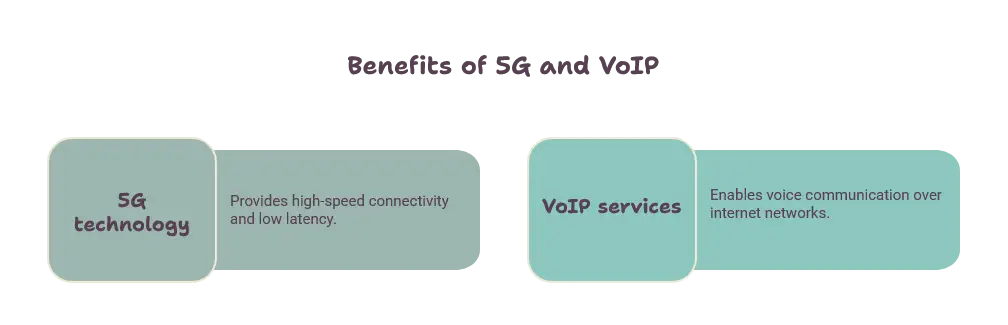
Businesses that combine these technologies gain several clear advantages.
Better Call Quality
Clear audio is the foundation of professional communication. With faster speeds and lower delay, 5G helps VoIP deliver fewer dropouts, less jitter, and cleaner sound.
Greater Flexibility
Teams are no longer tied to a desk or a single office network. A mobile device on a strong 5G connection can act as a full business phone, with the same number and the same features.
Easier Scaling
Cloud based VoIP already makes it simple to add users and locations. 5G builds on this by offering fast connectivity at new sites without waiting for fixed line installation.
Reliable Backup Connectivity
If the main office internet goes down, a 5G connection can step in as a backup. Calls continue, and customers never notice a problem.
Real World Use Cases
The combination of 5G and VoIP is already useful across many industries.
Remote and Hybrid Teams
Remote staff can join calls and meetings from home, cafes, or shared spaces with consistent quality. Managers get a team that stays connected no matter where people sit.
Customer Support Centers
Support agents depend on clear audio and quick response. 5G strengthens the connection behind cloud contact center tools, which helps agents resolve issues faster and keeps customers satisfied.
Healthcare and Telemedicine
Doctors and patients need calls that are clear and dependable. 5G and VoIP make virtual consultations smoother, with stable video and audio even from remote areas.
Field Services
Technicians, delivery teams, and site managers spend much of their day away from a desk. Mobile VoIP over 5G keeps them reachable and lets them share photos, updates, and live video from the job site.
Challenges to Consider
Like any technology shift, this one comes with a few challenges.
Coverage is the first. 5G is still expanding, and signal strength varies by location. Businesses should check coverage in the areas where their teams work most.
Security is the second. Voice traffic carries sensitive information, so encryption, secure authentication, and regular updates are essential.
Device compatibility also matters. Older phones and equipment may not support 5G, which can limit the benefits.
Finally, network management needs attention. Prioritizing voice traffic helps keep call quality high when many applications compete for bandwidth.
How to Prepare for 5G and VoIP
A little planning makes the transition smoother. Start with these actions.
- Review your current VoIP setup and identify where call quality drops.
- Check 5G coverage in your main work locations.
- Choose devices and softphone apps that support 5G.
- Set quality of service rules so voice traffic gets priority.
- Train your team on mobile calling features and security habits.
Test everything with a small group first. This helps you find issues early and build confidence before a wider rollout.
The Future of 5G and VoIP
The partnership between 5G and VoIP is only getting started. As networks expand, more businesses will treat mobile connections as a primary way to communicate, not just a backup.
Expect smarter features too. Artificial intelligence can already transcribe calls, reduce background noise, and summarize meetings. With faster networks, these tools will work in real time and feel seamless.
Immersive experiences such as augmented reality meetings may also become more common. They need fast, stable connections, and 5G is built to deliver them.
Conclusion
5G and VoIP are a natural match. VoIP brings flexible, internet based communication, and 5G brings the speed, low latency, and stability that make it work at its best.
Together they improve call quality, support mobile and remote teams, and prepare businesses for the next wave of communication tools. The smartest move is to review your setup now, test carefully, and build a strategy that grows with the technology.
Frequently Asked Questions
What is the connection between 5G and VoIP?
VoIP sends voice calls over the internet, and 5G is a fast mobile network that carries internet data. When VoIP runs on 5G, calls benefit from higher speeds, lower delay, and better stability.
Does 5G improve VoIP call quality?
Yes. 5G reduces latency and jitter and offers more bandwidth, which leads to clearer audio, fewer dropped calls, and smoother video during VoIP sessions.
Can 5G replace a traditional office internet connection for VoIP?
In many cases, 5G can serve as a strong primary or backup connection for VoIP. The best choice depends on local coverage, the number of users, and your communication needs.
Is VoIP over 5G secure?
It can be very secure when you use encryption, strong passwords, multi factor authentication, and regular software updates. Security depends on how the VoIP system is set up and managed.
Do I need a special phone to use VoIP on 5G?
You need a device that supports 5G and a VoIP app or softphone. Most newer smartphones support both, so many users can start without extra equipment.













Post Comment