
AI and Automation in VoIP Communications
AI and Automation in VoIP Communications are transforming how businesses communicate with customers, employees, and partners. Modern businesses no longer rely only on traditional phone systems. Instead, they use internet-based communication systems powered by artificial intelligence and automation tools.
These technologies help companies automate calls, analyze conversations, improve customer service, and reduce operational costs. As businesses move toward digital transformation, AI-powered VoIP systems are becoming essential communication tools.
In today’s fast-paced business environment, companies need communication systems that are smart, efficient, and scalable. That’s exactly what AI and Automation in VoIP Communications provide.
This article explains how AI and automation are changing VoIP systems, their benefits, real-world applications, challenges, and future trends.
Understanding VoIP Communication Systems
VoIP stands for Voice over Internet Protocol. It allows users to make phone calls using the internet instead of traditional landline telephone networks.
How VoIP Works
VoIP technology converts voice signals into digital data packets and sends them over the internet. When the data reaches the receiver, it is converted back into audio.
Basic VoIP process:
- Voice is captured through a microphone.
- Voice is converted into digital data.
- Data is transmitted through the internet.
- The receiver’s device converts data into audio.
- The receiver hears the voice.
This process happens in milliseconds, so calls feel instant and smooth.
Traditional vs VoIP Phone Systems
| Feature | Traditional Phone | VoIP Phone System |
|---|---|---|
| Uses Internet | No | Yes |
| Hardware Required | High | Low |
| Cost | Expensive | Affordable |
| Remote Work | Limited | Easy |
| Scalability | Difficult | Easy |
| Features | Basic | Advanced |
| Maintenance | High | Low |
Because of these advantages, many businesses are switching to VoIP systems.
What is Artificial Intelligence in VoIP?
Artificial Intelligence in VoIP refers to the use of smart algorithms and machine learning systems to automate and improve communication processes.
AI can analyze voice calls, understand customer questions, route calls, and even respond automatically.
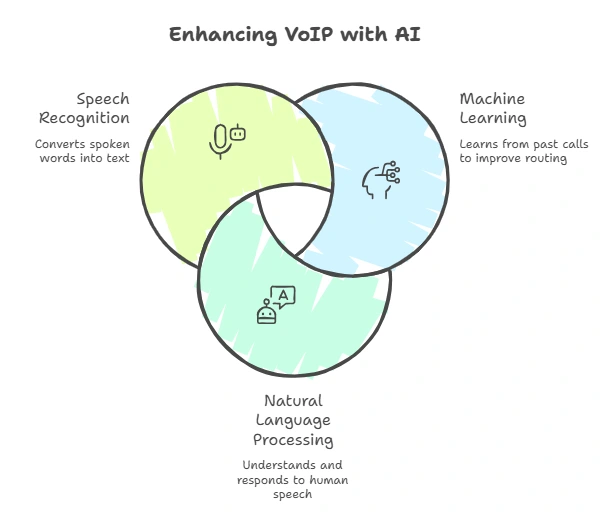
Machine Learning
Machine learning allows VoIP systems to learn from past calls and improve over time. For example, AI can learn which department handles certain customer issues and automatically route calls correctly.
Natural Language Processing
Natural Language Processing (NLP) allows AI systems to understand human speech and respond appropriately. This technology powers voice assistants and automated call systems.
Speech Recognition
Speech recognition converts spoken language into text. Businesses use this feature for call transcription, analytics, and documentation.
AI technologies make VoIP systems smarter and more efficient.
What is Automation in VoIP Systems?
Automation in VoIP systems refers to using software to perform communication tasks without human involvement.
Automation reduces manual work and improves efficiency.
Automated Call Routing
Automated call routing sends calls to the correct department or employee based on customer input, call history, or AI analysis.
Benefits include:
- Reduced wait times
- Improved customer satisfaction
- Efficient call management
- Better resource allocation
Automated Customer Support
Automated customer support systems use voice bots and interactive voice response (IVR) systems to answer customer questions.
Automated systems can:
- Answer frequently asked questions
- Provide business hours
- Track orders
- Schedule appointments
- Transfer calls to agents
- Collect customer information
This reduces workload for customer service teams.
Key Benefits of AI and Automation in VoIP Communications
There are many benefits of AI and Automation in VoIP Communications for businesses.
Improved Customer Experience
AI-powered VoIP systems reduce wait times and provide faster responses. Customers can get answers quickly without waiting for human agents.
Cost Reduction
Automation reduces the need for large customer support teams and manual call handling. Businesses save money on salaries, infrastructure, and phone systems.
Increased Productivity
Employees can focus on important tasks while automation handles repetitive tasks like call routing and voicemail management.
24/7 Availability
AI call assistants can answer calls anytime, even outside business hours. This improves customer service and business availability.
Better Data and Analytics
AI systems analyze call data and provide insights such as:
- Customer behavior
- Call duration
- Common issues
- Customer satisfaction
- Agent performance
Businesses can use this data to improve operations.
AI Features in Modern VoIP Systems
Modern VoIP systems include many AI-powered features that improve communication and automation.
Common AI VoIP features include:
- Interactive Voice Response (IVR)
- Smart call routing
- Voice assistants
- Call transcription
- Call sentiment analysis
- Automated call summaries
- Spam call detection
- Fraud detection
- Voice authentication
- CRM integration
- Predictive call routing
- Automated follow-up messages
- Call analytics dashboards
These features make VoIP systems intelligent communication platforms instead of simple phone systems.
Use Cases Across Industries
Many industries use AI and Automation in VoIP Communications to improve operations and customer service.
| Industry | Use Case |
|---|---|
| Healthcare | Appointment scheduling and reminders |
| Real Estate | Client follow-ups and call routing |
| E-commerce | Automated customer support |
| Banking | Fraud detection and verification |
| Education | Student support call systems |
| Logistics | Delivery notifications |
| Customer Support | AI call assistants |
| Hospitality | Booking and reservations |
| Insurance | Claims support automation |
These industries rely heavily on communication, so automation improves efficiency significantly.
Security and Fraud Detection
Security is very important in VoIP communication systems. AI helps detect fraud and security threats.
AI security features include:
- Spam call detection
- Fraud call pattern detection
- Voice biometrics authentication
- Call encryption monitoring
- Network threat detection
- Suspicious activity alerts
AI improves VoIP security by monitoring communication patterns and detecting unusual behavior.
Challenges and Limitations
Despite many benefits, there are some challenges when implementing AI VoIP systems.
Common challenges include:
- High initial setup cost
- Integration with existing systems
- Data privacy concerns
- Employee training requirements
- Dependence on internet connection
- AI learning curve
- System maintenance
However, these challenges are manageable with proper planning and implementation.
Future Trends of AI in VoIP Communications
The future of AI and Automation in VoIP Communications is very promising. Technology continues to improve, and communication systems are becoming smarter.
Future trends include:
- Fully automated call centers
- AI voice assistants replacing basic support agents
- Real-time language translation during calls
- Voice biometrics security
- Predictive customer support
- AI meeting summaries
- Smart communication analytics
- Integration with CRM and business software
- Personalized customer communication
- Automated workflow management
- AI-based employee performance analytics
- Intelligent call routing systems
In the future, business phone systems will not just handle calls — they will analyze, automate, and optimize communication systems.
How Businesses Can Implement AI VoIP Systems
Businesses can implement AI-powered VoIP systems by following these steps:
- Choose a cloud VoIP provider
- Integrate AI call assistants
- Enable call transcription
- Set up automated call routing
- Integrate CRM software
- Use call analytics tools
- Implement cybersecurity measures
- Train employees
- Monitor system performance
- Optimize automation workflows
FAQs
What is AI in VoIP communications?
AI in VoIP communications refers to using artificial intelligence to automate calls, analyze conversations, and improve communication systems.
How does automation help VoIP systems?
Automation helps by routing calls, answering customer queries, scheduling calls, and reducing manual work.
Is AI VoIP expensive?
Initial setup may be expensive, but it reduces long-term operational costs.
Can small businesses use AI VoIP systems?
Yes, many cloud VoIP providers offer affordable AI features for small businesses.
Is AI VoIP secure?
Yes, AI improves security by detecting fraud, spam calls, and suspicious call patterns.
What industries use AI VoIP systems?
Healthcare, real estate, banking, education, logistics, customer support, and e-commerce industries use AI VoIP systems.
What is the future of AI in VoIP communications?
The future includes automated call centers, AI assistants, predictive analytics, and smart communication platforms.
Conclusion
AI and Automation in VoIP Communications are transforming business communication systems worldwide. These technologies help businesses automate communication processes, improve customer service, reduce costs, and increase productivity.
Companies adopting AI-powered VoIP systems gain a competitive advantage by improving communication efficiency and customer experience. As technology continues to evolve, AI and automation will become essential components of business communication systems.
The future of communication is smart, automated, data-driven, and powered by AI VoIP systems. Businesses that adopt these technologies early will be better prepared for the future of digital communication.













Post Comment