Top VoIP Security Practices for Businesses
You’re running a business, and efficiency is key. You’ve probably heard about VoIP (Voice over Internet Protocol) phone systems and how they can streamline communication, reduce costs, and offer advanced features. And you’re right, they can do all of that and more! But as you embrace this powerful technology, one critical question looms large: how do you keep your VoIP system secure? In today’s digital landscape, a security breach can cripple a business, and your communication lines are no exception. This guide is designed to equip you with the essential VoIP security practices you need to implement to protect your business.
Before diving into solutions, it’s vital to understand what you’re up against. VoIP, while incredibly beneficial, introduces a new set of vulnerabilities that attackers can exploit. Thinking of your phone system as just another network device is the first step. Just like your computers and servers are targets, so too are your IP phones and the pathways they use to communicate.
The Evolving Nature of Cyber Threats
The world of cybersecurity is a constantly shifting battlefield. Attackers are always devising new methods to gain unauthorized access, steal data, or disrupt services. For VoIP, this means threats are not static. What might be a common attack vector today could be superseded by something more sophisticated tomorrow. You need to be aware that attackers are not just interested in traditional phone scams; they are targeting the infrastructure itself.
Malware and Viruses: Not Just for Computers Anymore
You might associate malware with your laptops and desktops, but it can also infect other network devices, including IP phones. Compromised phones can be used for malicious purposes, such as unauthorized calls, eavesdropping, or even as entry points into your broader network. Think of a compromised IP phone as a Trojan horse, appearing innocent but harboring a hidden threat.
Denial of Service (DoS) and Distributed Denial of Service (DDoS) Attacks
These attacks aim to overwhelm your VoIP system with traffic, making it unavailable to legitimate users. Imagine your phone lines being flooded with junk calls, preventing your employees from making or receiving important business calls. DDoS attacks are even more potent, leveraging multiple compromised systems to launch the attack, making them harder to trace and mitigate.
Eavesdropping and Call Interception
This is perhaps one of the most concerning threats for businesses. Imagine sensitive customer conversations, internal discussions, or even financial negotiations being overheard by competitors or malicious actors. If your VoIP traffic isn’t encrypted, it can be relatively easy for someone with the right tools to intercept and listen in.
Toll Fraud and Premium Rate Number Exploitation
This is a common and often profitable attack for cybercriminals. They gain access to your VoIP system and then make expensive international calls or calls to premium-rate numbers, racking up huge bills that you are then responsible for. This can happen through compromised credentials or exploiting vulnerabilities in your system’s configuration.
SPIT (Spam over Internet Telephony)
Similar to email spam, SPIT involves sending unsolicited and often unwanted voice messages over VoIP networks. While it might seem like a mere annoyance, it can clog up your phone lines, waste employee time, and potentially carry malicious payloads disguised as voice messages.
Your Network is the Gateway
It’s crucial to understand that your VoIP system doesn’t exist in isolation. It’s integrated into your business network. Therefore, the security of your broader network directly impacts the security of your VoIP. A weak point in your Wi-Fi security or an unpatched server can provide an indirect pathway for attackers to reach your phone system.
The Interconnectedness of Your Digital Assets
Think of your internet connection and your internal network as a web. Any vulnerability in one part of the web can potentially affect other parts. If an attacker can compromise a less critical device on your network, they might then be able to pivot and gain access to your VoIP infrastructure, which is often considered a more valuable target.
Weaknesses in Connected Devices
Beyond your VoIP phones, consider any other devices connected to your network that might interact with your VoIP system. This could include office printers with network capabilities, IoT devices, or even employee personal devices if they are allowed to connect to your internal network.
Implementing Strong Authentication and Access Control
The first line of defense against unauthorized access is ensuring that only legitimate users and devices can connect to and operate your VoIP system. This involves robust authentication mechanisms and clearly defined access controls. You need to make it as difficult as possible for an attacker to simply “walk in the door.”
Secure Passwords and Multi-Factor Authentication (MFA)
This is fundamental, yet often overlooked. You need a clear policy for strong, unique passwords for all administrative accounts, user accounts, and even device configurations. Don’t let users get away with “password123.”
The Power of Complexity and Regular Changes
Encourage the use of a mix of uppercase and lowercase letters, numbers, and special characters. Furthermore, mandate regular password changes – perhaps every 90 days – to further mitigate the risk of compromised passwords being used long-term.
Multi-Factor Authentication: The Game Changer
For administrative access and any sensitive configurations, implementing MFA is non-negotiable. This requires users to provide more than one form of verification, such as a password and a code from a mobile app or a physical security key. Even if an attacker gets your password, they won’t be able to access your system without the second factor.
Role-Based Access Control (RBAC)
Not everyone in your organization needs access to every feature of your VoIP system. RBAC ensures that users are only granted the permissions necessary to perform their job duties. A receptionist might need to transfer calls and manage basic user settings, while an IT administrator will require full control.
Limiting the Blast Radius of a Compromise
By assigning roles and permissions, you effectively limit what an attacker can do if they manage to compromise a single user account. If a user with limited permissions is compromised, the damage they can inflict on your VoIP system will be significantly less.
Regular Auditing of Permissions
It’s not enough to set up RBAC once; you need to regularly review and audit user permissions. Employees change roles, leave the company, or their responsibilities evolve. Ensuring that permissions are kept up-to-date is crucial for maintaining security.
Secure Device Registration and Provisioning
When you introduce new IP phones or other VoIP devices to your network, there’s a critical window for potential compromise. You need to ensure that these devices are provisioned securely from the outset.
Whitelisting Approved Devices
Implement a system where only approved and pre-configured devices can register with your VoIP server. This prevents unknown or potentially malicious devices from connecting to your network and your phone system.
Secure Boot and Firmware Updates
Ensure that your IP phones have a secure boot process, verifying the integrity of the firmware before it loads. Equally important is a robust process for applying firmware updates promptly to patch known vulnerabilities.
Encrypting Your Voice and Data Traffic
As mentioned earlier, eavesdropping is a significant threat. Encryption is your shield against this. By encrypting your VoIP traffic, you render it unreadable to anyone who might intercept it without the proper decryption keys.
Signaling Encryption: Securing the Call Setup
The signaling protocols (like SIP – Session Initiation Protocol) are used to establish, maintain, and terminate VoIP calls. If this traffic is not encrypted, attackers can gain information about your call patterns, user activity, and even manipulate call routing.
Secure SIP (SIPS)
Look for VoIP systems that support SIPS, which is the encrypted version of SIP. This ensures that the exchange of setup information for your calls is protected.
Transport Layer Security (TLS) for Signaling
TLS (Transport Layer Security) is a widely used encryption protocol that can be applied to secure SIP signaling. Your VoIP provider or your internal IT team should configure this correctly.
Media Encryption: Protecting the Conversation Itself
While signaling encryption is important, protecting the actual voice data is paramount. This is where media encryption comes in.
SRTP (Secure Real-time Transport Protocol)
SRTP is the standard for encrypting the actual voice packets being transmitted during a VoIP call. It provides both confidentiality (preventing eavesdropping) and integrity (ensuring that the voice data hasn’t been tampered with).
End-to-End Encryption (if applicable)
For the highest level of security, consider end-to-end encryption. This means that the voice data is encrypted on the sender’s device and can only be decrypted by the recipient’s device, with no intermediate points (not even your VoIP provider) able to access the unencrypted audio. While not always practical for business-wide deployments, explore this option for highly sensitive communications.
Encrypting Data Storage and Backups
Beyond live calls, any stored call recordings, voicemails, or configuration data associated with your VoIP system should also be encrypted. This is crucial in the event of a data breach or physical theft of backup media.
Database and File Encryption
Ensure that any databases storing VoIP-related information are encrypted. Similarly, if you store call recordings, they should be encrypted at rest.
Secure Backup Procedures
Regularly back up your VoIP system’s configuration and any stored data. Critically, ensure these backups are stored securely, ideally in an encrypted format, and in a physically secure location.
Network Segmentation and Firewall Protection
Your network is the highway for your VoIP traffic. You need to build secure roads and control who can travel on them. Network segmentation and robust firewall configurations are essential for isolating your VoIP system and controlling external access.
Isolating Your VoIP Network
Don’t let your VoIP traffic mingle indiscriminately with all other network traffic. Segregating your VoIP devices onto their own distinct network segment (often a VLAN) provides an additional layer of security.
Virtual Local Area Networks (VLANs)
VLANs allow you to create separate logical networks within your physical network infrastructure. By placing your IP phones and VoIP servers on a dedicated VLAN, you can apply specific security policies to that segment.
Limiting Lateral Movement
If an attacker were to gain access to a non-VoIP device on your network, network segmentation makes it much harder for them to “hop” over to your VoIP infrastructure. This contains potential breaches.
Hardening Your Firewalls
Your firewall is the gatekeeper between your internal network and the outside world. It needs to be configured correctly and maintained diligently.
Stateful Packet Inspection (SPI)
Ensure your firewall uses SPI, which tracks the state of active network connections and determines whether incoming traffic is legitimate and expected.
Inbound and Outbound Rule Management
Carefully define inbound and outbound rules. Only allow the specific ports and protocols necessary for your VoIP system to function. For example, you might need to allow SIP traffic and RTP (Real-time Transport Protocol), but block everything else. Regularly review and update these rules.
Intrusion Detection and Prevention Systems (IDPS)
Consider implementing IDPS on your network. These systems can monitor network traffic for suspicious activity and alert you to potential threats or even automatically block malicious traffic.
Secure Remote Access
If your employees or administrators need to access your VoIP system remotely, this presents a significant security challenge. You must implement secure methods for this.
Virtual Private Networks (VPNs)
Always require the use of a VPN for remote access to your VoIP system. This creates an encrypted tunnel for all traffic between the remote user and your network, protecting it from interception.
Least Privilege for Remote Access
Ensure that remote access only grants the minimum necessary permissions for users to perform their tasks.
Regular Auditing, Monitoring, and Updates
| Security Practice | Description |
|---|---|
| Use Strong Passwords | Encourage employees to use complex passwords and change them regularly to prevent unauthorized access. |
| Implement Encryption | Ensure that all VoIP communications are encrypted to protect sensitive data from interception. |
| Regular Software Updates | Keep VoIP software and hardware updated to patch security vulnerabilities and improve overall protection. |
| Network Segmentation | Separate VoIP traffic from other network traffic to minimize the impact of potential security breaches. |
| Employee Training | Provide regular training on VoIP security best practices to ensure all staff are aware of potential risks. |
Security is not a one-time setup; it’s an ongoing process. You need to establish practices for regular auditing, continuous monitoring, and prompt updating of your VoIP system and its components.
Proactive Monitoring of System Activity
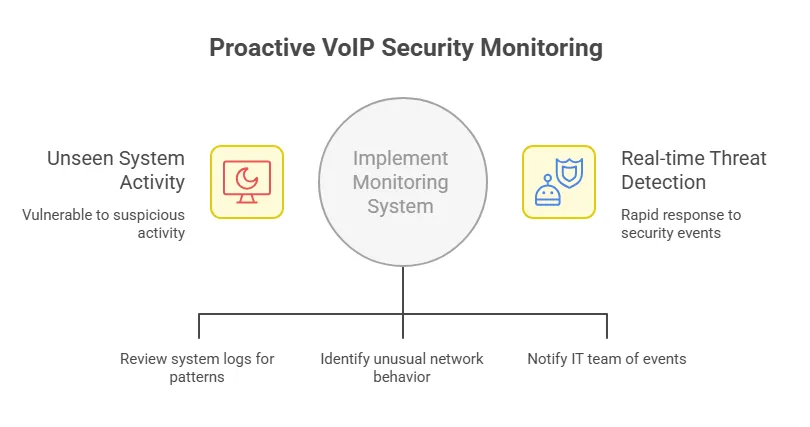
You can’t protect what you don’t see. Implementing a robust monitoring system is crucial for detecting suspicious activity in real-time.
Log Analysis
Regularly review system logs from your VoIP server, firewalls, and IP phones. Look for unusual patterns, repeated failed login attempts, or unexpected network traffic.
Anomaly Detection
Many modern security systems can identify anomalies in network behavior. If your VoIP system suddenly starts exhibiting unusual call volumes or connections to unexpected destinations, an anomaly detection system can flag it.
Alerting Mechanisms
Set up alerts for critical security events. This ensures that your IT team is notified immediately when something suspicious occurs, allowing for a rapid response.
Scheduled Audits and Vulnerability Assessments
Don’t wait for an incident to discover weaknesses. Schedule regular security audits and vulnerability assessments.
Internal Audits
Conduct internal audits of your VoIP system’s configuration, user permissions, and security policies at least quarterly.
External Vulnerability Scans
Consider engaging third-party security professionals to perform external vulnerability scans. They can identify weaknesses that may be exploited from the outside.
Penetration Testing
For a more in-depth assessment, consider penetration testing. This involves ethically simulating attacks on your VoIP system to uncover exploitable vulnerabilities.
Staying Ahead with Updates and Patch Management
Manufacturers regularly release patches and updates for their VoIP hardware and software to address security vulnerabilities. You need a system to ensure these are applied promptly.
Firmware Updates for IP Phones and Servers
Establish a clear process for applying firmware updates to all your IP phones, VoIP gateways, and the VoIP server software itself. Don’t ignore these updates!
Software Updates for Related Applications
If you use any associated software, such as call recording platforms or unified communications clients, ensure these are also kept up-to-date.
Vendor Security Bulletins
Sign up for security bulletins from your VoIP equipment and service providers. This will keep you informed about emerging threats and available patches.
By implementing these top VoIP security practices, you can significantly enhance the protection of your business’s communication infrastructure. Remember, security is a journey, not a destination. Stay vigilant, stay informed, and prioritize the security of your VoIP system as you would any other critical business asset. This proactive approach will not only safeguard your sensitive data and operations but also ensure the reliability and integrity of your business communications, allowing you to focus on what you do best: running your business.
FAQs
What is VoIP security and why is it important for businesses?
VoIP security refers to the measures and practices put in place to protect Voice over Internet Protocol (VoIP) systems from security threats such as eavesdropping, call tampering, and unauthorized access. It is important for businesses to secure their VoIP systems to protect sensitive communication data and maintain the integrity of their communications.
What are some best practices for securing VoIP systems in businesses?
Some best practices for securing VoIP systems in businesses include implementing strong encryption for voice data, using firewalls and intrusion detection systems, regularly updating and patching VoIP software, implementing strong authentication measures, and conducting regular security audits and assessments.
How can businesses protect against eavesdropping and call tampering in VoIP systems?
Businesses can protect against eavesdropping and call tampering in VoIP systems by implementing end-to-end encryption for voice data, using secure and private networks for VoIP communications, and implementing measures to detect and prevent unauthorized access to VoIP systems.
What are the risks of not securing VoIP systems in businesses?
The risks of not securing VoIP systems in businesses include the potential for eavesdropping on sensitive communications, unauthorized access to VoIP systems leading to call tampering or fraud, and the potential for disruption of business operations due to security breaches.
How can businesses stay updated on the latest VoIP security threats and best practices?
Businesses can stay updated on the latest VoIP security threats and best practices by subscribing to industry newsletters and security alerts, participating in relevant industry forums and conferences, and working with trusted VoIP service providers who stay abreast of the latest security developments.













Post Comment