VoIP Compliance Requirements in the USA
You’ve decided to launch a Voice over Internet Protocol (VoIP) service in the United States, or perhaps you’re already operating one. Congratulations! VoIP offers incredible flexibility and cost savings, revolutionizing how businesses and individuals communicate. However, navigating the regulatory landscape for VoIP in the USA isn’t a stroll in the park; it’s more like a trek through a dense forest. There are numerous rules and regulations you must adhere to, not just to avoid hefty fines, but also to build trust with your customers and ensure the reliable, secure operation of your service. This guide will walk you through the essential compliance requirements, offering clarity on the complexities you’ll face.
Before you even think about lifting a finger, you need to grasp the fundamental principle: VoIP isn’t treated as a single, monolithic entity by US regulators. Instead, it’s often categorized based on the type of service you provide. This distinction is crucial because it dictates which specific regulations apply to you.
VoIP Service Classifications
The Federal Communications Commission (FCC) is the primary regulatory body governing communications in the US, and they have established key classifications for VoIP services.
- Interconnected VoIP Services: This is the most common and heavily regulated type. If your VoIP service allows users to send and receive calls to and from the public switched telephone network (PSTN) – meaning, you can call traditional landlines and mobile phones – then you’re offering interconnected VoIP. This classification brings with it a much larger regulatory burden.
- Non-Interconnected VoIP Services: These services are inherently limited. They only allow calls within their own network or similar IP-based networks, without connecting to the PSTN. Think of services like internal office communication systems that never dial out to external numbers. While less regulated, you still have some obligations.
- One-Way VoIP Services: These services allow users to make calls to the PSTN but not receive calls from it, or vice-versa. While less common, they still fall under specific regulatory umbrellas depending on their functionality.
Understanding your service’s classification is the very first step in determining your compliance obligations. Don’t assume; actively assess and classify your service accurately.
The Role of the FCC and State Public Utility Commissions (PUCs)
The FCC is your primary federal regulator, setting nationwide standards for everything from emergency services to consumer protection. However, states also play a significant role. Each state has its own Public Utility Commission (PUC) or equivalent body, which may impose additional regulations, particularly concerning consumer protection, intrastate taxation, and local service quality.
You cannot afford to overlook state-specific requirements. What’s compliant in one state might not be in another. This often means you need to register with relevant state authorities and understand their specific rules, especially if your service has a national footprint.
Emergency Services (E911) Compliance
This is arguably one of the most critical and non-negotiable compliance areas for interconnected VoIP providers. When someone dials 911, they expect help to arrive, and your service must facilitate that.
Directing Calls to the Proper Public Safety Answering Point (PSAP)
For interconnected VoIP services, you are legally obligated to provide Enhanced 911 (E911) capabilities. This means that when a user dials 911, the call must be routed to the appropriate Public Safety Answering Point (PSAP) – the local emergency dispatch center – based on the caller’s registered address.
- Automatic Location Information (ALI): Your system must be able to transmit the caller’s accurate, dispatchable location information to the PSAP. This is where VoIP gets tricky compared to traditional landlines, as VoIP phones can be portable.
- Registered Location Requirement: You must prompt your users to register and regularly update their physical address with your service. You also need a mechanism for them to easily update this information, as their VoIP device may move.
- PSAP Connectivity: You need to establish and maintain connections to appropriate PSAPs, often through an E911 service provider who acts as an intermediary. This ensures that calls reach the correct emergency services.
Customer Notification Requirements
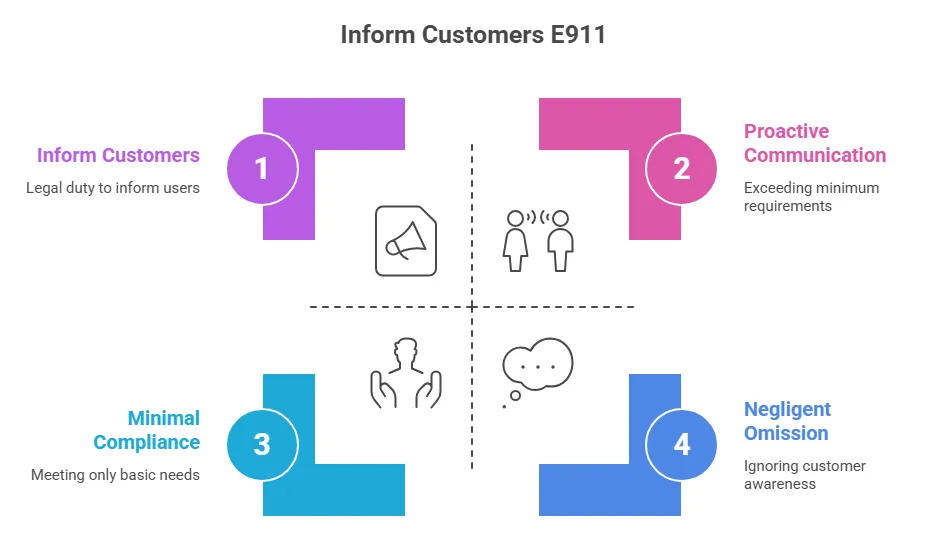
It’s not enough to just technically support E911; you also have a legal obligation to inform your customers about any limitations of your E911 service.
- Disclosures for E911 Limitations: You must clearly and conspicuously inform users that E911 service over VoIP may have limitations compared to traditional phone service. These limitations can include:
- Failure to function during power outages if the VoIP device isn’t battery-backed.
- Failure to function during broadband internet outages.
- The need for users to update their registered address if they move their VoIP device.
- Potential for calls to be routed to a centralized call center where the user must verbally provide their location.
- Warning Stickers/Labels: You are typically required to provide a warning label or sticker that customers can affix to their VoIP device, reminding them of E911 limitations.
- Terms of Service and Website Disclosures: These disclosures must be prominently featured in your terms of service, on your website, and during the onboarding process.
Failing to meet E911 compliance can lead to severe penalties, including hefty fines and, more importantly, put your customers’ lives at risk.
Consumer Protection and Privacy
The FCC, along with other federal and state agencies, places a strong emphasis on protecting consumers from deceptive practices and safeguarding their privacy. You must prioritize transparency and secure data handling.
Customer Proprietary Network Information (CPNI)
CPNI refers to sensitive customer information generated by your telecommunications service. This includes details like call records, billing information, services subscribed to, and more.
- Safeguarding CPNI: You are legally obligated to protect CPNI from unauthorized access, use, or disclosure. This means implementing robust security measures, both technical and administrative.
- Customer Consent: You generally cannot use, disclose, or permit access to CPNI without the express consent of your customer, except for specific, legally defined purposes (e.g., providing the service, billing, legally mandated disclosures).
- Annual CPNI Certifications: You’ll likely need to file annual CPNI compliance certifications with the FCC, demonstrating your adherence to CPNI rules.
Truth in Billing and Transparency
Customers have a right to clear, accurate, and understandable billing practices.
- Clear Disclosures of Charges: All charges, fees, and taxes must be clearly itemized and explained on your bills. Hidden fees or deceptively worded charges are a no-go.
- Cancellation Policies: Your cancellation policies must be unambiguous and fair. Customers should be able to cancel service without undue difficulty or unexpected charges.
- Avoiding Cramming and Slamming: “Cramming” is charging for services not authorized by the customer. “Slamming” is changing a customer’s telecommunications provider without their consent. Both are illegal and strictly prohibited.
Robocall and Spoofing Prevention (STIR/SHAKEN)
The fight against illegal robocalls and fraudulent caller ID spoofing is a major focus for the FCC.
- STIR/SHAKEN Implementation: If you provide VoIP services that originate calls to the PSTN, you are generally required to implement STIR/SHAKEN (Secure Telephone Identity Revisited/Signature-based Handling of Asserted information using toKENs) authentication. This technology helps verify the authenticity of caller ID information.
- Traceback Cooperation: You must cooperate with traceback efforts to identify the source of illegal robocalls. This often involves responding to inquiries from the FCC or their designated traceback entities.
Compliance with consumer protection and privacy regulations is not just about avoiding fines; it’s about building a trustworthy relationship with your customer base.
Regulatory Fees, Taxes, and Contributions
Running a VoIP service in the US means you’ll be contributing to various federal and state programs through direct fees and taxes. This is a complex area, often requiring the expertise of a specialized tax consultant.
Universal Service Fund (USF) Contributions
The USF program ensures that all Americans have access to affordable telecommunications services, particularly in rural and high-cost areas, and supports schools, libraries, and healthcare providers.
- Interconnected VoIP Provider Obligation: If you are an interconnected VoIP provider, you are considered a telecommunications carrier for USF purposes and must contribute a percentage of your interstate and international end-user revenues to the USF.
- Quarterly Filings (FCC Form 499-A): You are required to file quarterly FCC Form 499-A reports, detailing your revenues and calculating your USF contribution. This form is technically complex, and errors can lead to significant penalties.
- Permitted Pass-Through: While you are responsible for the contributions, you are generally permitted to pass these costs through to your customers as a separate line item on their bills.
State and Local Taxes
This is where the complexity truly ramps up, as tax obligations can vary dramatically from state to state and even locality to locality.
- Sales Tax: Most states impose sales tax on telecommunications services. You’ll need to register for sales tax in each state where you have nexus (a sufficient physical or economic presence) and collect and remit sales tax from your customers.
- Gross Receipts Taxes: Some states or localities impose gross receipts taxes on telecommunications providers, which are often levied on your total revenue.
- 911 Surcharges: Nearly all states and many localities impose specific 911 surcharges on phone lines, including VoIP. You are responsible for collecting these from your customers and remitting them to the appropriate state or local authorities. These surcharges directly fund emergency services.
- Other Fees and Assessments: Be aware of other potential fees, such as intrastate universal service contributions, state regulatory fees, and local franchise fees, depending on your service’s footprint.
The critical takeaway here is to not underestimate the complexity of telecommunications taxation. Engage with experts early to ensure you’re correctly calculating, collecting, and remitting all required fees and taxes.
Regulatory Reporting and Record Keeping
| Compliance Requirement | Description |
|---|---|
| FCC Regulations | Regulations set by the Federal Communications Commission to ensure VoIP providers comply with certain standards for emergency services, disability access, and more. |
| E911 Requirements | VoIP providers must offer Enhanced 911 services, allowing emergency services to pinpoint the location of a caller. |
| CALEA Compliance | VoIP providers must comply with the Communications Assistance for Law Enforcement Act, which requires them to assist law enforcement in conducting electronic surveillance. |
| Disability Access | VoIP providers must ensure accessibility for individuals with disabilities, in accordance with the Americans with Disabilities Act. |
Beyond active compliance measures, you have ongoing responsibilities to report certain information to regulatory bodies and maintain detailed records.
FCC Form 477 (Local Competition and Broadband Reporting)
- Broadband Deployment Data: If your VoIP service is bundled with or relies on broadband internet access you provide, you may need to file FCC Form 477. This form collects data on broadband deployment and subscribership across the nation.
- Voice Customer Data: This form also collects data on voice customers, including subscribership and technology used.
Accessible Communication Requirements
You have obligations under the Americans with Disabilities Act (ADA) and other FCC rules to ensure your services are accessible.
- Telecommunications Relay Service (TRS) Fund: You must contribute to the TRS Fund, which supports services like Text-to-911 and relay services for individuals with hearing or speech disabilities. This is typically included as part of your FCC Form 499-A calculations.
- Hearing Aid Compatibility (HAC): If you provide IP-enabled telecommunications services, certain VoIP handheld devices you provide may need to be hearing aid compatible.
- Access to Customer Service for Individuals with Disabilities: Your customer service channels must be accessible to individuals with disabilities.
Record Keeping Requirements
Regulators can and will audit your compliance. You must be prepared to demonstrate adherence through meticulously maintained records.
- Call Detail Records (CDRs): You must retain call detail records for a specified period (often 18-24 months or longer). These records include information like caller and called numbers, date, time, and duration of calls. This is crucial for law enforcement requests, billing disputes, and traceback efforts.
- Customer Agreements and Disclosures: Keep comprehensive records of all customer agreements, terms of service, and disclosures, especially those related to E911 limitations and CPNI permissions.
- Tax and Fee Remittance Records: Maintain detailed documentation of all tax and fee collections and remittances.
- Security Incident Logs: In light of CPNI rules and general cybersecurity best practices, keep logs of security incidents, data breaches, and your response.
Maintaining thorough and organized records is your best defense in the event of an audit or inquiry. It demonstrates your commitment to compliance and facilitates a smoother resolution.
The Consequences of Non-Compliance
Ignoring or misunderstanding VoIP compliance requirements in the USA is not an option. The consequences can be severe and far-reaching.
Financial Penalties and Fines
The FCC has a significant enforcement arm and regularly levies substantial fines for non-compliance. These can range from thousands to millions of dollars, depending on the severity and duration of the violation.
- E911 Violations: Can lead to fines per day of violation and per customer impacted.
- CPNI Breaches: Result in significant fines, often tied to the number of affected customers.
- Robocall Violations: Some of the largest FCC fines have been issued for illegal robocalling and caller ID spoofing.
- USF Non-Payment: Unpaid USF contributions or inaccurate reporting can lead to back payments, penalties, and interest.
Operational and Reputational Damage
Beyond financial penalties, non-compliance can inflict serious damage on your business’s operations and reputation.
- Service Disruption: Regulatory action could lead to orders to cease and desist operations, effectively shutting down your service.
- Negative Publicity: Public enforcement actions can generate negative media attention, eroding customer trust and making it harder to attract new business.
- Loss of Customer Trust: Customers expect their communications services to be reliable and secure. If you fail to protect their privacy or provide essential services like E911, they will quickly move elsewhere.
- Legal Action: Non-compliance can also expose you to civil lawsuits from customers who have been harmed by your failures.
Navigating the labyrinthine world of VoIP compliance in the USA requires diligence, expertise, and a proactive approach. It’s not a one-time task but an ongoing commitment. By understanding the classifications, adhering to E911 mandates, protecting consumer data, fulfilling your tax and fee obligations, and maintaining meticulous records, you’ll be well-positioned to operate a successful and compliant VoIP service. Remember, investing in compliance is not just about avoiding penalties; it’s about building a robust, trustworthy, and sustainable business. When in doubt, always seek guidance from legal counsel specializing in telecommunications law and regulatory compliance.
FAQs
What are VoIP compliance requirements in the USA?
VoIP compliance requirements in the USA refer to the regulations and standards that Voice over Internet Protocol (VoIP) service providers must adhere to in order to operate legally within the country.
What are some key VoIP compliance regulations in the USA?
Some key VoIP compliance regulations in the USA include the Communications Assistance for Law Enforcement Act (CALEA), which requires VoIP providers to enable law enforcement agencies to conduct authorized electronic surveillance, and the Federal Communications Commission (FCC) regulations regarding emergency 911 services.
How do VoIP providers ensure compliance with USA regulations?
VoIP providers ensure compliance with USA regulations by implementing technical solutions to enable lawful interception of communications, providing access to emergency services, and maintaining records of customer information and call data as required by the regulations.
What are the consequences of non-compliance with VoIP regulations in the USA?
The consequences of non-compliance with VoIP regulations in the USA can include fines, penalties, and legal action by regulatory authorities. Non-compliance can also result in the suspension or revocation of a VoIP provider’s license to operate.
Where can I find more information about VoIP compliance requirements in the USA?
More information about VoIP compliance requirements in the USA can be found on the websites of regulatory agencies such as the FCC, as well as through legal and industry publications that cover telecommunications regulations.














Post Comment