Securing VoIP Phone Systems: Best Practices
You’ve made the smart move to Voice over Internet Protocol (VoIP) for your business, and you’re likely already enjoying the benefits: lower costs, increased flexibility, and a suite of features that traditional phone systems simply can’t match. But with these advantages comes a critical responsibility: security. Your VoIP system, unlike its analog predecessors, operates over your data network, making it susceptible to the same cyber threats that plague your computers and servers. Neglecting VoIP security is akin to leaving the front door of your business wide open, inviting not just inconvenience but potentially catastrophic breaches. This isn’t just about dropped calls or service disruptions; it’s about safeguarding sensitive conversations, protecting customer data, and maintaining the integrity of your entire IT infrastructure.
Before you can effectively defend your VoIP system, you need to understand what you’re up against. The threat landscape is dynamic and ever-evolving, but several common attack vectors consistently target VoIP deployments. You might think your small business isn’t a target, but attackers often cast a wide net, looking for the easiest vulnerabilities to exploit.
Common Attack Vectors
Recognizing these vulnerabilities is the first step in building a robust defense. You might be surprised at how many of these sound familiar from general IT security.
Eavesdropping and Call Interception
Imagine a competitor listening in on your sales calls or a malicious actor intercepting confidential client discussions. This isn’t science fiction; it’s a very real threat. Since VoIP calls are transmitted as data packets over your network, they can be intercepted and reconstructed by attackers if encryption isn’t properly implemented. This can lead to a loss of intellectual property, compromised customer data, and severe reputational damage. Remember, silence doesn’t always mean security.
Denial of Service (DoS/DDoS) Attacks
A DoS or Distributed Denial of Service (DDoS) attack aims to overwhelm your VoIP system with so much traffic that it becomes unusable. This can manifest as dropped calls, inability to make or receive calls, and severely degraded voice quality. For a business reliant on phone communication for sales, support, or emergency services, a successful DoS/DDoS attack can be devastating, leading to significant financial losses and customer dissatisfaction. Think about the impact of your main customer service line being completely out of commission during peak hours.
Toll Fraud and Call Hijacking
This is a particularly insidious threat where attackers gain unauthorized access to your VoIP system and use it to make expensive calls to premium rate numbers, often in foreign countries. You’re left with the bill and potentially exorbitant charges. In some cases, attackers might even hijack legitimate outgoing lines to route calls through their own systems, masking their activities and further amplifying your costs. This isn’t just about inconvenience; it can lead to massive unbudgeted expenses.
Phishing and Vishing (Voice Phishing)
You’re probably familiar with email phishing, but imagine a similar attack delivered over the phone. Vishing involves attackers impersonating legitimate entities (e.g., your bank, a government agency, or even your IT department) to trick you or your employees into revealing sensitive information, like passwords, account numbers, or personal data. These attacks can be highly sophisticated, using social engineering tactics to build trust and exploit human vulnerabilities. Your employees are your first line of defense, but also your biggest vulnerability without proper training.
Vulnerabilities in VoIP Software and Hardware
Just like any software or hardware, your VoIP system’s components can contain bugs, misconfigurations, or unpatched vulnerabilities that attackers can exploit. This includes your IP phones, softphones, Session Initiation Protocol (SIP) servers, and even the operating systems they run on. Outdated firmware, default passwords left unchanged, and improperly configured firewalls can all create gaping holes in your security posture. You wouldn’t run an ancient version of Windows without updates, so why would you do the same for your critical communications infrastructure?
Establishing a Strong Foundation: Network Security For VoIP
Your VoIP system doesn’t exist in a vacuum. It sits squarely on your existing network infrastructure. Therefore, the security of your VoIP system is inextricably linked to the overall security of your network. Think of your network as the superhighway for your voice data; if the highway is compromised, so are the vehicles traveling on it.
Network Segmentation and VLANs
One of the most effective ways to enhance VoIP security is to isolate your voice traffic from the rest of your data traffic. You can achieve this through network segmentation, typically using Virtual Local Area Networks (VLANs). By putting your VoIP phones and servers on a separate VLAN, you create a virtual barrier that prevents attackers who compromise a regular workstation from easily accessing your voice infrastructure. This limits the “blast radius” of any potential breach.
Benefits of VLANs for VoIP
- Improved Security: If an attacker compromises a device on your data network, they won’t have direct access to your VoIP devices or servers.
- Enhanced Performance: Separating voice traffic ensures it receives appropriate Quality of Service (QoS), preventing data-heavy applications from degrading call quality.
- Easier Management: IT administrators can apply specific security policies and network configurations tailored to VoIP traffic without affecting other network segments.
Robust Firewall Configuration
Your firewall is the first line of defense for your network, and it plays an equally critical role in protecting your VoIP system. Proper firewall configuration is not a “set it and forget it” task; it requires careful planning and ongoing maintenance.
VoIP-Specific Firewall Rules
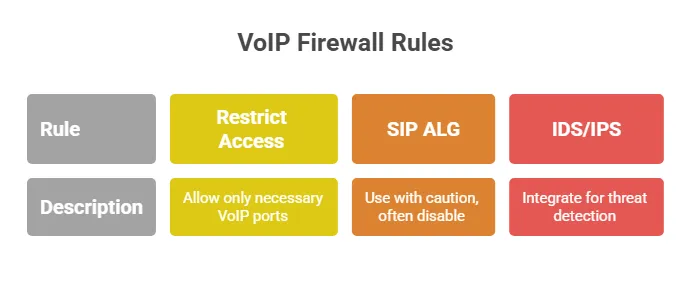
- Restrict Access: Only allow necessary ports and protocols for VoIP traffic to pass through your firewall. Block all other ports by default. Common VoIP ports include UDP 5060/5061 (SIP), UDP 10000-20000 (RTP for media), and TCP 5222 (XMPP if used).
- SIP ALG (Application Layer Gateway): Be cautious with SIP ALG settings. While intended to help with NAT traversal, poorly implemented SIP ALGs can sometimes interfere with VoIP traffic or even introduce security vulnerabilities. Often, it’s better to disable SIP ALG and implement proper firewall rules and NAT settings.
- Intrusion Detection/Prevention Systems (IDS/IPS): Integrate IDS/IPS into your firewall strategy. These systems can detect and block suspicious traffic patterns, including attempts at unauthorized access or DoS attacks.
Implementing Quality of Service (QoS)
While primarily a performance optimization, QoS directly impacts the security and reliability of your VoIP calls. By prioritizing voice traffic over less time-sensitive data, you ensure that even during periods of high network congestion, your calls remain clear and uninterrupted. This isn’t just about user experience; it prevents attackers from easily degrading call quality as a form of denial of service.
QoS Mechanisms
- DiffServ (Differentiated Services): Marks voice packets with a higher priority (e.g., EF – Expedited Forwarding) so routers and switches prioritize their delivery.
- Bandwidth Reservation: Allocating a dedicated portion of your network bandwidth specifically for VoIP traffic.
Fortifying Your VoIP Infrastructure
Beyond the network, the core components of your VoIP system itself require dedicated security measures. This includes your SIP server, IP phones, and any associated applications.
Strong Authentication and Authorization
Weak authentication is an open invitation for attackers. You need to implement and enforce strong authentication policies across your entire VoIP ecosystem.
Complex Passwords and Multi-Factor Authentication (MFA)
- Mandatory Complex Passwords: Enforce strong password policies for all user accounts, including PBX administrators, individual phone extensions, and voicemail access. This means requiring a combination of uppercase and lowercase letters, numbers, and special characters, along with a minimum length.
- Regular Password Changes: Implement a policy for periodic password changes.
- Multi-Factor Authentication (MFA): Where possible, enable MFA for administrative access to your VoIP server and any critical management interfaces. This adds an extra layer of security, typically requiring a second form of verification (e.g., a code from a mobile app or a hardware token) in addition to a password.
Role-Based Access Control (RBAC)
Don’t give everyone administrative privileges. Implement RBAC to ensure that users only have access to the resources and functionalities they absolutely need to perform their jobs. For instance, a regular user only needs to make and receive calls, while specific IT personnel require access to system configurations. This principle of “least privilege” significantly reduces the attack surface.
Encryption for Voice and Signaling
Perhaps the most crucial security measure for protecting the confidentiality of your conversations is encryption. Without it, your voice calls are transmitted in plain text, making them susceptible to eavesdropping.
SRTP (Secure Real-time Transport Protocol)
SRTP encrypts the actual voice data (media stream) flowing between VoIP endpoints. This is essential for preventing call interception and ensuring privacy. While not always enabled by default, you should configure your phones and PBX to use SRTP.
TLS (Transport Layer Security) for SIP
TLS encrypts the SIP signaling messages, which handle call setup, teardown, and other control functions. This prevents attackers from tampering with call signaling or gaining information about your call patterns and participants. Look for SIP over TLS (SIPS) support in your VoIP solution.
Regular Software Updates and Patch Management
Attackers constantly look for new vulnerabilities in software. Vendors regularly release patches and updates to address these security flaws. You must have a robust patch management strategy for all components of your VoIP system.
Firmware Updates for IP Phones
Your IP phones are small computers in themselves, and their firmware often contains vulnerabilities. Regularly check for and apply firmware updates from your phone manufacturer.
PBX/Softswitch Software Updates
Keep your PBX software (whether on-premise or cloud-based) updated to the latest stable version. This ensures you benefit from the latest security fixes and features.
Operating System and Application Updates
If your VoIP server runs on a standard operating system (e.g., Linux), ensure that the OS and any associated applications are also regularly patched and updated.
Vigilance and Proactive Monitoring
Even with the best initial security measures, threats evolve. You need to remain vigilant and proactively monitor your VoIP system for any signs of suspicious activity. Security is an ongoing process, not a one-time project.
Logging and Auditing
Comprehensive logging is your eyes and ears into your VoIP system’s activity. Ensure that your PBX and network devices generate detailed logs.
What to Log
- Call Detail Records (CDRs): Track all inbound and outbound calls, including source, destination, duration, and time. This helps in identifying unauthorized usage or toll fraud.
- Login Attempts: Log all successful and failed login attempts to your PBX administration interfaces and phone extensions.
- Configuration Changes: Record who made what changes to your system settings and when.
- System Errors and Warnings: Monitor for any unusual errors or warnings that might indicate a problem or an attack.
Centralized Log Management
Consider using a centralized log management system (e.g., a SIEM solution) to collect, store, and analyze logs from all your VoIP and network devices. This makes it easier to spot patterns and anomalies that might indicate a security incident.
Intrusion Detection and Prevention Systems (IDS/IPS)
While mentioned under firewalls, IDS/IPS deserves its own emphasis for VoIP. These systems actively monitor network traffic for malicious activity and can either alert you (IDS) or automatically block (IPS) suspicious connections.
Network-Based IDS/IPS
Deploy network-based IDS/IPS solutions that can inspect VoIP protocols like SIP and RTP for unusual behavior, known attack signatures, or policy violations.
Host-Based IDS/IPS
If your VoIP server runs on a dedicated operating system, consider a host-based IDS/IPS to monitor the server itself for unauthorized access or suspicious processes.
Regular Security Audits and Penetration Testing
Don’t wait for an attack to find your vulnerabilities. Proactively seek them out.
Internal Security Audits
Regularly review your VoIP system’s configurations, security policies, and user accounts. Look for weak passwords, unnecessary open ports, and outdated software.
Professional Penetration Testing
Engage with third-party security professionals to conduct penetration tests specifically targeting your VoIP system. Ethical hackers will attempt to exploit vulnerabilities, providing you with a realistic assessment of your security posture and actionable recommendations. This is an invaluable investment for critical systems.
Training and Policy: The Human Element
| Security Measure | Description |
|---|---|
| Encryption | Implement end-to-end encryption to protect voice data from eavesdropping. |
| Firewall | Use a firewall to monitor and control incoming and outgoing VoIP traffic. |
| Access Control | Implement strong authentication and access control measures to prevent unauthorized access to the VoIP system. |
| Regular Updates | Keep the VoIP system and its components updated with the latest security patches and updates. |
| Monitoring | Regularly monitor VoIP traffic and system logs for any suspicious activity. |
Technology alone isn’t enough. Your employees are both your first line of defense and potentially your weakest link. Comprehensive user training and clear security policies are paramount for a secure VoIP environment.
Employee Education on VoIP Security Risks
You can implement all the technical safeguards in the world, but if your employees fall victim to a vishing attack or share their passwords, your system remains vulnerable. Educate them thoroughly.
Social Engineering Awareness
Teach your employees about common social engineering tactics, including vishing, phishing, and pretexting. Explain how attackers might try to impersonate IT staff, vendors, or even senior management to gain unauthorized access.
Best Practices for Phone Usage
- Password Protection: Remind employees never to share their VoIP extension passwords or voicemail PINs.
- Suspicious Calls: Instruct them on how to identify and report suspicious calls, especially those asking for sensitive information.
- Physical Security: Emphasize the importance of securing IP phones, especially in shared or public areas, to prevent unauthorized physical access.
Comprehensive VoIP Security Policies
Document your security expectations and procedures in clear, actionable policies. These policies should be readily accessible and regularly reviewed.
Acceptable Use Policy
Define how employees are permitted to use the VoIP system, including restrictions on personal use, recording calls, and the installation of unauthorized software.
Incident Response Plan
Develop a clear incident response plan specifically for VoIP security breaches. This plan should outline:
- Detection: How security incidents are identified.
- Containment: Steps to isolate the affected system to prevent further damage.
- Eradication: Actions to remove the threat.
- Recovery: Procedures to restore normal operations.
- Post-Incident Analysis: Lessons learned to prevent future occurrences.
Password Policy
Formalize your password requirements, including complexity, length, and renewal frequency, for all VoIP-related accounts.
By diligently implementing these best practices, you can significantly enhance the security posture of your VoIP phone system. Remember, security is an ongoing journey, not a destination. Staying informed about emerging threats, continuously monitoring your systems, and empowering your employees with the right knowledge are essential for keeping your voice communications secure in an increasingly interconnected world.
FAQs
What is VoIP and why is it important to secure it?
VoIP, or Voice over Internet Protocol, is a technology that allows users to make voice calls using a broadband internet connection instead of a regular (analog) phone line. It is important to secure VoIP systems because they are vulnerable to various security threats, such as eavesdropping, call tampering, and denial of service attacks.
What are some common security threats to VoIP phone systems?
Common security threats to VoIP phone systems include eavesdropping, where unauthorized users listen in on calls, call tampering, where calls are intercepted and altered, and denial of service attacks, where the system is overwhelmed with traffic and becomes unavailable.
How can VoIP phone systems be secured?
VoIP phone systems can be secured by using encryption to protect call data, implementing strong authentication measures to prevent unauthorized access, regularly updating software and firmware to patch security vulnerabilities, and using firewalls and intrusion detection systems to monitor and control network traffic.
What are some best practices for securing VoIP phone systems?
Best practices for securing VoIP phone systems include conducting regular security audits and assessments, training employees on security protocols and best practices, implementing access controls to limit who can make changes to the system, and using quality of service (QoS) measures to prioritize VoIP traffic.
What are the potential consequences of not securing VoIP phone systems?
The potential consequences of not securing VoIP phone systems include unauthorized access to sensitive call data, financial losses due to toll fraud, damage to the organization’s reputation, and disruption of business operations due to denial of service attacks or other security breaches.













Post Comment