
SIP Trunking for Businesses: The Complete Guide to Modern Business Communication
In today’s fast-moving digital landscape, businesses of every size are rethinking how they communicate. Traditional phone lines are being replaced by smarter, more flexible solutions, and one technology is leading that shift: SIP trunking. Whether you run a growing startup or an established enterprise, understanding SIP trunking for businesses can unlock a new level of communication efficiency, reliability, and control.
This guide covers everything you need to know, from what SIP trunking actually is, to why more businesses are adopting it, and what you should consider before making the switch.
- What Is SIP Trunking?
- How Does SIP Trunking Work for Businesses?
- Key Benefits of SIP Trunking for Businesses
- SIP Trunking vs. Traditional Phone Systems
- What to Consider Before Implementing SIP Trunking
- SIP Trunking and the Future of Business Communication
- Is SIP Trunking Right for Your Business?
- Final Thoughts
- FAQs
What Is SIP Trunking?
SIP stands for Session Initiation Protocol, a signaling protocol used to initiate, maintain, and terminate real-time communication sessions. These sessions can include voice calls, video calls, and messaging. A “trunk” in telecommunications refers to a shared line or channel that carries multiple simultaneous communications.
SIP trunking, therefore, is a method of delivering telephone services and unified communications to a business over the internet using the SIP protocol. Instead of relying on traditional copper phone lines or ISDN circuits, SIP trunking connects your on-premise PBX (Private Branch Exchange) to the public switched telephone network (PSTN) through a Voice over Internet Protocol (VoIP) connection.
You can learn more about the foundational technology behind this on Wikipedia’s SIP page, which offers an in-depth technical overview of how the protocol works.
In simpler terms: SIP trunking replaces your physical phone lines with a virtual equivalent that travels over your internet connection. This makes your business phone system more agile, cost-effective, and scalable.
How Does SIP Trunking Work for Businesses?
When a call is placed using SIP trunking, your business phone system converts the audio into data packets. Those packets travel over your internet connection to a SIP trunk provider, which then routes the call to its destination, whether that is another VoIP user, a mobile phone, or a standard landline.
The key component on your end is the IP-PBX or a SIP-enabled phone system. This acts as the control hub, managing incoming and outgoing calls, extensions, voicemail, and other features. The SIP trunk connects this hub to the outside world.
Unlike traditional phone systems that required a physical line for every simultaneous call, SIP trunking uses channels. Each channel supports one concurrent call, and businesses can add or reduce channels based on their actual usage. This flexibility is one of the most significant advantages SIP trunking offers.
Key Benefits of SIP Trunking for Businesses
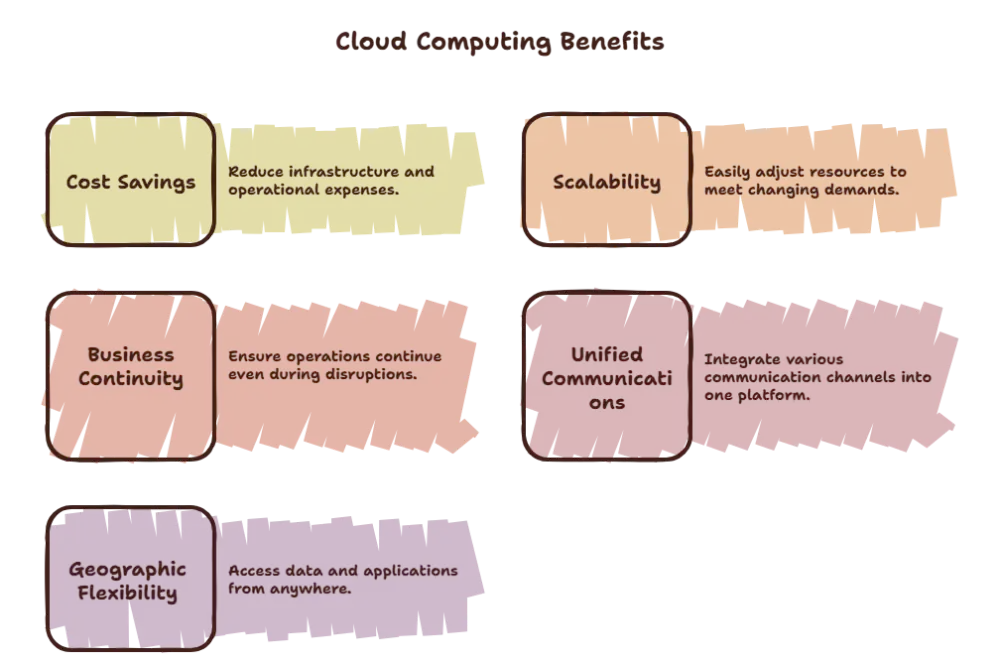
Significant Cost Savings
One of the most immediate reasons businesses switch to SIP trunking is cost reduction. Traditional PRI (Primary Rate Interface) lines and analog phone systems come with high setup fees, monthly rental costs, and expensive long-distance charges. SIP trunking eliminates much of that overhead by running voice communication over your existing internet infrastructure.
Long-distance and international calls typically cost far less with SIP trunking, which is especially beneficial for businesses with global clients or remote teams spread across multiple regions.
Scalability on Demand
Growing businesses need communication systems that can keep up. With traditional phone systems, adding new lines often requires physical installation and long lead times. SIP trunking changes that entirely.
You can scale your capacity up or down almost instantly. Adding new channels to accommodate seasonal peaks in call volume or a new team of employees takes minimal time and involves no hardware installation. Similarly, you can scale back during quieter periods to avoid paying for unused capacity.
Business Continuity and Disaster Recovery
SIP trunking plays a critical role in keeping businesses operational during unexpected disruptions. Because the system runs over the internet rather than physical infrastructure tied to a specific location, calls can be rerouted to mobile phones, remote offices, or other locations with ease.
Many SIP trunking setups include failover configurations that automatically redirect calls if your primary internet connection goes down. This level of resilience is difficult and expensive to achieve with legacy phone systems. Research from institutions such as MIT’s Sloan School of Management has highlighted the importance of communication continuity in business resilience planning.
Unified Communications Integration
Modern businesses use a wide range of communication tools, including email, instant messaging, video conferencing, and CRM platforms. SIP trunking integrates naturally with unified communications platforms, allowing businesses to manage all of their communication channels from a single interface.
This integration improves team collaboration, speeds up response times, and creates a more cohesive customer experience. For distributed teams and remote workforces, this kind of connectivity is not a luxury but a necessity.
Geographic Flexibility
SIP trunking allows businesses to use virtual phone numbers from almost any location or area code. A business based in one city can have a local number in another city or country, giving it a local presence without a physical office there. This is particularly useful for businesses expanding into new markets.
Employees working remotely can use the same business phone system as if they were in the office, ensuring consistent communication regardless of where they are located.
SIP Trunking vs. Traditional Phone Systems
To appreciate what SIP trunking offers, it helps to compare it directly with traditional options.
Traditional PSTN lines require physical copper wiring installed by a telecommunications company. Each line supports one call at a time. Expanding capacity means ordering more physical lines, which takes time and costs money. Maintenance responsibilities and costs often fall on the business.
SIP trunking, on the other hand, operates over the internet. Capacity is virtual and adjustable. Maintenance is largely managed by the SIP provider. Features that would require expensive add-ons in legacy systems, such as call routing, auto-attendants, and voicemail to email, are often included as standard.
According to research highlighted by Carnegie Mellon University’s Information Networking Institute, the shift toward IP-based communication infrastructure represents one of the most significant evolutions in enterprise networking over the past two decades.
What to Consider Before Implementing SIP Trunking
Internet Connection Quality
Since SIP trunking relies entirely on your internet connection, the quality and reliability of that connection directly affects your call quality. Businesses should ensure they have sufficient bandwidth and a stable connection before switching.
A dedicated internet connection or a connection with Quality of Service (QoS) settings is highly recommended. QoS prioritizes voice data packets over other types of internet traffic, ensuring calls remain clear even during periods of heavy internet usage.
Security Considerations
As with any internet-based communication system, security is an important concern with SIP trunking. Voice over IP systems can be vulnerable to threats such as toll fraud, eavesdropping, and denial-of-service attacks.
To protect your system, businesses should work with providers that offer encryption (such as TLS and SRTP), use strong authentication protocols, and regularly audit their communication infrastructure. Partnering with a reputable SIP trunk provider that prioritizes security is essential.
Compatibility with Existing Equipment
Not all PBX systems are immediately compatible with SIP trunking. Older analog or digital PBX systems may require an adapter, known as an Analog Telephone Adapter (ATA), to work with SIP. Alternatively, businesses may choose to upgrade to an IP-PBX system that natively supports SIP.
Before transitioning, conduct an audit of your current phone system to identify any compatibility gaps and plan accordingly.
Number Porting
Most businesses want to keep their existing phone numbers when switching to SIP trunking. The process of transferring numbers from one provider to another is called porting, and it is generally straightforward but requires coordination with both your old provider and your new SIP trunk provider.
Allow adequate time for porting and plan to run your old and new systems in parallel during the transition to avoid any service interruption.
SIP Trunking and the Future of Business Communication
The telecommunications industry is continuing to evolve rapidly. As more businesses move to cloud-based infrastructure, SIP trunking is increasingly being paired with cloud-hosted PBX systems, creating fully hosted communication environments that require no on-premise hardware at all.
The rise of remote work has further accelerated this shift. Businesses that previously saw SIP trunking as an optional upgrade now view it as fundamental infrastructure. The ability to connect employees wherever they are, maintain consistent call quality, and manage everything from a single dashboard aligns perfectly with how modern teams operate.
Additionally, as 5G networks become more widespread, the reliability and speed of internet connectivity will improve further, making SIP trunking even more dependable and accessible for businesses of all sizes.
Academic research from institutions such as Stanford University’s communications programs has examined how digital communication technologies are reshaping business operations, workforce structures, and organizational productivity, reinforcing just how central tools like SIP trunking have become.
Is SIP Trunking Right for Your Business?
SIP trunking is well-suited for a broad range of businesses, from small offices with a handful of employees to large enterprises managing thousands of calls per day. The key questions to ask are:
Do you want to reduce your monthly communication costs? Do you need the flexibility to scale your phone system quickly? Are your employees working from multiple locations or remotely? Do you want to integrate your phone system with other business tools?
If you answered yes to any of these, SIP trunking is worth serious consideration.
That said, success depends on choosing the right provider, ensuring your internet infrastructure is up to the task, and planning your implementation carefully. Taking time to evaluate your current setup, your growth projections, and your specific communication needs will help ensure a smooth transition and long-term satisfaction.
Final Thoughts
SIP trunking for businesses is no longer an emerging technology. It is a proven, mature solution that thousands of organizations around the world rely on every day. It delivers real savings, genuine flexibility, and the kind of communication capabilities that modern businesses need to stay competitive.
As the world continues to move toward digital-first infrastructure, SIP trunking stands out as one of the smartest investments a business can make in its communication systems. Understanding how it works, what it offers, and what to look for in a provider puts you in a strong position to make a confident, informed decision.
The future of business communication is connected, flexible, and cloud-ready. SIP trunking is how you get there.
FAQs
What is the difference between SIP trunking and VoIP?
VoIP (Voice over Internet Protocol) is the broad technology that allows voice calls to travel over the internet. SIP trunking is a specific method of implementing VoIP for businesses. Think of VoIP as the category and SIP trunking as the solution within that category that connects your business phone system to the public telephone network using the SIP protocol.
How many SIP trunk channels does my business need?
The number of channels you need depends on how many simultaneous calls your business handles at peak times. A common starting point is to calculate your busiest call period and match your channel count to the maximum number of concurrent calls during that window. Most businesses find they need fewer channels than they had physical phone lines because SIP trunking uses capacity more efficiently.
Will call quality be as good as a traditional phone line?
Yes, and in many cases better. Call quality with SIP trunking depends primarily on your internet connection. With sufficient bandwidth and Quality of Service (QoS) settings configured on your network, voice clarity is excellent. HD voice is also supported by most modern SIP trunking setups, which delivers noticeably clearer audio than traditional copper phone lines.
Can I keep my existing phone numbers when switching to SIP trunking?
Absolutely. Most businesses port their existing numbers to their new SIP trunk provider without any issue. The porting process involves coordinating between your current provider and your new one. It typically takes a few days to a couple of weeks depending on the provider, so planning ahead and running both systems in parallel during the transition is recommended to avoid any disruption.
Is SIP trunking secure enough for business use?
Yes, when properly configured. SIP trunking uses encryption protocols such as TLS (Transport Layer Security) for signaling and SRTP (Secure Real-time Transport Protocol) for voice data, which protects calls from interception. Businesses should also use strong authentication, implement a firewall or session border controller (SBC), and choose a provider with a proven security track record to ensure their communication infrastructure remains protected.











Post Comment