
AI in Telecommunication: Transforming the Future of Connectivity
The telecommunication industry has always been at the heart of human connection. From the first telephone lines to today’s ultra-fast 5G networks, this sector drives how the world communicates, collaborates, and grows. Now, a powerful new force is reshaping everything: artificial intelligence. AI in telecommunication is not a distant concept; it is actively transforming how networks operate, how customers are served, and how businesses scale in an increasingly digital world.
AI refers to the simulation of human intelligence in machines that are programmed to think, learn, and problem-solve. When applied to telecom, these capabilities unlock possibilities that were once unimaginable, from self-healing networks to hyper-personalized customer experiences.
This blog post explores the most impactful ways AI is changing the telecom landscape, why it matters, and what lies ahead for this exciting convergence of technology and connectivity.
How AI Is Reshaping Network Management
One of the most significant contributions of AI in telecommunication is its ability to optimize and automate network management. Traditional telecom networks required constant human monitoring to detect faults, allocate bandwidth, and respond to traffic surges. Today, AI-powered systems can handle all of this autonomously and in real time.
Machine learning algorithms analyze massive volumes of network data continuously to predict potential failures before they occur. This proactive approach, often called predictive maintenance, reduces downtime significantly and ensures smoother service delivery for millions of users simultaneously.
AI also plays a central role in dynamic spectrum management. By analyzing traffic patterns across different regions and time zones, AI systems can allocate network resources where they are needed most, optimizing signal quality without any manual intervention. This is especially critical as 5G networks roll out globally, demanding more precise and intelligent spectrum coordination than previous generations ever required.
Research published by MIT’s Computer Science and Artificial Intelligence Laboratory has explored how autonomous systems can be applied to network infrastructure, reinforcing the growing importance of AI-driven automation in managing complex communication systems.
AI-Powered Customer Experience
Customer service has long been a pain point in the telecom industry. Long wait times, repetitive queries, and inconsistent support have frustrated users for decades. AI is changing this dynamic dramatically.
Intelligent virtual assistants and AI-driven chatbots now handle millions of customer interactions every day. These tools can resolve billing inquiries, troubleshoot connectivity issues, process upgrades, and even predict when a customer is about to churn, enabling proactive outreach before dissatisfaction reaches a breaking point.
Natural language processing, a core branch of AI, allows these systems to understand and respond to human language in a conversational, context-aware manner. This means customers are no longer forced to navigate rigid phone menus or wait on hold. They receive instant, accurate answers around the clock.
Beyond reactive support, AI enables telecom companies to deliver truly personalized experiences. By analyzing usage behaviors, location data, and service preferences, AI can recommend the most suitable plans, flag unusual activity that might indicate fraud, and even customize network settings to match individual usage habits.
Fraud Detection and Cybersecurity
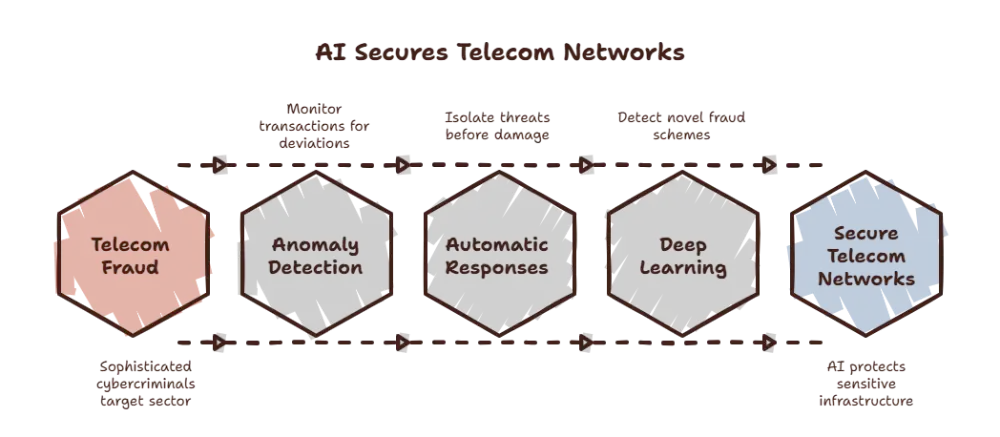
The telecom sector is a frequent target for fraud, including SIM card cloning, subscription fraud, and unauthorized network access. Traditional rule-based security systems often struggle to keep up with the sophistication of modern cybercriminals. AI changes this equation entirely.
AI systems can monitor billions of transactions and network events simultaneously, identifying anomalies that deviate from established patterns. When suspicious activity is detected, these systems can trigger automatic responses, isolating threats before they cause widespread damage.
Deep learning models, a specialized category within AI, are particularly effective at detecting novel fraud schemes that have never been seen before. Unlike conventional systems that rely on predefined rules, deep learning models adapt continuously, learning from new data to stay ahead of evolving threats.
Researchers at Stanford University’s Computer Science Department have documented the growing application of machine learning in cybersecurity, highlighting how these technologies are being adapted to protect sensitive digital infrastructure, including telecommunications networks.
5G and the AI Connection
The arrival of 5G technology and the expansion of AI are not happening in isolation. They are deeply intertwined. 5G networks generate enormous amounts of data at unprecedented speeds, and only AI has the capacity to process and act on that data in real time.
AI is essential for managing the complexity that comes with 5G. From network slicing, which creates customized virtual networks for different use cases, to intelligent beamforming that directs signal strength precisely where it is needed, AI enables 5G to deliver on its extraordinary promise.
For industries like healthcare, smart manufacturing, autonomous vehicles, and smart cities, the combination of 5G and AI creates a foundation for transformative applications. Telemedicine powered by low-latency 5G connections and AI diagnostic tools, for example, can bring specialist care to remote regions where doctors are scarce.
The Internet of Things is another domain where this convergence is profoundly impactful. Billions of connected devices generate continuous data streams, and AI-powered telecom networks are the backbone that makes intelligent, real-time device communication possible at scale.
AI in Network Planning and Infrastructure
Building and expanding telecom infrastructure has traditionally been an expensive, time-consuming process requiring extensive human expertise. AI is streamlining this process in remarkable ways.
Predictive analytics tools powered by AI can model population growth, data consumption trends, and geographic demand shifts to guide smarter infrastructure investment. This means towers, fiber lines, and data centers can be placed where they will deliver the greatest impact, reducing waste and improving coverage.
AI also enables digital twins, virtual replicas of physical network infrastructure, that allow engineers to simulate changes, test configurations, and predict outcomes before implementing anything in the real world. This reduces costly trial and error and accelerates the pace of innovation.
Furthermore, energy efficiency is a growing concern in the telecom industry. AI-driven systems can optimize power consumption across network nodes dynamically, reducing carbon footprints while maintaining service quality. This aligns telecom expansion with global sustainability goals.
The Role of AI in Rural and Underserved Connectivity
One of the most socially impactful applications of AI in telecommunication is its potential to bridge the digital divide. Billions of people around the world still lack reliable internet access, particularly in rural and remote areas. AI is helping address this challenge in creative ways.
Intelligent network planning tools can identify underserved regions and model the most cost-effective ways to extend connectivity. AI-powered low-earth orbit satellite systems are also becoming smarter, dynamically adjusting coverage areas and bandwidth allocation based on real-time demand data from the ground.
Community-level connectivity solutions, guided by AI analysis, can prioritize areas where connectivity will have the greatest economic and social returns, ensuring that investment goes where it matters most. This democratization of access is one of the most exciting social dimensions of AI-driven telecom innovation.
Challenges and Ethical Considerations
While the benefits of AI in telecommunication are substantial, it is important to acknowledge the challenges and ethical considerations that come with this transformation.
Data privacy is a major concern. AI systems in telecom process vast amounts of personal data, including location information, call records, and browsing behavior. Ensuring that this data is handled responsibly, with clear consent and strong security protections, is non-negotiable.
There is also the issue of algorithmic bias. If AI systems are trained on incomplete or unrepresentative datasets, they may deliver unequal service quality to different customer segments. Continuous auditing of AI models is essential to ensure fairness.
Workforce transformation is another consideration. As AI automates more telecom functions, some roles will evolve or become redundant. Investing in reskilling and upskilling programs ensures that the human workforce can transition alongside technology rather than being displaced by it.
Finally, regulatory frameworks must keep pace with AI adoption. Governments and regulatory bodies need clear policies on AI use in telecom to protect consumers, ensure competition, and promote responsible innovation.
The Road Ahead
AI in telecommunication is not a trend but a fundamental shift in how the industry operates. As AI capabilities continue to advance, telecom networks will become more autonomous, more efficient, and more responsive to the needs of users and society at large.
The convergence of AI, 5G, edge computing, and the Internet of Things is creating a new era of intelligent connectivity. Businesses, governments, and individuals who understand and embrace this shift will be best positioned to thrive in an increasingly connected world.
The telecom companies investing in AI today are not just improving their operations; they are laying the groundwork for a smarter, more inclusive digital future.
Conclusion
From autonomous network management and intelligent customer service to fraud prevention and rural connectivity, AI in telecommunication is driving one of the most comprehensive transformations the industry has ever seen. The technology brings extraordinary opportunity alongside real responsibilities around privacy, fairness, and workforce development.
As networks grow more complex and user expectations continue to rise, AI will not simply be an advantage for telecom providers; it will be essential. Understanding and engaging with this transformation today is the most important step toward staying relevant and competitive in the telecommunications landscape of tomorrow.
FAQS
What is AI in telecommunication?
AI in telecommunication refers to the application of artificial intelligence technologies such as machine learning, natural language processing, and deep learning to improve and automate various functions within the telecom industry. This includes network management, customer service, fraud detection, infrastructure planning, and more. AI enables telecom systems to operate more intelligently, efficiently, and responsively than traditional methods allow.
How does AI improve network performance in telecom?
AI improves network performance by continuously analyzing traffic data, predicting potential faults before they occur, and dynamically allocating bandwidth where it is needed most. This process, known as predictive maintenance and intelligent traffic management, reduces network downtime, enhances signal quality, and ensures a smoother experience for users even during peak usage periods. AI also supports 5G network slicing and beamforming, making next-generation connectivity far more precise and reliable.
Can AI help reduce fraud in the telecom industry?
Yes, AI is one of the most powerful tools available for detecting and preventing telecom fraud. By monitoring billions of network transactions and usage patterns in real time, AI systems can identify anomalies that indicate fraudulent activity such as SIM card cloning, subscription fraud, or unauthorized access. Deep learning models adapt continuously to new fraud techniques, giving telecom providers a significant advantage over cybercriminals who rely on evolving methods.
How does AI enhance customer service in telecom companies?
AI enhances customer service through intelligent virtual assistants, AI-powered chatbots, and predictive analytics tools. These systems handle common queries such as billing issues, plan upgrades, and technical troubleshooting instantly without the need for human agents. They also analyze customer behavior to predict churn, enabling proactive outreach before a customer decides to leave. The result is faster resolution times, personalized experiences, and significantly higher customer satisfaction levels.
What are the challenges of implementing AI in telecommunication?
The main challenges include data privacy concerns, since AI systems process large volumes of sensitive personal data. There is also the risk of algorithmic bias if AI models are trained on unrepresentative datasets, leading to unequal service quality. Workforce transformation is another challenge, as automation may affect certain job roles. Additionally, regulatory frameworks in many regions are still catching up with the pace of AI adoption, creating uncertainty for telecom providers investing in these technologies.













Post Comment