
Unified Communications Solutions: The Complete Business Guide
In today’s fast-moving business landscape, communication fragmentation is one of the biggest silent productivity killers. Teams juggle separate tools for email, video calls, instant messaging, and file sharing, which results in lost time, miscommunication, and operational inefficiencies. This is exactly where unified communications solutions step in to make a transformative difference. By bringing all communication channels under one seamless platform, unified communications solutions are helping organizations of every size work smarter, respond faster, and collaborate without friction. Whether you are a growing startup or a large enterprise, understanding how these solutions work and why they matter is the first step toward building a more connected and agile organization.
- What Are Unified Communications Solutions?
- Why Businesses Are Adopting Unified Communications Solutions
- Key Features to Look for in Unified Communications Solutions
- How Unified Communications Solutions Transform Team Collaboration
- Industry Applications of Unified Communications Solutions
- Steps to Implement Unified Communications Solutions Successfully
- The Future of Unified Communications Solutions
- Frequently Asked Questions
What Are Unified Communications Solutions?
Unified communications solutions refer to an integrated framework that combines multiple communication and collaboration tools into a single, cohesive platform. Rather than using a standalone tool for each function, businesses gain access to a centralized system where voice, video, messaging, conferencing, and file sharing all coexist and interact with one another.
The core idea is simple: eliminate the silos between communication channels. When a sales representative can transition from a text chat to a video call and then share a document all within the same platform, the entire workflow becomes significantly more productive. Unified communications solutions are designed to make this kind of fluid, multi-channel communication the everyday norm.
Key Components of Unified Communications Solutions:
- Voice calling and VoIP integration allow teams to make and receive calls over the internet, eliminating the need for traditional phone infrastructure.
- Video conferencing capabilities enable face-to-face collaboration across geographies without requiring physical presence.
- Instant messaging and team chat give employees a fast, informal channel to ask quick questions and share updates in real time.
- Presence indicators show colleagues whether a team member is available, busy, or away, which reduces interruptions and improves responsiveness.
- File sharing and document collaboration allow teams to work on shared materials without switching between platforms.
- Integration with business tools such as CRM software, project management apps, and calendars ties communication directly into existing workflows.
Why Businesses Are Adopting Unified Communications Solutions
The shift toward unified communications solutions is not a trend driven by novelty. It is a strategic response to real business challenges that have intensified in the era of remote and hybrid work.
Eliminating Communication Silos
When different departments rely on different communication tools, information gets trapped within those tools. A customer support team using one platform while the sales team uses another creates gaps that lead to delayed responses and poor customer experiences. Unified communications solutions dissolve these silos by giving everyone access to the same channels and conversation history.
Supporting Remote and Hybrid Workforces
The modern workforce is distributed. Employees work from home offices, coworking spaces, different cities, and different time zones. A unified communications solution provides every employee with the same communication experience regardless of where they are located. This consistency is critical for maintaining team cohesion and service quality at scale.
Improving Response Times and Customer Satisfaction
When internal communication flows smoothly, external communication improves as well. Customers benefit when employees can quickly connect with colleagues, retrieve information, and resolve issues without navigating through disjointed systems. Unified communications solutions contribute directly to faster resolution times and higher customer satisfaction scores.
Reducing Operational Complexity
Managing multiple subscriptions, vendors, and platforms adds administrative burden to IT teams. Unified communications solutions reduce this complexity by consolidating tools under a single vendor relationship and management interface.
Key Features to Look for in Unified Communications Solutions
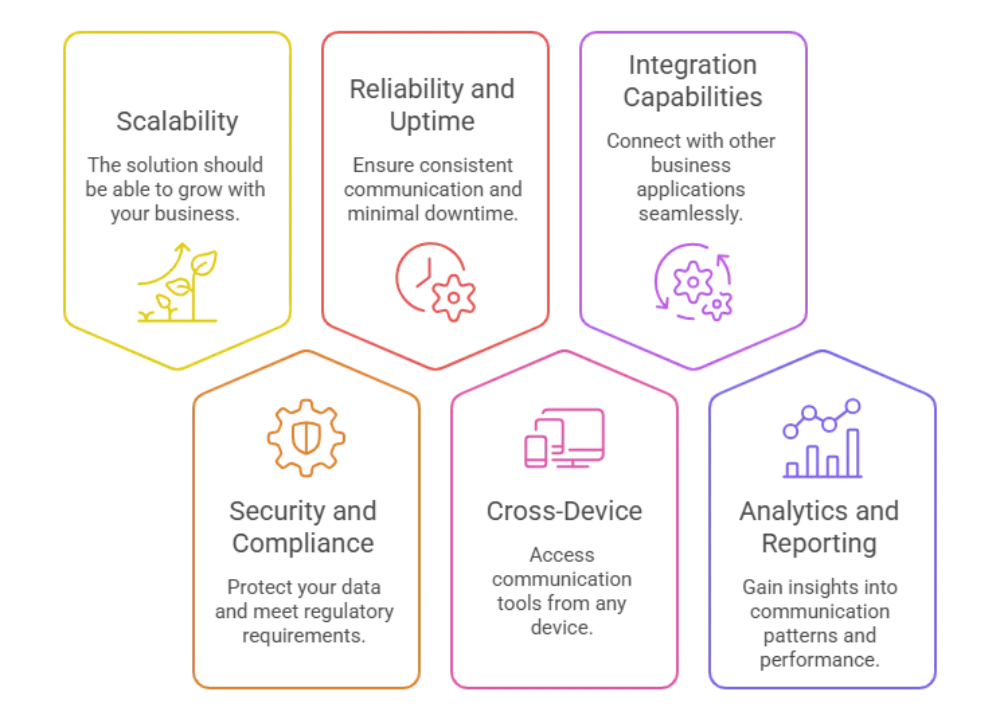
Not all unified communications solutions are built the same. When evaluating options for your business, these are the features that genuinely matter.
Scalability
A good solution grows with your organization. Whether you are adding ten users or a thousand, the platform should accommodate that growth without requiring a complete infrastructure overhaul.
Security and Compliance
Business communications contain sensitive information. Look for solutions that offer end-to-end encryption, role-based access controls, and compliance with relevant industry regulations such as GDPR, HIPAA, or SOC 2.
Reliability and Uptime
Downtime in communication systems can have serious consequences. Choose a solution backed by strong service level agreements and a track record of high availability.
Cross-Device Compatibility
Employees use different devices throughout their workday. A strong unified communications solution works seamlessly across desktops, laptops, tablets, and smartphones, with a consistent user experience on each.
Integration Capabilities
The real power of unified communications solutions is unlocked when they connect with the other tools your business already uses. Native integrations with email platforms, CRM systems, helpdesk software, and productivity suites ensure that communication becomes embedded in your existing workflows rather than sitting beside them.
Analytics and Reporting
Visibility into communication patterns helps managers identify bottlenecks, track team responsiveness, and make informed decisions about staffing and resource allocation.
How Unified Communications Solutions Transform Team Collaboration
The impact of unified communications solutions goes beyond simple convenience. When implemented effectively, they fundamentally change how teams work together.
Consider a project team spread across multiple locations. Without unified communications, coordination involves a mix of email threads, scheduled calls, and separate file-sharing links that quickly become difficult to track. With a unified platform, the same team can maintain a persistent channel where all project-related messages, files, calls, and meeting recordings live in one place. New team members can onboard by reviewing previous conversations rather than requesting repetitive briefings.
This shift from fragmented coordination to unified collaboration reduces the cognitive load on individual employees. They spend less time managing communication logistics and more time on the work itself.
Collaboration Benefits at a Glance:
Team members access shared workspaces where messages, files, and meeting notes are stored together and searchable.
Real-time co-editing and document collaboration reduces version control issues and email attachments.
Automated meeting summaries and transcripts ensure that decisions and action items are captured without manual note-taking.
Task and project management integrations allow teams to create and track assignments directly from within communication threads.
Industry Applications of Unified Communications Solutions
Unified communications solutions are not industry-specific. They add value across a wide range of sectors.
In healthcare, they enable secure communication between clinical staff, facilitate telehealth consultations, and ensure that patient information reaches the right people quickly without compromising privacy.
In education, they support hybrid learning models, faculty collaboration, and parent-teacher communication through a single managed platform.
In financial services, they provide secure channels for client communication, compliance recording, and cross-departmental coordination.
In retail and e-commerce, they connect customer service teams with inventory and logistics staff in real time, enabling faster problem resolution and improved customer experiences.
In professional services such as legal and consulting firms, they facilitate client communication, internal knowledge sharing, and document collaboration within a compliant and organized environment.
Steps to Implement Unified Communications Solutions Successfully
Adopting a unified communications solution requires more than choosing the right platform. A structured implementation approach is essential for ensuring strong adoption and return on investment.
Step 1: Assess Your Current Communication Landscape
Map out every tool your teams currently use for communication and collaboration. Identify redundancies, pain points, and gaps. This baseline assessment will guide your selection criteria.
Step 2: Define Your Requirements
Determine the must-have features for your specific business context. Consider the size of your team, the nature of your work, regulatory requirements, and the devices your employees use.
Step 3: Involve Key Stakeholders
Include representatives from IT, HR, operations, and end users in the evaluation process. Their input ensures that the chosen solution actually fits how people work day to day.
Step 4: Plan a Phased Rollout
Rather than switching everything at once, introduce the unified communications solution to a pilot group first. Gather feedback, address issues, and refine the rollout strategy before a full-scale deployment.
Step 5: Invest in Training
Technology adoption succeeds when people feel confident using new tools. Provide clear training resources, quick-start guides, and ongoing support to help employees get comfortable with the platform quickly.
Step 6: Monitor and Optimize
After launch, track usage patterns and gather employee feedback regularly. Use the platform’s analytics tools to identify underutilized features and areas where additional training or configuration changes could improve outcomes.
The Future of Unified Communications Solutions
The evolution of unified communications solutions is accelerating. Artificial intelligence is increasingly embedded into these platforms to offer capabilities such as real-time transcription, sentiment analysis, meeting summaries, and intelligent routing of customer inquiries to the right agent.
The integration of AI-driven assistants within communication platforms means employees can schedule meetings, retrieve information, and manage tasks using natural language without leaving the communication interface.
As 5G networks become more widespread, the performance of mobile communication within unified solutions will improve significantly, enabling richer video experiences and more reliable connectivity for mobile workers in the field.
The convergence of unified communications with customer experience platforms is also growing. Businesses are increasingly looking to use the same infrastructure that powers internal collaboration to also manage customer interactions, creating a genuinely end-to-end communication ecosystem.
Frequently Asked Questions
What is the difference between unified communications solutions and traditional phone systems?
Traditional phone systems handle only voice calls and are typically tied to physical infrastructure. Unified communications solutions integrate voice, video, messaging, file sharing, and collaboration tools into a single digital platform that works across devices and locations, offering far greater flexibility and functionality.
Are unified communications solutions suitable for small businesses?
Absolutely. Unified communications solutions are available in configurations that fit businesses of all sizes. Small businesses benefit from reduced tool sprawl, lower communication costs, and the ability to scale easily as the team grows, without major infrastructure investment.
How secure are unified communications solutions for sensitive business communication?
Modern unified communications solutions are built with enterprise-grade security in mind. Features such as end-to-end encryption, multi-factor authentication, data residency controls, and compliance certifications make them suitable for industries with strict regulatory requirements.
Can unified communications solutions integrate with the tools we already use?
Yes. Most leading unified communications solutions offer extensive integration libraries that connect with popular CRM platforms, project management tools, email services, HR systems, and productivity suites. Native integrations and open APIs give businesses flexibility in how they connect their tech stack.
How long does it typically take to deploy unified communications solutions?
Deployment timelines vary based on the size of the organization and the complexity of the implementation. A small team might be fully operational within a few days, while a large enterprise rollout with custom integrations and compliance requirements may take several weeks to months. A phased approach with proper planning significantly reduces disruption during the transition.














Post Comment