
AI-Powered VoIP Solutions: Smarter Communication for Modern Businesses
The way businesses communicate has undergone a radical shift. Traditional phone systems that once anchored offices to physical infrastructure are rapidly giving way to something far more intelligent. AI-powered VoIP solutions are at the forefront of this transformation, merging the flexibility of internet-based calling with the analytical and automation capabilities of artificial intelligence. Whether you run a growing startup or a large enterprise, understanding how these technologies work together can unlock a new level of operational efficiency, customer satisfaction, and competitive advantage.
- What Are AI-Powered VoIP Solutions?
- How AI Transforms Traditional VoIP Systems
- Key Benefits of AI-Powered VoIP Solutions for Businesses
- Industries Benefiting Most from AI-Powered VoIP Solutions
- Essential Features to Look for in AI-Powered VoIP Solutions
- Implementing AI-Powered VoIP Solutions: What to Expect
- The Future of AI-Powered VoIP Solutions
- Conclusion
- Frequently Asked Questions
What Are AI-Powered VoIP Solutions?
VoIP, or Voice over Internet Protocol, refers to the technology that enables voice calls to be transmitted over the internet rather than traditional telephone networks. When artificial intelligence is layered on top of this foundation, the result is a communication platform that does far more than simply connect callers.
AI-powered VoIP solutions incorporate machine learning, natural language processing, speech recognition, and predictive analytics directly into the calling and messaging infrastructure. This means your phone system can transcribe conversations in real time, detect caller sentiment, route calls intelligently, automate responses, and surface actionable data, all without requiring manual intervention.
How AI Transforms Traditional VoIP Systems
Traditional VoIP systems were a major improvement over legacy landline infrastructure, but they still relied heavily on human judgment for routing, monitoring, and quality control. Artificial intelligence changes that equation entirely.
Intelligent Call Routing
One of the most immediate benefits is intelligent call routing. AI analyzes caller history, intent signals, and agent availability to direct each call to the most suitable team member. This reduces wait times, improves first-call resolution rates, and ensures customers always reach someone equipped to help them.
Real-Time Transcription and Sentiment Analysis
During active calls, AI engines can transcribe spoken words with remarkable accuracy and analyze the emotional tone of the conversation. If a customer grows frustrated, the system can alert a supervisor or automatically offer escalation options. This kind of proactive response was simply not possible with conventional VoIP setups.
Automated Virtual Assistants and Voice Bots
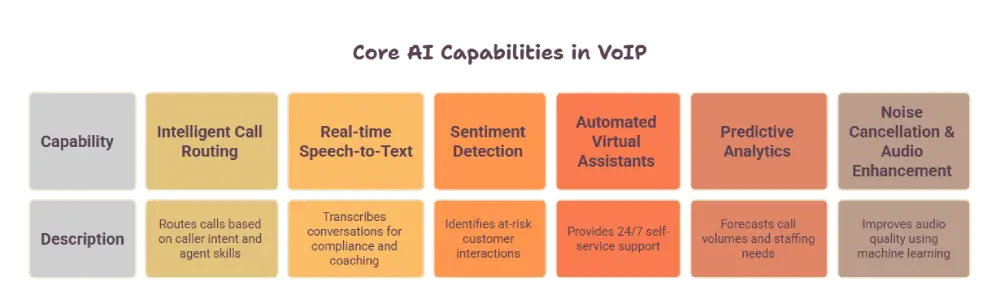
AI-powered VoIP solutions often include conversational virtual assistants that can handle routine inquiries, appointment scheduling, order status updates, and frequently asked questions around the clock. These voice bots understand natural language, learn from each interaction, and escalate to a human agent whenever the conversation moves beyond their scope.
Key Points: Core AI Capabilities in VoIP
- Intelligent call routing based on caller intent and agent skill sets
- Real-time speech-to-text transcription for compliance and coaching
- Sentiment detection to identify at-risk customer interactions
- Automated virtual assistants for 24/7 self-service support
- Predictive analytics to forecast call volumes and staffing needs
- Noise cancellation and audio enhancement powered by machine learning
Key Benefits of AI-Powered VoIP Solutions for Businesses
The decision to adopt AI-powered VoIP solutions goes beyond upgrading a phone system. It represents a strategic investment in the operational backbone of your customer communications.
Enhanced Customer Experience
Customers today expect fast, personalized, and frictionless service. AI-powered VoIP systems can greet callers by name, reference previous interactions, and anticipate needs based on account history. This level of personalization builds trust and loyalty over time, which directly impacts customer retention rates.
Increased Agent Productivity
When AI handles repetitive tasks such as call logging, note-taking, and basic query resolution, human agents are freed to focus on complex, high-value conversations. Real-time call guidance tools can also suggest responses during live calls, helping newer agents perform at the level of seasoned professionals from day one.
Reduced Operational Costs
Automating routine communications through AI voice assistants and intelligent self-service menus means businesses can handle higher call volumes without a proportional increase in staffing. Over time, this automation dividend compounds, significantly reducing the cost per interaction while maintaining or improving service quality.
Superior Analytics and Reporting
Every call becomes a data source. AI-powered VoIP platforms analyze conversation patterns, peak traffic times, common customer pain points, and agent performance metrics. Business leaders gain dashboards that translate raw call data into strategic insight, enabling smarter decisions about staffing, training, and product development.
Industries Benefiting Most from AI-Powered VoIP Solutions
While virtually any business that relies on voice communication can gain from these systems, certain industries stand to benefit most profoundly.
Key Industries:
- Healthcare: Patient appointment scheduling, triage automation, and secure record integration make AI-powered VoIP a natural fit for clinics and hospitals managing high call volumes with sensitive compliance requirements.
- Financial Services: Banks and insurance providers use these solutions for fraud detection alerts during calls, identity verification, and automated policy explanations that comply with regulatory standards.
- Retail and E-commerce: Order tracking, return processing, and personalized shopping assistance can all be handled efficiently through AI-enabled voice and messaging systems.
- Real Estate: Agents benefit from automated lead qualification, appointment setting, and follow-up sequences that keep prospects engaged without consuming hours of manual outreach time.
- Education: Institutions deploy AI VoIP to handle admissions inquiries, fee reminders, and student support services at scale.
Essential Features to Look for in AI-Powered VoIP Solutions
Not all AI-powered VoIP platforms are created equal. When evaluating options for your business, it is important to assess which features align with your communication goals and growth trajectory.
Key Features to Prioritize:
- Natural Language Processing (NLP): The system should understand conversational speech, not just keyword commands, to enable genuinely human-like interactions.
- CRM Integration: Deep integration with your customer relationship management platform ensures that AI insights surface within the tools your agents already use.
- Call Recording and Compliance Tools: Automated recording with searchable transcripts supports quality assurance, legal compliance, and agent training programs.
- Omnichannel Capabilities: Modern business communication extends beyond voice. Look for platforms that unify calls, SMS, chat, and email under a single AI intelligence layer.
- Scalability: The solution should grow alongside your business without requiring infrastructure overhauls each time your team expands.
- Security and Encryption: End-to-end encryption and compliance with data protection standards such as GDPR and HIPAA are non-negotiable for any business handling sensitive customer information.
Implementing AI-Powered VoIP Solutions: What to Expect
Transitioning to an AI-powered VoIP platform is more straightforward than many businesses anticipate. Most modern providers offer cloud-based deployment, which eliminates the need for on-premise hardware installation. The migration process typically involves porting existing numbers, configuring call flows, integrating with existing software tools, and training the AI models on your specific business vocabulary and customer interaction patterns.
The most successful implementations begin with a clear understanding of existing communication bottlenecks. Identifying where calls drop off, where agents struggle, or where customers most often request escalation helps you configure the AI to address your most pressing challenges first.
Ongoing improvement is built into the nature of these systems. As the AI processes more calls, it continuously refines its routing logic, transcription accuracy, and sentiment detection capabilities. This means your system becomes more intelligent and more valuable over time simply through daily use.
The Future of AI-Powered VoIP Solutions
The evolution of AI-powered VoIP solutions is still in its early chapters. Emerging developments point toward even deeper integration between voice AI and business intelligence platforms. Real-time language translation will make global customer service seamless. Emotion-aware AI will adapt its tone and pacing mid-conversation to match caller mood. Predictive outreach will allow systems to initiate contact with customers at exactly the right moment based on behavioral triggers.
Generative AI is also beginning to influence how virtual assistants are built. Instead of following rigid decision trees, next-generation voice bots will craft contextually appropriate responses on the fly, making them nearly indistinguishable from human agents in straightforward service scenarios.
Businesses that establish a strong AI-powered VoIP foundation today will be well-positioned to adopt these advances as they mature, maintaining a communication infrastructure that consistently outpaces customer expectations.
Conclusion
AI-powered VoIP solutions represent one of the most impactful investments a modern business can make in its communication infrastructure. By combining the cost efficiency of internet-based calling with the intelligence of machine learning and natural language processing, these platforms transform every conversation into an opportunity to serve customers better, empower agents more fully, and make smarter operational decisions. As AI continues to advance, the businesses that embrace these solutions now will find themselves holding a substantial and durable competitive edge.
Frequently Asked Questions
What makes AI-powered VoIP solutions different from standard VoIP systems?
Standard VoIP systems handle call transmission over the internet but rely on manual configuration for routing, reporting, and quality control. AI-powered VoIP solutions layer machine learning and natural language processing on top of that foundation, enabling the system to learn, adapt, automate complex tasks, and generate insights from every conversation without constant human oversight.
Are AI-powered VoIP solutions suitable for small businesses?
Absolutely. Many AI-powered VoIP platforms are designed to scale from small teams to enterprise operations. Small businesses benefit particularly from automated virtual assistants that provide professional customer service around the clock without the overhead of a large support team. Cloud-based deployment also removes the need for expensive on-site hardware.
How does AI improve call quality in VoIP systems?
AI improves call quality through machine learning-based noise cancellation, which filters out background sounds in real time, and through adaptive audio compression algorithms that maintain voice clarity even on lower-bandwidth connections. Some systems also monitor call quality metrics continuously and automatically reroute traffic to optimize performance.
Is data collected by AI-powered VoIP solutions secure?
Reputable AI-powered VoIP providers implement end-to-end encryption for voice and data transmission, along with access controls, audit trails, and compliance frameworks such as GDPR, HIPAA, and SOC 2. Before selecting a platform, businesses should review the provider’s security certifications and data residency policies to ensure alignment with their own compliance obligations.
How long does it take to implement an AI-powered VoIP solution?
Implementation timelines vary based on the complexity of your existing infrastructure and the number of integrations required, but cloud-based AI-powered VoIP solutions can often be deployed within days to a few weeks. Basic configurations can go live quickly, while more sophisticated setups involving CRM integration, custom AI model training, and multi-site rollouts may take four to eight weeks for full deployment.














Post Comment