
Best VoIP Providers for Small Business: A Complete Guide (2025)
Finding the best VoIP providers for small business is one of the smartest investments a growing company can make. Traditional phone lines are costly, inflexible, and increasingly outdated. Voice over Internet Protocol (VoIP) technology allows businesses to make and receive calls over the internet, cutting costs dramatically while unlocking a suite of communication tools that simply were not possible with copper wire systems.
Whether you run a startup with five employees or a growing team spread across multiple locations, choosing the right VoIP provider shapes how professionally you communicate with customers, partners, and your own team. This guide walks you through everything you need to know to make the right choice.
- What Is VoIP and Why Do Small Businesses Need It?
- What to Look for in the Best VoIP Providers for Small Business
- Essential Features Every Small Business VoIP System Should Include
- How to Choose the Best VoIP Provider for Your Small Business
- VoIP for Remote and Hybrid Small Business Teams
- Common Mistakes to Avoid When Choosing a VoIP Provider
- Frequently Asked Questions
What Is VoIP and Why Do Small Businesses Need It?
VoIP stands for Voice over Internet Protocol. Instead of routing calls through a traditional telephone network, VoIP converts your voice into digital data packets and transmits them over the internet. The result is crisp, reliable communication at a fraction of the cost of landline systems.
For small businesses, the appeal is straightforward. Lower monthly bills, the ability to use existing devices like smartphones and laptops, seamless remote work support, and access to enterprise-grade features that were once reserved for large corporations. These features include auto attendants, call routing, voicemail to email transcription, video conferencing integration, and analytics dashboards.
Key reasons small businesses are switching to VoIP:
- Significant reduction in monthly phone bills compared to traditional landlines
- Easy scalability as your team grows without expensive hardware installations
- Employees can take their business number anywhere with a mobile app
- Advanced call management features available from day one
- Integration with CRM tools, helpdesk platforms, and productivity software
- Centralized management through a simple online dashboard
What to Look for in the Best VoIP Providers for Small Business
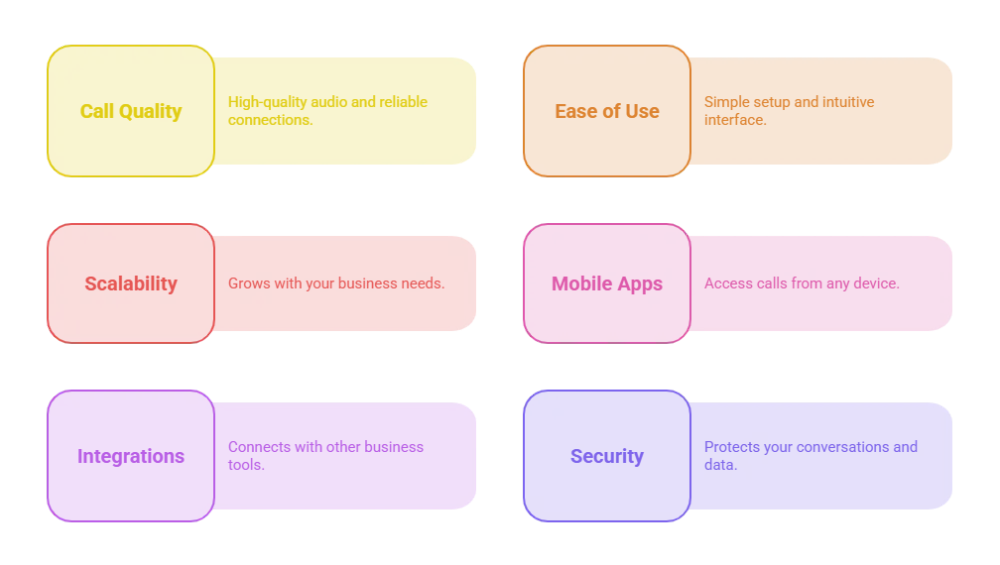
Before diving into specific options, it is important to understand what features truly matter for a small business environment. Not every VoIP solution is built the same way, and the wrong choice can lead to poor call quality, unexpected costs, and frustrated customers.
Call Quality and Reliability
This is non-negotiable. A VoIP system that drops calls or produces choppy audio will damage your professional reputation. Look for providers that guarantee high uptime, ideally 99.99%, and offer HD voice quality as a standard feature. Ask whether they have redundant data centers that keep your calls running even if one server goes down.
Ease of Setup and Use
Small businesses rarely have a dedicated IT team. The best VoIP providers for small business offer intuitive dashboards that let you add users, configure call flows, and manage settings without technical expertise. Setup should take hours, not days, and customer support should be accessible when you need it.
Scalability
Your business will grow. Your phone system should grow with it. A good VoIP provider allows you to add new lines, users, or locations with a few clicks. You should never need to overhaul your entire system simply because you hired three new people.
Mobile and Desktop Applications
Modern work happens everywhere. Your VoIP provider should offer polished mobile apps for iOS and Android, as well as desktop software for Windows and Mac. This ensures your team stays reachable whether they are at the office, at home, or traveling.
Integrations
The most productive small business phone systems connect with the tools your team already uses. Look for native integrations with platforms like Salesforce, HubSpot, Slack, Microsoft Teams, Google Workspace, and Zoho CRM. These connections eliminate the need to manually log calls and streamline customer communication.
Security Features
Business calls often involve sensitive information. Your VoIP provider should offer end-to-end encryption, multi-factor authentication, and compliance with relevant regulations such as HIPAA if you operate in healthcare or similar fields.
Essential Features Every Small Business VoIP System Should Include
Not all plans are created equal. When evaluating the best VoIP providers for small business, here are the core features that should come standard rather than as expensive add-ons.
Auto Attendant (Virtual Receptionist) This feature greets callers with a professional recorded message and routes them to the right department or person. It gives even the smallest business a polished, enterprise-level first impression without the cost of a full-time receptionist.
Call Forwarding and Routing Intelligent call routing ensures no call goes unanswered. Calls can be forwarded to mobile phones, distributed across a team through ring groups, or queued during busy periods.
Voicemail to Email Instead of manually checking voicemail, this feature sends audio recordings and transcripts directly to your inbox. You can read or listen to messages from anywhere, making it ideal for a team that is constantly on the move.
Conference Calling Whether you need to connect two colleagues or host a virtual all-hands meeting, built-in conference calling is essential. Look for providers that support at least ten participants without requiring a separate conferencing license.
Call Analytics and Reporting Understanding call volume, peak hours, average handle time, and missed call rates helps you make smarter staffing and operational decisions. Look for providers that offer real-time and historical reporting in an easy-to-read format.
Number Portability You should be able to keep your existing business phone numbers when switching to a VoIP provider. Always confirm that your provider supports local number portability (LNP) before committing.
How to Choose the Best VoIP Provider for Your Small Business
With so many options available, narrowing down the right provider requires a structured approach. Follow these steps to make a confident, informed decision.
Step 1: Assess your current communication needs. Count how many users need phone access, estimate daily call volume, identify whether you need local, toll-free, or international numbers, and list the tools you currently use that need to integrate with your phone system.
Step 2: Set a realistic budget. VoIP pricing is typically per user per month. Factor in not just the base plan but also any additional charges for features, international calls, or setup fees. Many providers offer significant discounts for annual billing.
Step 3: Test call quality before committing. Most reputable VoIP providers offer a free trial or demo period. Use this time to test call quality on your actual internet connection, explore the dashboard, and evaluate the responsiveness of customer support.
Step 4: Evaluate customer support options. Small businesses cannot afford hours of downtime waiting for support. Prioritize providers that offer 24/7 phone and chat support, detailed knowledge bases, and onboarding assistance.
Step 5: Review contract terms carefully. Month-to-month contracts offer flexibility, while annual plans typically offer better rates. Read the fine print regarding cancellation policies, data ownership, and any auto-renewal clauses.
VoIP for Remote and Hybrid Small Business Teams
One of the most powerful advantages of VoIP is how naturally it supports distributed teams. If your small business operates with employees working from home, in the field, or across multiple time zones, VoIP is the communication backbone that makes it all work.
Remote employees can use the same business phone number whether they are on a laptop at home or a smartphone at a coffee shop. Calls, voicemails, and messages stay in one unified system. Managers can monitor team availability, queue activity, and call performance from a central dashboard without needing anyone to be physically present in an office.
This level of flexibility was once only available to enterprises with large IT budgets. Today, the best VoIP providers for small business deliver the same capabilities at accessible monthly rates, often with no hardware investment required at all.
Common Mistakes to Avoid When Choosing a VoIP Provider
Even well-intentioned small business owners make avoidable errors when selecting a VoIP system. Being aware of these pitfalls saves you time, money, and frustration.
Choosing based on price alone is the most common mistake. The cheapest plan rarely offers the call quality, reliability, or features your business actually needs. A dropped call or a long hold with support can cost you more in lost business than you ever saved on the monthly bill.
Underestimating your internet bandwidth needs is another frequent issue. VoIP calls require stable, adequate internet speeds. A general guideline is approximately 100 kbps of bandwidth per concurrent call. If your office internet connection is already stretched thin, upgrading it should be part of your VoIP transition budget.
Ignoring onboarding and training needs can also slow down adoption. Even the most intuitive VoIP system requires some team training to ensure everyone uses it effectively from day one.
Frequently Asked Questions
What is the best VoIP provider for a small business with a tight budget?
The best approach for budget-conscious small businesses is to look for providers that offer flexible per-user pricing with no long-term contracts. Many providers include essential features like call forwarding, voicemail, and mobile apps in their entry-level plans. Starting with a monthly plan and scaling as needed gives you financial flexibility while you assess the value the system provides.
Do I need special hardware to use VoIP for my small business?
Not necessarily. Many of the best VoIP providers for small business allow you to use existing devices such as smartphones, laptops, and desktop computers through their apps and software clients. If your team prefers physical desk phones, VoIP-compatible IP phones are available, but they are optional rather than required.
How reliable is VoIP compared to a traditional landline?
Modern VoIP systems from reputable providers are extremely reliable, often guaranteeing 99.99% uptime through redundant infrastructure. The key factor is the quality and stability of your internet connection. With a solid broadband or fiber connection, VoIP call quality can match or exceed traditional landline quality.
Can I keep my existing business phone number when switching to VoIP?
Yes, in most cases. This process is called number portability or Local Number Portability (LNP). Before committing to a VoIP provider, confirm that they support number porting for your specific type of number (local, toll-free, etc.) and ask about the typical timeline, which usually ranges from a few days to a few weeks.
Is VoIP secure enough for sensitive business communications?
Yes, provided you choose a provider that prioritizes security. Look for VoIP systems that offer end-to-end encryption, secure SRTP (Secure Real-time Transport Protocol) for voice data, and TLS (Transport Layer Security) for signaling. For businesses in regulated industries like healthcare or finance, confirm that the provider offers compliance certifications such as HIPAA or SOC 2.














Post Comment