
VoIP vs PBX: Which Business Phone System Is Right for You?
Choosing between VoIP and PBX is one of the most important decisions a growing business can make when setting up its communication infrastructure. The VoIP vs PBX debate often confuses business owners because both systems handle calls, but they work in completely different ways and offer very different benefits. Understanding how each system functions will help you decide which one fits your business needs, your budget expectations, and your long term growth plans.
In this guide, we will break down everything you need to know about VoIP and PBX systems, how they work, their core differences, and which scenarios suit each option best.
What Is PBX
PBX stands for Private Branch Exchange. It is a traditional telephone system that businesses have used for decades to manage internal and external calls. A PBX system connects multiple telephone lines within an office and routes calls between employees without needing a separate external line for every single phone.
Traditional PBX systems rely on physical hardware installed on site. This hardware includes a central switchboard, wiring, and dedicated phone lines that connect to the public telephone network. Every call placed or received passes through this on site equipment, which is why classic PBX systems are often associated with large server rooms and heavy maintenance requirements.
What Is VoIP
VoIP stands for Voice over Internet Protocol. Unlike PBX, VoIP does not rely on physical telephone lines. Instead, it converts voice signals into digital data and transmits them over the internet. This means calls can be made from computers, smartphones, or VoIP enabled desk phones as long as there is a stable internet connection.
Because VoIP operates through the internet rather than traditional phone lines, it eliminates the need for extensive on site hardware. Many VoIP providers offer cloud based solutions, meaning the entire phone system is hosted remotely and managed through software rather than physical equipment.
Key Differences Between VoIP and PBX
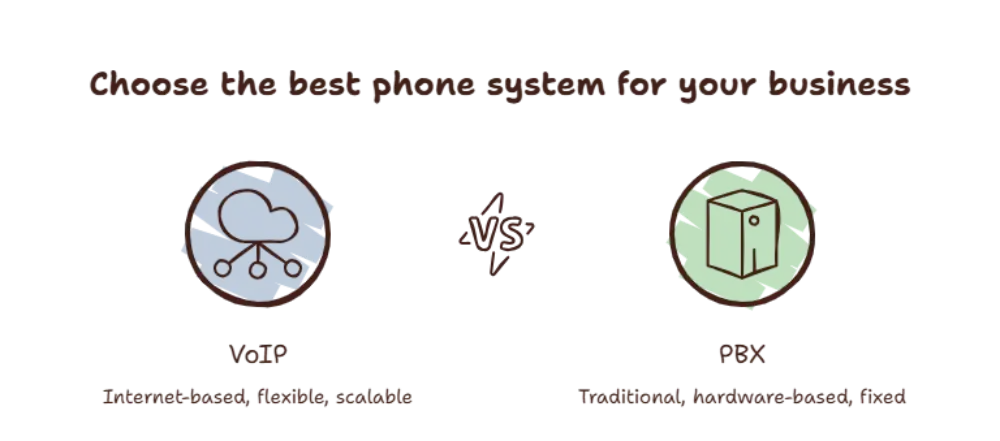
When comparing VoIP vs PBX, the differences become clear once you look at how each system is built, installed, and maintained. Here are some key points to understand the distinction.
VoIP systems use the internet to transmit calls, while PBX systems use traditional telephone lines.
PBX requires physical hardware and wiring installed on site, whereas VoIP can often be set up with minimal or no hardware.
VoIP allows employees to make and receive calls from virtually anywhere with an internet connection, while traditional PBX ties communication to a fixed physical location.
PBX systems are generally harder to scale since adding new lines often means installing additional hardware, while VoIP systems can usually scale by simply adding new user accounts.
Maintenance for PBX systems typically requires on site technicians, while VoIP systems are often maintained remotely by the service provider.
How VoIP Works
VoIP technology works by converting analog voice signals into digital packets of data. These packets travel across the internet to reach the recipient, where they are converted back into audio. This process happens almost instantly, allowing for real time conversations similar to a traditional phone call.
Because VoIP relies on internet bandwidth, the quality of calls can depend on the strength and stability of the internet connection. Businesses with reliable high speed internet typically experience clear call quality with VoIP systems.
How PBX Works
A traditional PBX system functions through a physical switchboard located within the business premises. This switchboard manages incoming and outgoing calls by routing them through internal extensions. When an employee makes a call, the PBX system directs that call through the appropriate line, whether it is an internal extension or an external phone number.
Because PBX systems use dedicated phone lines, they are not dependent on internet connectivity for call quality. This makes them a reliable option in areas where internet service is inconsistent.
Flexibility and Mobility
One of the most noticeable differences in the VoIP vs PBX comparison is flexibility. VoIP systems are inherently mobile since calls can be made from any device connected to the internet. This is particularly useful for businesses with remote employees, multiple office locations, or staff who travel frequently.
Traditional PBX systems are generally fixed to a physical location. Since the hardware and wiring are installed on site, employees typically need to be physically present in the office to use the system effectively. This can be limiting for businesses that operate with flexible or hybrid work arrangements.
Scalability Considerations
Scalability is another important factor when comparing VoIP vs PBX. As a business grows, its communication needs often grow as well. VoIP systems are generally easier to scale because adding new users typically only requires creating new accounts or licenses within the software.
PBX systems, on the other hand, may require purchasing and installing additional hardware to accommodate more lines or extensions. This can make scaling a PBX system a more involved process, especially for businesses experiencing rapid growth.
Maintenance and Reliability
Maintenance is a key consideration for any business communication system. Traditional PBX systems often require dedicated IT staff or external technicians to handle repairs, upgrades, and troubleshooting since the equipment is physically located on site.
VoIP systems are typically maintained by the service provider, with software updates and system improvements handled remotely. This can reduce the burden on internal staff, though it also means businesses are relying on their provider for consistent uptime and support.
In terms of reliability, PBX systems are not affected by internet outages since they operate on dedicated phone lines. VoIP systems, however, depend on a stable internet connection, so any disruption to internet service could potentially impact call functionality.
Which Option Fits Your Business
Deciding between VoIP and PBX ultimately depends on your specific business needs. If your business values mobility, remote work capabilities, and the ability to scale communication tools quickly, VoIP may align well with those priorities. Its internet based structure allows for flexibility that traditional systems cannot easily match.
On the other hand, if your business operates from a single fixed location and prioritizes a system that does not depend on internet connectivity, a traditional PBX system might be a better fit. Businesses in areas with unreliable internet service may also find PBX systems more dependable for everyday operations.
It is also worth noting that some businesses adopt hybrid approaches, combining elements of both systems to balance reliability with flexibility. Understanding your specific operational needs, work environment, and long term goals will help guide this decision.
Final Thoughts
The VoIP vs PBX comparison comes down to understanding how each system operates and which features align with your business goals. VoIP offers flexibility, mobility, and ease of scaling thanks to its internet based structure. PBX offers a traditional, dependable approach that does not rely on internet connectivity, making it suitable for businesses with fixed locations and stable operational needs.
Taking the time to evaluate your business size, work style, growth plans, and location based connectivity will help you determine which communication system best supports your operations moving forward.
Frequently Asked Questions
What is the main difference between VoIP and PBX?
The main difference is that VoIP transmits calls over the internet using digital data, while traditional PBX uses physical telephone lines and on site hardware to route calls.
Can VoIP be used without an internet connection?
No, VoIP requires a stable internet connection to function since it converts voice into digital data that travels over the internet rather than traditional phone lines.
Is PBX still used by businesses today?
Yes, many businesses still use PBX systems, particularly those that prioritize reliability without dependence on internet connectivity or operate from a single fixed location.
Which system is easier to scale, VoIP or PBX?
VoIP is generally easier to scale since adding new users often only requires creating new accounts, whereas PBX typically requires additional hardware installation.
Does VoIP work well for remote teams?
Yes, VoIP is well suited for remote teams since calls can be made from any device with an internet connection, allowing employees to stay connected regardless of their physical location.













Post Comment