
How VoIP Works: A Complete Guide to Internet Based Calling
If you have ever wondered how VoIP works, you are not alone. Millions of people use VoIP every single day without fully understanding what happens behind the scenes when they make a call. VoIP, which stands for Voice over Internet Protocol, has quietly replaced traditional phone lines in homes, offices, and call centers around the world. Understanding how VoIP works helps you appreciate why it has become the preferred way to communicate, and it also helps you troubleshoot issues, choose the right setup, and get the most out of the technology.
In simple terms, VoIP allows you to make voice calls using an internet connection instead of a traditional analog phone line. Instead of sending your voice through copper wires the way landlines did for over a century, VoIP converts your voice into digital data and sends it across the internet just like an email or a video file. This guide breaks down exactly how VoIP works, step by step, so you can understand the journey your voice takes from your mouth to the other person’s ear.
What Is VoIP and Why Does It Matter
Before diving into how VoIP works, it helps to understand what it actually is. VoIP is a technology that converts analog voice signals into digital data packets and transmits them over the internet. This is fundamentally different from traditional telephone systems, which rely on circuit switched networks that create a dedicated physical connection between two callers for the duration of a call.
Because VoIP relies on the internet rather than dedicated phone lines, it offers far more flexibility. You can make calls from a computer, a smartphone, a tablet, or a specialized VoIP phone, all using the same underlying technology. This flexibility is one of the biggest reasons VoIP has become so widely adopted by businesses and individuals alike.
How VoIP Works: The Step by Step Process
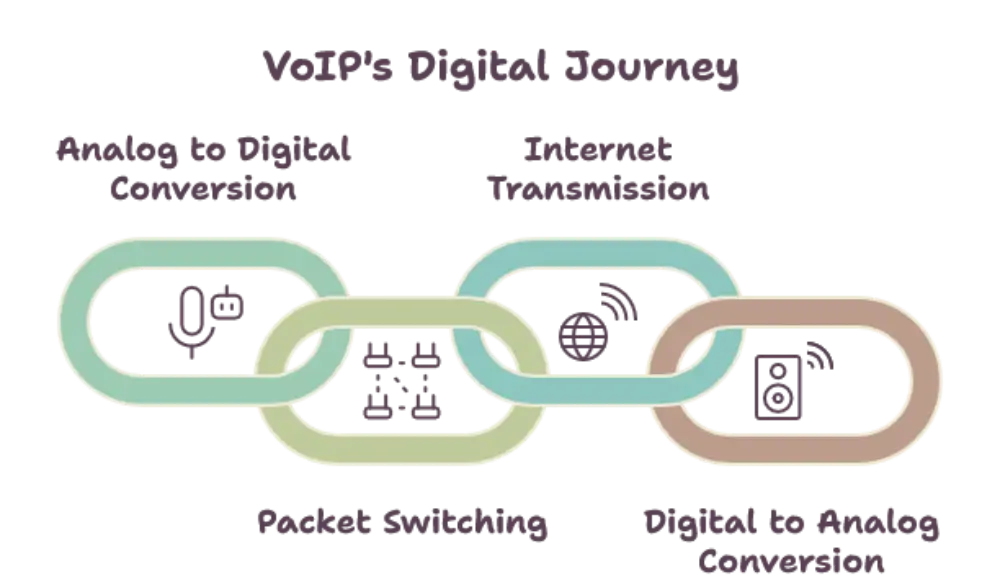
Understanding how VoIP works becomes much easier when you break the process into distinct stages. Every VoIP call follows a similar journey, regardless of the device or service being used.
Step One: Voice Is Captured as Analog Sound
When you speak into a phone, headset, or microphone, your voice exists as analog sound waves. These are continuous vibrations in the air that carry the unique tone, pitch, and rhythm of your speech. At this stage, the sound has not yet been altered or processed in any digital form.
Step Two: Analog Signals Are Converted Into Digital Data
This is where the real magic of how VoIP works begins. A device called a codec, short for coder decoder, takes the analog sound and converts it into digital data. The codec samples the analog waveform thousands of times per second and translates those samples into binary code made up of ones and zeros.
Different codecs offer different levels of audio quality and compression. Some prioritize clarity and sound quality, while others prioritize smaller file sizes for faster transmission over limited bandwidth. The choice of codec can significantly affect how smooth and clear a VoIP call sounds.
Step Three: Digital Data Is Broken Into Packets
Once your voice has been converted into digital data, it needs to be transmitted efficiently. Rather than sending one massive continuous stream of data, VoIP systems break the digital voice data into smaller units called packets. Each packet contains a small portion of the conversation along with information about where it needs to go.
This packet based approach is one of the defining features of how VoIP works, and it is also what separates VoIP from traditional telephone networks. Traditional landlines use circuit switching, which reserves a dedicated line for the entire call. VoIP instead uses packet switching, where data travels independently and can take different paths to reach its destination.
Step Four: Packets Travel Across the Internet
After your voice has been broken into packets, those packets are sent across the internet using standard networking protocols. The most common protocol used in VoIP is the Session Initiation Protocol, often referred to as SIP. SIP is responsible for setting up, maintaining, and ending calls. It handles tasks such as identifying the caller and receiver, establishing the connection, and managing call signals like ringing or call waiting.
Alongside SIP, the Real Time Transport Protocol, known as RTP, is responsible for actually carrying the voice data packets across the network. While SIP manages the conversation setup, RTP ensures that the audio data moves efficiently from one point to another.
As packets travel through the internet, they pass through routers, switches, and servers, sometimes crossing multiple networks before reaching their final destination. This is a key part of understanding how VoIP works, because the quality of your call depends heavily on the speed and reliability of the internet connection at every point along this journey.
Step Five: Packets Are Reassembled at the Receiving End
Once the voice packets arrive at the receiving device, whether that is another VoIP phone, a smartphone app, or a traditional phone connected through a VoIP adapter, the system needs to put everything back together. The receiving device collects the packets, checks them for completeness, and reassembles them into the correct order.
Because packets can sometimes arrive out of order or with slight delays, VoIP systems include mechanisms to handle this. Buffering and jitter correction techniques help smooth out any inconsistencies so that the conversation sounds natural rather than choppy or delayed.
Step Six: Digital Data Is Converted Back Into Analog Sound
The final step in how VoIP works mirrors the very first step, only in reverse. The codec on the receiving end converts the digital data back into analog sound waves. These sound waves are then played through the speaker of the receiving device, allowing the listener to hear the caller’s voice almost instantly.
This entire process, from the moment you speak to the moment the other person hears you, typically happens in a fraction of a second. The speed and efficiency of modern internet infrastructure is what makes real time conversation possible despite all the conversion and transmission happening behind the scenes.
Key Components That Make VoIP Possible
Several core components work together to make VoIP function smoothly. Some of the most important elements include:
- Internet connection: A stable and sufficiently fast internet connection is the foundation of any VoIP service, since poor connectivity directly affects call quality.
- Codecs: These convert voice between analog and digital formats and determine the balance between sound quality and data efficiency.
- SIP and RTP protocols: These manage call setup and the actual transmission of voice data across networks.
- VoIP enabled devices: These include VoIP phones, softphones installed on computers, mobile apps, and adapters that connect traditional phones to internet networks.
- Routers and network infrastructure: These guide data packets along the most efficient path from sender to receiver.
Why VoIP Quality Can Vary
Since how VoIP works depends so heavily on internet performance, several factors can influence call quality. Bandwidth availability determines how much data can be transmitted at once, which directly affects clarity and reliability. Latency, or the delay between sending and receiving data, can cause noticeable lag in conversations if it becomes too high. Jitter refers to inconsistent packet arrival times, which can lead to choppy or distorted audio if not properly managed. Packet loss occurs when some data packets fail to arrive at all, potentially causing gaps or dropouts in the conversation.
Understanding these factors helps explain why VoIP calls sometimes sound different depending on network conditions, even though the underlying technology remains the same.
The Bigger Picture of How VoIP Works
At its core, how VoIP works comes down to one elegant idea: turning sound into data, sending that data efficiently across a network, and turning it back into sound on the other end. This process happens so quickly and seamlessly that most users never think about the complex technology operating behind every call they make.
As internet infrastructure continues to improve and become more widely available, VoIP technology continues to evolve as well. New codecs offer better compression and clearer audio, networks become faster and more reliable, and devices become increasingly capable of handling real time communication with minimal delay. Understanding how VoIP works gives you a deeper appreciation for the technology that now powers so much of modern communication, from casual personal calls to large scale business operations.
Frequently Asked Questions
What does VoIP stand for and what does it mean?
VoIP stands for Voice over Internet Protocol. It refers to technology that allows voice communication to travel over the internet rather than through traditional analog phone lines.
Do I need a special phone to use VoIP?
Not necessarily. While dedicated VoIP phones exist, you can also use VoIP through software applications on computers and smartphones, or by connecting a traditional phone to an adapter that converts signals for internet transmission.
Why does my VoIP call sometimes sound choppy or delayed?
Choppy or delayed calls are usually caused by network issues such as limited bandwidth, high latency, jitter, or packet loss. Since VoIP relies on internet connectivity, the quality of that connection directly affects call clarity.
What is the difference between SIP and RTP in VoIP?
SIP is responsible for setting up, managing, and ending calls, including tasks like identifying callers and establishing connections. RTP is responsible for actually transporting the voice data packets during the call itself.
Can VoIP work without an internet connection?
No, VoIP requires an active internet connection to function, since it relies on transmitting digital voice data across internet based networks rather than traditional telephone lines.











Post Comment