
VoIP vs Landline: Which Phone System Is Right for You in 2026
When it comes to choosing a business or home phone system, the VoIP vs Landline debate is one of the most common questions people ask today. With more companies moving toward digital communication and remote work becoming the norm, understanding the real differences between these two technologies can help you make a smarter decision for your communication needs.
In this guide, we will break down everything you need to know about VoIP vs Landline, including how each system works, their advantages, limitations, and which one might suit your lifestyle or business better.
- What Is a Landline Phone System
- What Is VoIP
- VoIP vs Landline: Key Differences You Should Know
- Advantages of VoIP
- Advantages of Landline
- VoIP vs Landline: Which One Should You Choose
- Security Considerations in VoIP vs Landline
- The Future of Business Communication
- Final Thoughts on VoIP vs Landline
- Frequently Asked Questions
What Is a Landline Phone System
A landline phone system uses traditional copper wiring to transmit voice calls through the Public Switched Telephone Network, commonly known as PSTN. This is the classic phone technology that has been used for decades. It relies on physical infrastructure, meaning your phone is connected directly to a wall jack, and calls travel through underground or overhead cables maintained by telephone companies.
Landlines have long been considered reliable because they do not depend on the internet. As long as the physical line is intact, you can usually make and receive calls even during a power outage, since many landline phones draw power directly from the phone line itself.
What Is VoIP
VoIP stands for Voice over Internet Protocol. Instead of using copper wires, VoIP converts your voice into digital data packets and sends them over the internet. This means you can make calls using a broadband connection, a VoIP-enabled desk phone, a computer, or even a mobile app.
Because VoIP relies on internet connectivity rather than physical telephone lines, it offers a level of flexibility that landlines simply cannot match. Many households and businesses are switching to VoIP because it integrates easily with modern digital tools and allows communication from virtually anywhere with an internet connection.
VoIP vs Landline: Key Differences You Should Know
Understanding the core differences between VoIP vs Landline can help clarify which system aligns better with your communication habits and infrastructure.
How They Connect
Landlines depend entirely on physical wiring, while VoIP depends on your internet connection. This single difference shapes almost everything else about how each system performs.
Mobility and Flexibility
One of the biggest advantages of VoIP over a landline is mobility. With VoIP, you are not tied to a single location. You can take calls on your laptop, smartphone, or any device with internet access, making it ideal for remote teams, traveling professionals, or anyone who needs to stay connected outside the office.
Landlines, on the other hand, are fixed to a specific physical location. If you move offices or relocate, transferring a landline service can be a slower and more complicated process.
Call Quality
Landline call quality has traditionally been considered more stable since it does not depend on internet bandwidth. However, modern VoIP systems have significantly improved, and with a strong, stable internet connection, VoIP call quality can match or even exceed traditional landline clarity.
Scalability
For growing businesses, scalability is an important factor. VoIP systems make it much easier to add new lines or users since everything happens digitally. Landlines often require physical installation work, additional wiring, and technician visits to scale up, which can be time consuming.
Features and Integrations
VoIP services typically come packed with features such as call forwarding, voicemail to email, video conferencing, auto attendants, and integration with customer relationship management tools. Landlines generally offer more limited functionality, focusing mainly on basic calling features.
Reliability During Power or Internet Outages
This is one area where landlines still hold an advantage. Since landlines can work independently of electricity in many cases, they remain functional during power outages. VoIP, however, depends on a working internet connection and power supply, so service can be disrupted if either goes down, unless backup systems are in place.
Advantages of VoIP
VoIP technology offers several compelling benefits that explain why many homes and businesses are transitioning away from traditional phone lines.
Key points to consider about VoIP advantages include the following.
- VoIP allows calls from any internet connected device, supporting remote and hybrid work setups.
- It offers advanced features like video calls, instant messaging, and call analytics within the same platform.
- Adding or removing users is simple and does not require new physical wiring.
- VoIP systems often integrate smoothly with business software and productivity tools.
- It supports multiple communication channels beyond voice, such as messaging and conferencing.
Advantages of Landline
Despite the rise of VoIP, landlines still offer certain benefits that make them relevant in specific situations.
Key points to consider about landline advantages include the following.
- Landlines tend to offer consistent call quality regardless of internet speed or bandwidth.
- They generally continue working during power outages, which can be crucial for emergency communication.
- Landline systems are simple to use, with no need for technical setup or internet troubleshooting.
- They are less vulnerable to certain types of cyber threats since they do not rely on internet connectivity.
VoIP vs Landline: Which One Should You Choose
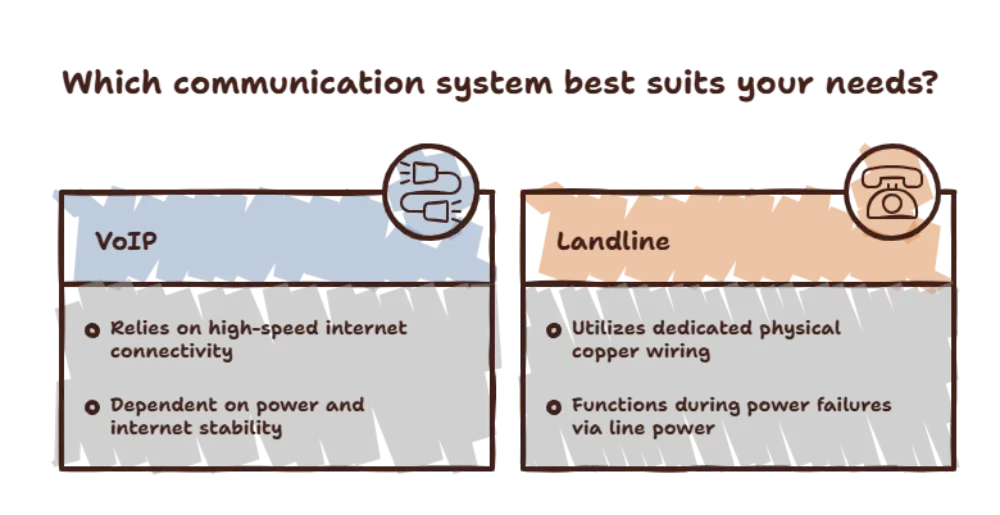
Choosing between VoIP vs Landline ultimately depends on your specific needs, lifestyle, and how you plan to use your phone system.
If mobility, flexibility, and advanced communication features are important to you, VoIP is likely the better fit. It is especially suited for businesses with remote employees, multiple office locations, or teams that rely heavily on digital collaboration tools.
If you prioritize maximum reliability during emergencies, simplicity, and a system that does not depend on internet stability, a landline may still serve your needs well, particularly in areas with inconsistent internet service.
Some businesses even choose a hybrid approach, keeping a landline as a backup option while using VoIP as their primary communication method. This way, they get the flexibility of VoIP along with the dependability of a traditional phone line during unexpected outages.
Security Considerations in VoIP vs Landline
Security is another factor worth thinking about when comparing VoIP vs Landline. Because VoIP transmits data over the internet, it can be exposed to certain cybersecurity risks such as unauthorized access or call interception if proper safeguards are not in place. Using strong passwords, secure networks, and reputable VoIP providers with encryption can help minimize these risks.
Landlines, since they do not rely on internet infrastructure, are generally less susceptible to these types of digital threats. However, they are not entirely immune to issues like physical line tampering.
The Future of Business Communication
As internet infrastructure continues to improve worldwide, VoIP technology is expected to become even more dominant in both personal and business communication. Many modern offices are designed with digital first communication systems in mind, often eliminating the need for traditional phone lines altogether.
That said, landlines have not disappeared entirely. In regions with unreliable internet access or industries where uptime during emergencies is critical, landlines continue to serve an important role.
Final Thoughts on VoIP vs Landline
The VoIP vs Landline decision is not about which technology is universally better, but which one aligns with your specific communication needs. VoIP offers flexibility, scalability, and a wide range of modern features, making it a strong choice for businesses embracing remote work and digital collaboration. Landlines, meanwhile, continue to offer dependable, straightforward service that does not rely on internet connectivity.
By weighing factors like mobility, reliability, features, and how you typically communicate, you can determine whether VoIP, a landline, or a combination of both is the right fit for your home or business.
Frequently Asked Questions
Is VoIP better than a landline for small businesses?
VoIP is often considered better for small businesses because it offers flexibility, scalability, and advanced features that support remote work and growth, without the need for extensive physical wiring.
Does VoIP work during a power outage?
VoIP generally requires both power and an active internet connection to function, so it can be disrupted during outages unless backup power or mobile data options are used.
Can I keep my existing phone number if I switch from a landline to VoIP?
In many cases, yes. Number porting is commonly offered, allowing users to transfer their existing phone number to a VoIP service during setup.
Is VoIP call quality as good as landline call quality?
With a stable and sufficiently fast internet connection, VoIP call quality can be just as clear as, or even better than, traditional landline calls.
Which is more secure, VoIP or landline?
Landlines are generally less exposed to internet based threats since they do not rely on online connectivity, while VoIP requires proper security measures like encryption and secure networks to minimize risks.














Post Comment