
SIP Trunking Explained
SIP Trunking is one of the most talked about technologies in modern business communication, and for good reason. It allows companies to make and receive calls over the internet instead of relying on traditional phone lines. As more businesses move their operations online, understanding how SIP Trunking works has become essential for anyone looking to modernize their communication systems.
What Is SIP Trunking?
SIP Trunking, short for Session Initiation Protocol Trunking, is a method of delivering voice and communication services over an internet connection. Instead of using physical copper phone lines, calls are converted into data packets and transmitted digitally. This approach connects a business phone system, often a PBX, to the public telephone network through a virtual connection called a trunk.
In simple terms, SIP Trunking replaces old fashioned phone lines with a digital pathway that carries voice, video, and messaging traffic across the internet.
Why the Name “Trunk”?
The term trunk comes from traditional telephony, where a trunk line referred to a bundle of circuits connecting different switching centers. SIP Trunking uses the same concept, but instead of physical cables, it uses virtual channels over an IP network.
How Does SIP Trunking Work?
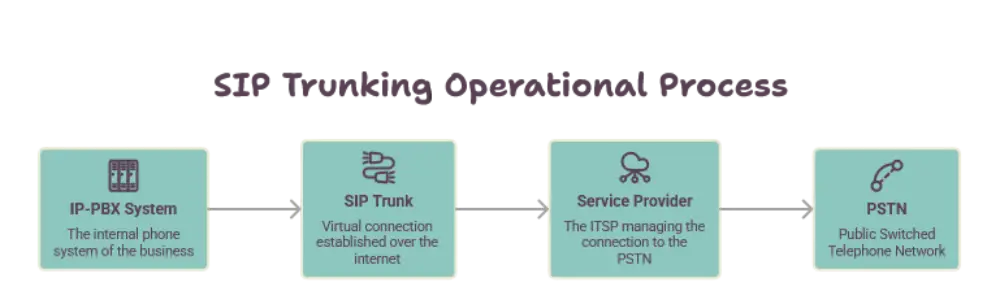
SIP Trunking works by converting voice signals into digital data packets that travel over the internet. These packets are sent to a SIP provider, who routes the call to its final destination, whether that is another business phone, a mobile device, or a landline.
The Role of VoIP
Voice over Internet Protocol, or VoIP, is the underlying technology that makes SIP Trunking possible. VoIP handles the actual transmission of voice data, while SIP manages the signaling process, such as starting, maintaining, and ending a call session.
Key Components Involved
A typical SIP Trunking setup includes several components working together. These include a business phone system or PBX, an internet connection with sufficient bandwidth, a SIP provider offering trunk lines, and a session border controller that manages security and call quality.
Each of these components plays a part in ensuring calls are clear, secure, and reliable.
Benefits of SIP Trunking
Businesses adopt SIP Trunking for a variety of operational reasons. Below are some of the most significant advantages.
Scalability
Unlike traditional phone lines, SIP Trunking allows businesses to add or remove channels based on demand. This makes it easy to scale communication capacity up or down without installing new physical lines.
Flexibility
SIP Trunking supports remote work and multiple office locations. Since calls travel over the internet, employees can connect from anywhere with a stable connection, making it ideal for hybrid and distributed teams.
Reliability
Many SIP providers offer built in redundancy, meaning calls can automatically reroute during outages or high traffic periods. This helps maintain consistent communication even during unexpected disruptions.
Simplified Infrastructure
Because SIP Trunking eliminates the need for multiple physical phone lines, businesses can consolidate voice, video, and messaging services into a single digital network.
SIP Trunking vs Traditional Phone Lines
Traditional phone lines rely on physical infrastructure, meaning every line requires a separate physical connection. SIP Trunking eliminates this limitation by allowing multiple calls to travel through a single internet connection using virtual channels.
This shift not only simplifies communication infrastructure but also allows businesses to integrate voice services with other digital tools such as customer relationship management platforms and collaboration software.
Who Should Use SIP Trunking?
SIP Trunking is suitable for businesses of many sizes and industries. Companies with multiple office locations, remote teams, or customer support centers often benefit the most, since SIP Trunking allows centralized management of communication systems regardless of physical location.
It is also a strong fit for organizations planning to modernize legacy phone systems or integrate voice services with cloud based platforms.
How to Implement SIP Trunking
Setting up SIP Trunking generally involves a few key steps. First, a business must have a compatible phone system, such as an IP PBX or a cloud based communication platform. Next, a reliable internet connection with adequate bandwidth is required to support voice traffic without quality issues.
Once the infrastructure is ready, a SIP provider configures the trunk lines and ensures proper security measures, such as encryption and firewall protection, are in place. Businesses should also test call quality and reliability before fully transitioning away from traditional phone lines.
Security Considerations
Since SIP Trunking operates over the internet, security is an important factor. Common protective measures include encryption protocols, firewalls, and session border controllers that monitor and filter incoming traffic to prevent unauthorized access.
Common Myths About SIP Trunking
There are several misconceptions surrounding SIP Trunking that are worth addressing.
Myth: SIP Trunking Is Only for Large Enterprises
In reality, businesses of all sizes can use SIP Trunking, thanks to its flexible and scalable nature.
Myth: SIP Trunking Compromises Call Quality
When properly configured with sufficient bandwidth, SIP Trunking can offer call quality that matches or exceeds traditional phone lines.
Myth: SIP Trunking Requires Complex Technical Knowledge
While some technical setup is involved, most SIP providers offer guided configuration and support to simplify the process for businesses.
Conclusion
SIP Trunking has transformed the way businesses handle voice communication by replacing outdated phone lines with a flexible, internet based system. It offers scalability, remote accessibility, and simplified infrastructure, making it a practical choice for organizations looking to modernize their communication systems. As internet based communication continues to grow, SIP Trunking remains a foundational technology supporting the future of business connectivity.
Frequently Asked Questions
What is SIP Trunking used for?
SIP Trunking is used to send and receive voice calls over the internet instead of traditional phone lines.
Is SIP Trunking the same as VoIP?
Not exactly. VoIP handles voice transmission, while SIP manages call signaling. SIP Trunking uses both together.
Do I need special equipment for SIP Trunking?
You typically need a compatible phone system such as an IP PBX and a stable internet connection.
Can SIP Trunking work with remote teams?
Yes, since calls travel over the internet, employees can connect from any location with internet access.
Is SIP Trunking secure?
Yes, when configured with encryption, firewalls, and session border controllers, SIP Trunking can be highly secure.













Post Comment