VoIP Security Risks: What Every Business Needs to Know
VoIP security risks are becoming a growing concern for businesses that rely on internet based calling systems. As more companies shift away from traditional phone lines toward Voice over Internet Protocol, they gain flexibility and cost savings, but they also open the door to a new category of cyber threats. Understanding these risks is the first step toward protecting your communication systems, your data, and your reputation.
What Is VoIP and Why Security Matters
VoIP allows voice calls to travel over the internet instead of traditional phone lines. This makes communication faster and more scalable, but it also means your calls are now vulnerable to the same threats that target any internet connected system.
Unlike traditional phone lines, VoIP traffic passes through networks, routers, and servers that can be intercepted or manipulated if proper security measures are not in place. This is why understanding VoIP security risks is essential for any business that depends on it for daily operations.
Common VoIP Security Risks
Eavesdropping and Call Interception
One of the most serious VoIP security risks is eavesdropping. Since voice data travels as packets over the internet, attackers can intercept unencrypted calls and listen in on private conversations. This is especially dangerous for businesses that discuss sensitive information such as financial details or client data over the phone.
Denial of Service Attacks
Denial of Service attacks flood a VoIP network with excessive traffic, overwhelming the system and causing call quality issues or complete outages. For businesses that rely on VoIP for customer service or sales calls, this can lead to major disruptions and lost opportunities.
Phishing and Vishing Attacks
Vishing, or voice phishing, is a growing threat in the VoIP space. Attackers use spoofed caller IDs to impersonate trusted contacts and trick employees into revealing sensitive information such as passwords or financial details.
Toll Fraud
Toll fraud occurs when hackers gain unauthorized access to a VoIP system and use it to make expensive international calls. This can result in significant unexpected charges before the breach is even detected.
Malware and Virus Attacks
VoIP systems that are connected to broader IT networks can become entry points for malware. Once inside, malicious software can spread across connected devices, compromising sensitive data and disrupting business operations.
Man in the Middle Attacks
In this type of attack, a hacker secretly intercepts and possibly alters communication between two parties without their knowledge. This can lead to data theft, call manipulation, or unauthorized access to confidential conversations.
Why VoIP Systems Are Vulnerable
Lack of Encryption
Many VoIP systems do not encrypt calls by default, leaving them exposed to interception. Without proper encryption protocols, sensitive conversations can be captured and misused.
Weak Authentication Practices
Weak passwords and poor authentication practices make it easier for attackers to gain unauthorized access to VoIP accounts and systems. This is one of the simplest yet most overlooked vulnerabilities.
Outdated Software and Firmware
Failing to update VoIP software and firmware regularly leaves known vulnerabilities unpatched, giving hackers an easy way into the system.
Unsecured Networks
VoIP systems that operate on unsecured or poorly configured networks are more susceptible to attacks. Public Wi-Fi and open network configurations increase the risk significantly.
The Impact of VoIP Security Breaches
Data Loss and Privacy Violations
A security breach can expose sensitive business and customer information, leading to privacy violations and potential legal consequences.
Reputational Damage
Customers and partners expect their communications to remain private. A breach can damage trust and harm long term business relationships.
Operational Disruption
Attacks such as Denial of Service can bring communication systems to a halt, affecting productivity and customer service capabilities.
Best Practices to Reduce VoIP Security Risks
Use Strong Encryption Protocols
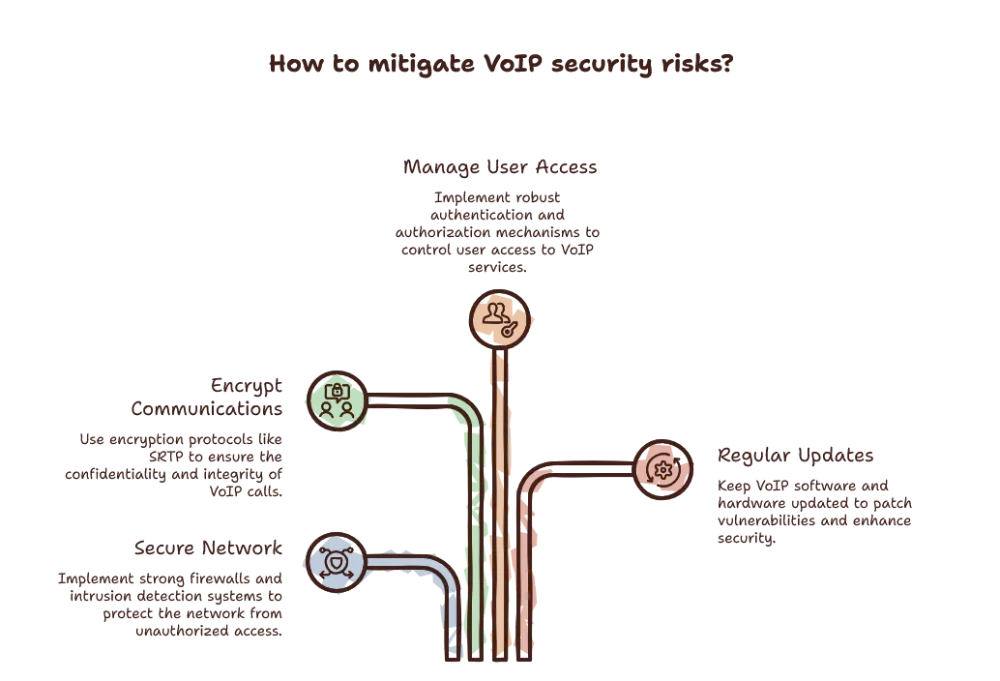
Implementing encryption protocols such as Secure Real Time Transport Protocol helps protect voice data from being intercepted during transmission.
Enforce Strong Password Policies
Requiring complex passwords and regularly updating them reduces the risk of unauthorized access to VoIP accounts.
Keep Systems Updated
Regularly updating VoIP software and firmware ensures that known vulnerabilities are patched before they can be exploited.
Implement Network Segmentation
Separating VoIP traffic from other network traffic using virtual local area networks can limit the damage caused by a potential breach.
Monitor Call Activity
Continuous monitoring of call logs and network activity helps identify unusual patterns that may indicate a security threat.
Educate Employees
Training employees to recognize phishing and vishing attempts can significantly reduce the likelihood of successful social engineering attacks.
Use a Firewall Designed for VoIP
A dedicated VoIP firewall can help filter malicious traffic while allowing legitimate voice data to pass through smoothly.
The Future of VoIP Security
As VoIP technology continues to evolve, so do the methods used by attackers to exploit it. Businesses must stay proactive by adopting new security measures, staying informed about emerging threats, and regularly auditing their systems. A strong security posture not only protects sensitive data but also ensures reliable communication for employees and customers alike.
Conclusion
VoIP security risks are a real and growing concern for businesses of all sizes. From eavesdropping and toll fraud to phishing attacks and system breaches, the threats are diverse and constantly evolving. By understanding these risks and implementing strong security practices such as encryption, employee training, and regular system updates, businesses can protect their communication systems and maintain the trust of their clients and partners. Staying vigilant and proactive is the key to keeping VoIP systems safe in an increasingly connected world.
FAQs
What are the most common VoIP security risks?
The most common VoIP security risks include eavesdropping, denial of service attacks, phishing and vishing, toll fraud, malware infections, and man in the middle attacks.
How can businesses protect their VoIP systems from hackers?
Businesses can protect their VoIP systems by using strong encryption, enforcing secure password policies, updating software regularly, segmenting networks, and training employees to recognize social engineering attempts.
Is VoIP less secure than traditional phone lines?
VoIP can be less secure than traditional phone lines if proper security measures are not implemented, since it relies on internet connections that are vulnerable to cyber threats.
What is toll fraud in VoIP systems?
Toll fraud happens when attackers gain unauthorized access to a VoIP system and use it to make expensive calls, often resulting in unexpected charges for the business.
Can VoIP calls be encrypted for added security?
Yes, VoIP calls can be encrypted using protocols such as Secure Real Time Transport Protocol, which helps prevent unauthorized interception of voice data.








Post Comment