
VoIP Disaster Recovery: How to Keep Your Business Calls Running When Things Go Wrong
Every business depends on phone communication, and a silent phone line can stop operations fast. A solid VoIP disaster recovery plan makes sure your calls keep flowing even when storms, outages, or cyberattacks strike.
Voice over IP is flexible and powerful, but it relies on internet access, power, and software. If any of these fail, your team can lose contact with customers.
This guide explains what VoIP disaster recovery means, why it matters, and how to build a plan that protects your business.
- What Is VoIP Disaster Recovery?
- Why VoIP Disaster Recovery Matters
- Common Causes of VoIP Downtime
- Core Components of a Strong VoIP Disaster Recovery Plan
- How to Build a VoIP Disaster Recovery Plan
- Testing and Maintaining Your Plan
- Best Practices for Stronger VoIP Resilience
- Communicating During a Disruption
- Conclusion
- Frequently Asked Questions
What Is VoIP Disaster Recovery?
VoIP disaster recovery is a set of strategies, tools, and procedures that restore your phone system quickly after a disruption. It covers everything from backup internet links to automatic call rerouting.
The goal is simple. Your business should keep receiving and making calls, with little or no downtime.
A good plan answers three questions:
- What could disrupt our phone service?
- How do we keep calls active during that disruption?
- How fast can we return to normal?
When these answers are documented and tested, your team can respond with confidence instead of confusion.
Why VoIP Disaster Recovery Matters
A missed call can mean a lost customer. Extended downtime can damage your reputation and slow down your entire team.
Unlike traditional phone lines, VoIP depends on several connected layers. Your internet, your network equipment, your provider, and your devices all need to work together.
That is why planning ahead is so valuable. A weak point in any layer can interrupt service, and recovery is much easier when the steps are already defined.
Common Causes of VoIP Downtime
Understanding the risks helps you prepare for them. Here are the most frequent causes of phone disruption.
Internet and Power Outages
Since VoIP travels over the internet, a lost connection means lost calls. Power cuts can also shut down routers, switches, and desk phones in your office.
These two issues are among the most common reasons for service interruption.
Hardware and Software Failures
Routers fail. Servers crash. Software updates sometimes cause unexpected errors.
Even a small technical fault can disrupt call routing, voicemail, or auto attendants if you have no backup in place.
Cyberattacks
Phone systems can be targeted by hackers. Attacks such as denial of service, toll fraud, and ransomware can take your communication tools offline.
Strong security is a key part of any disaster recovery strategy.
Natural Disasters and Human Error
Floods, fires, earthquakes, and severe storms can damage office buildings and equipment. Human mistakes, like a wrong configuration change, can be just as disruptive.
Both types of events are unpredictable, which is why preparation matters.
Core Components of a Strong VoIP Disaster Recovery Plan
A reliable plan combines several protective layers. Each one reduces the chance of a complete communication blackout.
Redundant Internet Connections
Relying on a single internet provider is risky. A second connection, such as a fiber line paired with a wireless backup, keeps voice traffic moving if one path fails.
Your network should switch between connections automatically so no one has to intervene.
Automatic Call Failover
Failover rules reroute incoming calls when your main system becomes unavailable. Calls can be sent to mobile phones, backup numbers, or another office location.
This keeps customers connected to a real person instead of a dead line.
Geographic Redundancy
Cloud based VoIP platforms often run across multiple data centers in different regions. If one location goes down, another takes over.
This setup protects your service from regional disasters and large scale outages.
Mobile and Softphone Access
Softphone apps let employees make and receive business calls from smartphones and laptops. If the office becomes unreachable, your team can keep working from anywhere.
This is especially helpful for remote and hybrid teams.
Data Backup and Configuration Storage
Your call flows, extensions, voicemail settings, and user profiles should be backed up regularly. Stored copies of these settings make it much faster to rebuild your system after a failure.
Keep backups in a secure and separate location.
How to Build a VoIP Disaster Recovery Plan
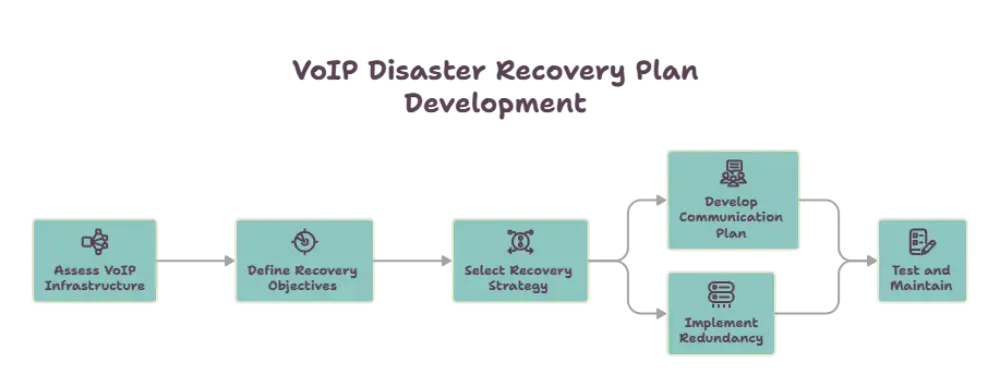
Creating a plan does not need to be complicated. Break the process into clear stages.
Assess Your Risks
Start by listing the threats most likely to affect your business. Consider your location, your infrastructure, and your reliance on specific systems.
A business in a storm prone area will have different priorities than one facing frequent power instability.
Set Clear Recovery Goals
Two key terms guide every recovery plan.
- Recovery Time Objective is how quickly you need service restored.
- Recovery Point Objective is how much data loss you can tolerate.
Setting these goals helps you choose the right tools and decide how much redundancy you actually need.
Document Every Step
Write down exactly what to do when an outage occurs. Include contact details for your provider, login information for management portals, and instructions for activating failover.
Keep this document accessible, even if your main systems are down. A printed copy and a cloud copy are both wise choices.
Assign Roles and Responsibilities
Everyone should know who does what during an emergency. Name a primary contact, a backup contact, and a person responsible for communicating with staff and customers.
Clear roles prevent delays and confusion when time matters most.
Testing and Maintaining Your Plan
A plan that has never been tested is only a theory. Regular testing shows you what works and what needs improvement.
Run simulated outages to check that failover rules activate correctly. Confirm that mobile forwarding, backup internet, and softphone apps perform as expected.
After each test, review the results and update your documentation. Technology and teams change, so your plan should evolve too.
It also helps to review your plan after major changes, such as moving offices, adding new users, or upgrading equipment.
Best Practices for Stronger VoIP Resilience
Following a few proven habits can greatly improve your recovery readiness.
- Choose a provider that offers strong uptime guarantees and redundant infrastructure.
- Use power backups, such as uninterruptible power supplies, for key network devices.
- Apply security measures like encryption, strong passwords, and multi factor authentication.
- Monitor call quality and network health continuously to catch problems early.
- Train employees so they know how to respond during an outage.
Small improvements add up. Together, they create a communication system that can handle unexpected events.
Communicating During a Disruption
Technology is only part of recovery. How you communicate matters just as much.
Let customers know if there are delays or alternative contact options. Update your website, social media, and email signatures with temporary details if needed.
Keep your team informed as well. Clear and calm updates help everyone stay focused and reduce stress during an outage.
Conclusion
Phone service is the lifeline of many businesses, and downtime can be costly in lost trust and missed opportunities. VoIP disaster recovery gives you the structure to stay connected no matter what happens.
By identifying risks, building redundancy, documenting procedures, and testing regularly, you create a phone system that is ready for real world challenges.
Start with a simple assessment today. Then strengthen your plan step by step, so your business can keep talking when it matters most.
Frequently Asked Questions
What is VoIP disaster recovery?
VoIP disaster recovery is a plan that restores business phone service quickly after an outage or emergency. It includes backup internet, call failover, data backups, and clear response procedures.
Why do businesses need a VoIP disaster recovery plan?
A plan helps prevent missed calls, lost customers, and long periods of downtime. It gives your team a clear path to restore communication quickly when something goes wrong.
How does call failover work in VoIP systems?
Call failover automatically reroutes incoming calls to another destination when your main system is unavailable. Calls can be sent to mobile phones, backup numbers, or other office locations.
How often should I test my VoIP disaster recovery plan?
Test your plan at least a few times each year and after any major change to your network or team. Regular testing confirms that failover, backups, and procedures work as expected.














Post Comment