
AI in VoIP: How Artificial Intelligence Is Transforming Business Calling
AI in VoIP is changing the way businesses handle phone calls, customer support, and internal communication. Traditional VoIP systems already made calling more flexible and affordable by moving voice traffic over the internet. Now artificial intelligence is adding a new layer of intelligence to these systems, helping businesses automate tasks, understand conversations, and serve customers faster than ever before.
In this article, we will explore what AI in VoIP actually means, how it works, its key benefits, real world applications, and what the future holds for this fast growing technology.
What Is AI in VoIP
AI in VoIP refers to the integration of artificial intelligence technologies such as machine learning, natural language processing, and voice recognition into Voice over Internet Protocol systems. This combination allows phone systems to do much more than simply connect calls.
Instead of acting as a passive tool, an AI powered VoIP system can understand speech, detect emotions, transcribe conversations, and even predict customer needs. It essentially turns a basic calling platform into a smart communication assistant.
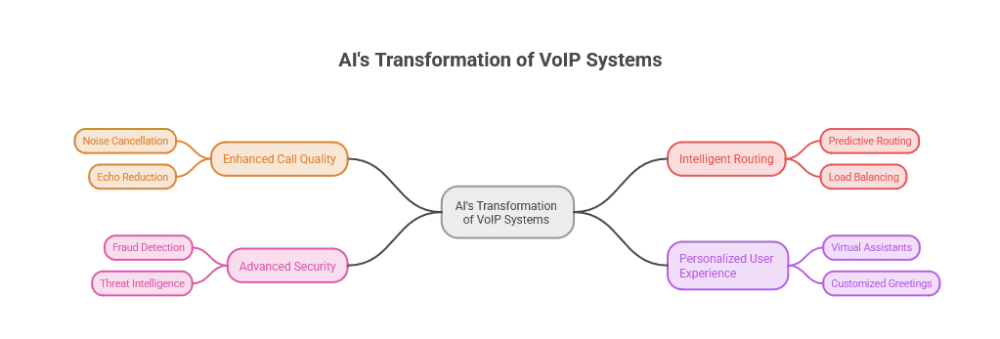
How AI Is Transforming VoIP Systems
Intelligent Call Routing
One of the most valuable uses of AI in VoIP is smart call routing. Instead of sending calls to the next available agent, AI systems can analyze caller data, past interactions, and query type to route the call to the most suitable agent. This reduces wait times and improves first call resolution rates.
Real Time Speech Analytics
AI powered VoIP platforms can analyze conversations as they happen. They can detect tone, sentiment, and keywords in real time. This allows supervisors to step in during difficult calls or gives agents live prompts to improve the conversation.
Voice Recognition and Virtual Assistants
Voice recognition technology allows VoIP systems to understand spoken commands and respond naturally. Many businesses now use AI virtual assistants to greet callers, answer common questions, and route requests without human involvement, especially outside business hours.
Automated Transcription and Summaries
AI can automatically transcribe calls and generate short summaries afterward. This saves agents from taking manual notes and gives managers a searchable record of every conversation, which is useful for training and quality checks.
Fraud Detection and Security
AI algorithms can identify unusual calling patterns, spoofed numbers, and suspicious voice signatures. This helps businesses detect fraudulent activity early and protect both their systems and their customers.
Benefits of AI in VoIP for Businesses
Improved Customer Experience
Faster call routing, accurate answers, and personalized service all lead to happier customers. AI in VoIP helps reduce hold times and ensures customers reach the right person quickly.
Higher Productivity for Teams
Automated transcription, call summaries, and smart routing free up agents from repetitive tasks. This allows teams to focus on solving problems instead of managing administrative work.
Better Data Insights
AI tools analyze thousands of calls to uncover patterns in customer behavior, common complaints, and agent performance. These insights help businesses make informed decisions and refine their communication strategy.
Real World Use Cases of AI in VoIP
Customer Support Centers
Support teams use AI powered VoIP to handle high call volumes efficiently. Virtual assistants manage simple queries while human agents focus on complex issues, improving overall response time.
Sales Teams
Sales professionals use AI insights from VoIP calls to understand customer intent, follow up at the right time, and personalize their pitch based on previous conversations.
Remote and Hybrid Workforces
As more teams work remotely, AI in VoIP helps maintain clear communication across locations. Features like automatic transcription and smart call forwarding ensure nothing gets missed, even when teams are spread across different time zones.
Challenges to Consider
While AI in VoIP offers major advantages, businesses should also be aware of certain challenges. Data privacy is an important concern since AI systems process large amounts of voice data. Companies must ensure compliance with relevant regulations and maintain transparency with customers about how their data is used.
Another challenge is ensuring the AI system understands different accents, languages, and speech patterns accurately. Continuous training and updates are often required to keep accuracy high across diverse user bases.
The Future of AI in VoIP
The future of AI in VoIP looks promising as technology continues to advance. We can expect more natural sounding virtual assistants, deeper integration with customer relationship management tools, and smarter predictive analytics that anticipate customer needs before they even ask.
As AI models become more sophisticated, VoIP systems will likely offer even more personalized and proactive communication experiences, helping businesses build stronger relationships with their customers.
Conclusion
AI in VoIP is reshaping how businesses communicate, offering smarter call routing, real time analytics, automated transcription, and stronger security. As adoption grows, companies that embrace these tools are better positioned to deliver faster, more personalized customer experiences while boosting overall team productivity. Understanding how AI in VoIP works today can help businesses prepare for a smarter and more connected communication future.
FAQs
What does AI in VoIP mean?
AI in VoIP refers to the use of artificial intelligence technologies like machine learning and natural language processing within Voice over Internet Protocol systems to automate tasks, analyze conversations, and improve call handling.
How does AI improve VoIP call quality?
AI can monitor network conditions in real time and adjust settings automatically to reduce lag, echo, and dropped calls, resulting in clearer and more reliable conversations.
Can AI in VoIP understand different languages and accents?
Yes, many AI powered VoIP systems are trained on diverse speech datasets to recognize multiple languages and accents, though accuracy can vary depending on the system and ongoing training.
Is AI in VoIP suitable for small businesses?
Yes, AI in VoIP can benefit businesses of all sizes by automating routine tasks, improving customer service, and providing valuable insights, regardless of company size.
Does AI in VoIP replace human agents?
No, AI in VoIP is designed to support human agents rather than replace them. It handles repetitive tasks and provides insights so agents can focus on more meaningful customer interactions.














Post Comment