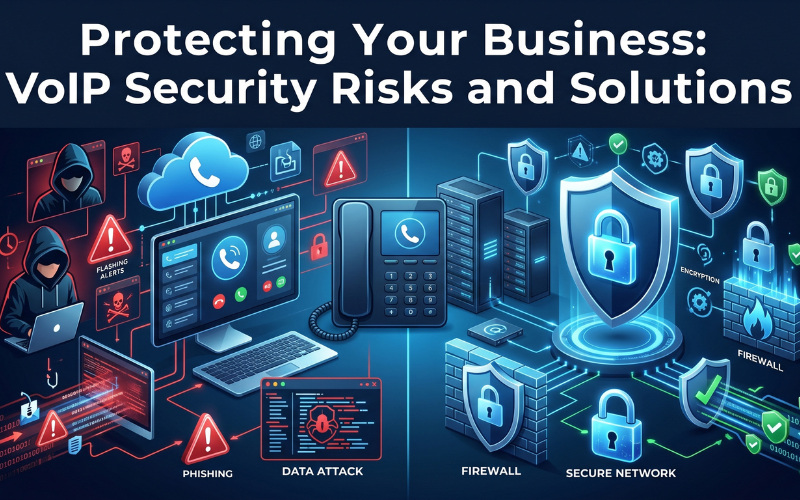
Protecting Your Business: VoIP Security Risks and Solutions
You’ve embraced the future of communication. Voice over Internet Protocol (VoIP) has revolutionized how your business connects with clients, partners, and employees, offering unparalleled flexibility, cost savings, and feature richness. But as with any powerful technology, VoIP introduces a new set of vulnerabilities that, if left unaddressed, could cripple your operations, compromise sensitive data, and erode your hard-earned reputation. It’s no longer enough to simply install a VoIP system; you must actively protect it. This article will guide you through the intricate landscape of VoIP security, highlighting common risks and offering actionable solutions to safeguard your business.
Before you can defend your VoIP system, you must understand what you’re defending against. The very nature of VoIP – leveraging internet protocols for voice communication – makes it susceptible to many of the same threats that plague your data networks. However, it also introduces unique attack vectors specific to real-time communication.
Eavesdropping and Call Interception
Imagine your confidential sales calls, strategic planning discussions, or customer support interactions being listened to by unauthorized individuals. This isn’t a scene from a spy movie; it’s a very real threat to unencrypted VoIP communications. Attackers can intercept your calls through various methods, including network sniffing, man-in-the-middle attacks, and compromising network devices. Once intercepted, your conversations become vulnerable to industrial espionage, extortion, or simply a breach of sensitive personal information.
Denial of Service (DoS/DDoS) Attacks
A DoS or DDoS attack on your VoIP system is designed to render your communication infrastructure unusable. By flooding your VoIP servers or network with an overwhelming amount of traffic, attackers can prevent legitimate calls from being made or received. This could mean lost sales opportunities, inability to provide customer support, and significant operational disruption. Imagine your busiest sales day, and suddenly all incoming and outgoing calls fail. The financial and reputational damage can be severe.
Toll Fraud and Call Hijacking
Toll fraud is a particularly insidious threat where attackers gain unauthorized access to your VoIP system to make expensive international calls or calls to premium-rate numbers. They essentially piggyback on your account, racking up massive charges that you’re ultimately responsible for. Call hijacking, a related threat, allows attackers to divert incoming calls to their own numbers, potentially impersonating your business or intercepting crucial communications. This can lead to significant financial losses and severe damage to your brand’s credibility.
Phishing and Vishing Attempts
Just as email phishing targets your employees with malicious links and attachments, vishing (voice phishing) uses VoIP to trick individuals into revealing sensitive information. Attackers might impersonate a legitimate organization, such as your bank or an IT support company, to gain access to passwords, account numbers, or other confidential data. These social engineering tactics exploit human trust and can be incredibly effective if employees aren’t adequately trained.
Malware and Viruses
While traditional malware often targets computers, specialized malware can also directly affect VoIP devices and servers. This could include spyware designed to record calls, ransomware that encrypts your communication data, or viruses that compromise the integrity of your VoIP system, leading to erratic behavior, call quality issues, or complete system failure.
Implementing Robust Security Measures
Understanding the threats is the first step; the next is implementing comprehensive security measures. Protecting your VoIP system requires a multi-layered approach that addresses various attack vectors and continuously adapts to evolving threats.
Encrypting Voice Traffic
Encryption is your first line of defense against eavesdropping. By encrypting your voice traffic, you scramble the data packets, making them unreadable to anyone who intercepts them without the correct decryption key.
Utilizing SRTP and TLS
Secure Real-time Transport Protocol (SRTP) encrypts the actual voice data, ensuring that even if an attacker manages to intercept your calls, they will only hear garbled noise. Transport Layer Security (TLS) is used to encrypt the signaling information, such as call initiation and termination, preventing attackers from understanding call patterns or manipulating call setup. Ensure your VoIP provider and your on-premise equipment support and properly implement both SRTP and TLS. Regularly verify that these protocols are active and configured correctly.
Securing Your Network Infrastructure
Your VoIP system doesn’t exist in a vacuum; it relies heavily on your underlying network infrastructure. Strengthening your network security is paramount to protecting your voice communications.
Implementing Firewalls and Intrusion Prevention Systems (IPS)
A properly configured firewall acts as a gatekeeper, inspecting all incoming and outgoing network traffic and blocking any suspicious activity. An Intrusion Prevention System (IPS) goes a step further by actively detecting and preventing malicious network attacks in real-time. Ensure your firewalls are specifically configured to protect VoIP traffic, allowing only legitimate call signaling and media streams, and blocking known VoIP attack patterns.
Segmenting Your Network
Networking segmentation involves dividing your network into smaller, isolated sub-networks or VLANs (Virtual Local Area Networks). By placing your VoIP system and devices on a separate VLAN from your general data network, you create a barrier that prevents attackers who compromise one part of your network from easily accessing your VoIP infrastructure. This “least privilege” approach limits the damage an attacker can inflict.
Regularly Patching and Updating Systems
Software vulnerabilities are frequently discovered, and manufacturers release patches to address them. Failing to apply these patches promptly leaves your system exposed to known exploits. This applies to your VoIP servers, IP phones, routers, switches, and any other network devices involved in your VoIP communication. Implement a rigorous patch management schedule to ensure all systems are up-to-date.
Fortifying Your VoIP Devices and Endpoints
Even with a secure network, individual VoIP devices and endpoints can become points of vulnerability if not properly secured. These include your IP phones, softphones, and VoIP gateways.
Changing Default Passwords and Credentials
This is perhaps the most fundamental and often overlooked security step. Many VoIP devices ship with default usernames and passwords (e.g., admin/admin, user/user). Attackers use automated scripts to try these common defaults, gaining unauthorized access with alarming ease. Immediately change all default credentials to strong, unique passwords for every VoIP device, including administrator accounts and user extensions.
Disabling Unused Services and Ports
Every open port or running service on a device is a potential entry point for an attacker. Review your VoIP devices and disable any services or ports that are not actively required for their operation. This reduces the attack surface and minimizes opportunities for exploitation. For example, if you don’t use web management for certain phones, disable the HTTP/HTTPS server on them.
Implementing Strong Authentication Mechanisms
Passwords are a good start, but in a world of brute-force attacks and credential stuffing, they aren’t always enough. Enhance your VoIP security with stronger authentication methods.
Multi-Factor Authentication (MFA)
Where possible, implement Multi-Factor Authentication (MFA) for accessing your VoIP system management interfaces, administrator accounts, and potentially even for user extension access. MFA requires users to provide two or more verification factors (e.g., a password and a code from a mobile app), making it significantly harder for unauthorized individuals to gain access even if they steal a password.
Certificate-Based Authentication
For server-to-server communication or for authenticating individual VoIP devices, consider using certificate-based authentication. This relies on digital certificates to verify the identity of devices and services, offering a more robust and scalable authentication method than shared secrets.
Managing Access and User Privileges
Human error and insider threats are significant factors in many security breaches. Proper access management is crucial to minimizing these risks within your VoIP environment.
Implementing Role-Based Access Control (RBAC)
Not everyone needs full administrative access to your VoIP system. RBAC ensures that users are only granted the permissions necessary to perform their job functions. For example, a receptionist might only need access to call forwarding settings, while an IT administrator needs full control over the system. This principle of “least privilege” limits the damage if a user account is compromised.
Regularly Reviewing User Accounts and Permissions
Employee turnover, role changes, and temporary assignments can lead to an accumulation of outdated or excessive user permissions. Conduct regular audits of all user accounts within your VoIP system. Deactivate accounts for former employees immediately and adjust permissions for current employees as their roles evolve. This prevents unauthorized access from lingering accounts.
Training Employees on Security Best Practices
Your employees are your first line of defense against many social engineering attacks. Comprehensive and ongoing security awareness training is essential.
Recognizing Phishing and Vishing Attempts
Educate your employees on how to identify suspicious emails, phone calls, and text messages. Teach them to verify the identity of callers, especially those requesting sensitive information or system access. Implement clear protocols for handling such requests.
Creating Strong, Unique Passwords
Reinforce the importance of using strong, unique passwords for all business accounts, including VoIP extensions. Encourage the use of password managers to simplify this process and conduct regular training on password best practices.
Developing a Comprehensive Incident Response Plan
When a security incident occurs, panic can ensue if there’s no clear plan. Define specific roles and responsibilities for your incident response team. Who will lead the investigation? Who will communicate with stakeholders? Who will handle technical remediation? Clear roles streamline the response and prevent confusion.
Creating Communication Protocols
How will you communicate during an incident? Internally, you’ll need channels to coordinate your response. Externally, you might need to inform customers, partners, or regulatory bodies, depending on the severity and nature of the breach. Develop pre-approved communication templates and strategies to ensure timely, accurate, and consistent messaging.
Regularly Testing and Updating Your Plan
An incident response plan is not a static document. It must be regularly reviewed, tested, and updated to remain effective. Conduct tabletop exercises or simulated breach scenarios to test your team’s readiness and identify any gaps in your plan. As your VoIP system evolves and new threats emerge, your incident response strategy must adapt accordingly.
Protecting your VoIP system is not a one-time task; it’s an ongoing commitment. By understanding the threats, implementing robust technical and administrative controls, and empowering your employees with knowledge, you can safeguard your business’s critical communication infrastructure. The investment in VoIP security is an investment in the continuity, reputation, and future success of your business. Don’t wait for an attack to realize the value of a secure VoIP system. Act now to protect your valuable communication assets.
FAQs
What are the common security risks associated with VoIP?
Common security risks associated with VoIP include eavesdropping, call tampering, denial of service attacks, and unauthorized access to the VoIP network.
How can eavesdropping be prevented in VoIP communication?
Eavesdropping in VoIP communication can be prevented by using encryption protocols such as Secure Real-time Transport Protocol (SRTP) and Virtual Private Networks (VPNs) to secure the transmission of voice data.
What measures can be taken to protect against call tampering in VoIP systems?
To protect against call tampering in VoIP systems, implementing authentication and access control measures, as well as using session border controllers (SBCs) to monitor and control VoIP traffic, can help prevent unauthorized manipulation of calls.
How can denial of service (DoS) attacks be mitigated in VoIP networks?
To mitigate denial of service (DoS) attacks in VoIP networks, implementing firewalls, intrusion detection systems, and quality of service (QoS) mechanisms can help detect and prevent malicious traffic from overwhelming the VoIP system.
What are some best practices for securing VoIP systems?
Best practices for securing VoIP systems include regularly updating software and firmware, implementing strong authentication and access control measures, conducting regular security audits, and providing employee training on VoIP security protocols and procedures.














Post Comment