
Revolutionizing Business Communication: Emerging VoIP Technologies in 2026
You’ve likely observed the steady progression of Voice over Internet Protocol (VoIP) technologies, but in 2026, the landscape of business communication is undergoing a significant transformation. The days of VoIP being a mere cost-saving alternative to traditional telephony are long past. Now, it stands as the central nervous system for integrated, intelligent, and highly adaptable communication ecosystems. Your understanding of these emerging trends is crucial for maintaining competitive advantage and ensuring operational efficiency.
You’re no longer just getting voice calls routed over the internet; you’re engaging with an intelligent system. The integration of Artificial Intelligence (AI) into VoIP platforms has moved beyond rudimentary features, creating a sophisticated communication hub that learns, adapts, and assists. This isn’t science fiction; it’s the operational reality for businesses in 2026.
Real-time Language Translation and Localization
You’ve probably experienced the frustrations of language barriers in global business. Current VoIP technologies, augmented by advanced AI, offer real-time, near-instantaneous language translation. This isn’t just a basic word-for-word swap; sophisticated natural language processing (NLP) algorithms understand context, idioms, and even nuances of tone.
- Adaptive Dialects: You can expect systems to learn and adapt to regional dialects and specific industry terminologies, improving translation accuracy significantly over time.
- Localized Content Generation: Think beyond just voice. AI can assist in generating localized follow-up emails, summary reports, and even marketing materials based on the translated conversation. This streamlines international operations remarkably.
Intelligent Call Routing and Prioritization
Your call center operations are being fundamentally reshaped. AI-powered intelligent call routing eliminates the need for complex, static IVR menus. Instead, AI analyzes the caller’s intent, emotional tone, and historical data to route the call to the most appropriate agent, or even an automated assistant, with remarkable precision.
- Sentiment Analysis for Urgency: You’re seeing systems that can detect frustration or urgency in a caller’s voice, automatically prioritizing those calls or flagging them for immediate human intervention. This prevents escalation and improves customer satisfaction.
- Predictive Agent Matching: Based on an agent’s past performance, expertise, and even personality traits, AI can match them with callers for whom they are most likely to achieve a positive outcome. This optimizes resource allocation and improves first-call resolution rates.
Automated Meeting Summarization and Action Item Extraction
You’re likely spending countless hours on follow-up tasks after meetings. AI in VoIP platforms now automatically transcribes meetings, not just for text, but also for meaning. It identifies key decisions, assigns action items, and even drafts executive summaries.
- Speaker Diarization: You’ll find that systems accurately differentiate between speakers, attributing comments and tasks to the correct individuals without manual intervention.
- CRM Integration: These summaries and action items are automatically populated into your CRM or project management tools, ensuring seamless workflow and eliminating the need for separate manual data entry.
The Immersive Communication Experience: Beyond Flat Screens
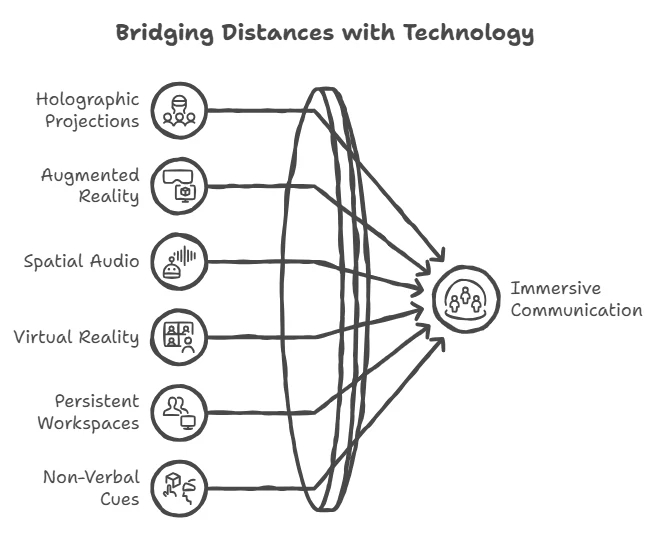
Traditional video conferencing, while effective, often lacks the depth and engagement of in-person interactions. Emerging VoIP technologies are pushing the boundaries to create more immersive and engaging communication experiences, aiming to bridge geographical distances more effectively. You are no longer just seeing a talking head; you are entering a shared virtual space.
Holographic Projections and Augmented Reality (AR) Integration
You might have considered this futuristic, but holographic projections and AR integration are no longer confined to science fiction. For high-stakes meetings or collaborative design sessions, you can participate in a conference where participants appear as 3D holograms, offering a more natural spatial presence.
- Interactive 3D Models: Imagine collaborating on a product design. With AR integration, you can manipulate and interact with 3D models of products or architectural designs in real-time, with all participants seeing the same changes simultaneously.
- Spatial Audio Localization: You’ll experience audio that emanates from the perceived location of the holographic participant, enhancing the sense of presence and making group discussions more intuitive.
Virtual Reality (VR) Meeting Spaces
For highly collaborative or sensitive discussions, you can now enter fully immersive VR meeting spaces. These aren’t just simulated rooms; they are designed to foster deeper engagement and focus by eliminating external distractions and creating a dedicated work environment.
- Persistent Virtual Workspaces: You can create persistent virtual offices or project rooms where teams can assemble, access shared documents, whiteboards, and collaborate as if they were in the same physical location, even when disengaged.
- Non-Verbal Cues Recognition: Advanced VR systems are beginning to capture and render subtle non-verbal cues, such as head nods, gaze direction, and even rudimentary hand gestures, making interactions feel more natural and intuitive.
The Edge-Computing Revolution: Low Latency, High Performance
You’ve probably encountered latency issues with cloud-based VoIP, especially in high-bandwidth applications or geographically dispersed teams. The migration towards edge computing is fundamentally altering how VoIP data is processed, bringing computation closer to the source and dramatically reducing latency. This means smoother, more reliable communication for you, even in demanding scenarios.
On-Device AI Processing for Enhanced Privacy and Speed
You are observing more AI processing occurring directly on your communication devices rather than solely in centralized cloud servers. This has significant implications for both speed and privacy.
- Reduced Data Transmission: You’ll find that less raw data needs to be sent to the cloud for processing, leading to faster responses and reduced bandwidth consumption.
- Enhanced Data Security: Sensitive information, such as real-time transcription or sentiment analysis, can be processed locally, minimizing the risk of data breaches during transmission or storage in central servers.
Localized Network Prioritization and Bandwidth Optimization
You will notice that edge computing allows for smarter network management. Instead of all traffic being routed through a central data center, local edge servers can prioritize VoIP traffic, ensuring consistent call quality even during periods of network congestion.
- Dynamic Bandwidth Allocation: You’re seeing systems that dynamically adjust bandwidth allocation based on the real-time demands of your VoIP calls, ensuring that voice and video quality remain high even when other network activities spike.
- Proactive Traffic Management: Edge nodes can proactively identify and mitigate potential network bottlenecks before they impact your communication, leading to a much more stable and reliable experience.
The Secure Communication Imperative: Protecting Your Conversations
You understand that in an era of increasing cyber threats, the security of your business communications is paramount. Emerging VoIP technologies are integrating advanced security measures that go beyond traditional encryption, providing multi-layered protection for your conversations and data. You are seeing a proactive approach to security, not just reactive.
Quantum-Resistant Encryption Protocols
You’re aware that current encryption methods, while robust, may eventually be vulnerable to quantum computing. VoIP providers are already implementing quantum-resistant encryption algorithms to secure communications against future threats.
- Post-Quantum Cryptography (PQC): You’ll find that platforms are adopting PQC standards that are designed to withstand attacks from quantum computers, ensuring the long-term confidentiality of your conversations.
- End-to-End Encryption (E2EE) with PQC: For highly sensitive discussions, E2EE, now strengthened with quantum-resistant protocols, ensures that only the intended participants can access the content of the communication.
Blockchain-Enabled Identity Verification and Authentication
You’re relying on more than just usernames and passwords. Blockchain technology is being utilized to create decentralized, tamper-proof identity verification systems for VoIP users. This significantly reduces the risk of impersonation and unauthorized access.
- Decentralized Identity (DID): You’ll encounter DID systems where your digital identity is cryptographically secured on a blockchain, providing a robust and verifiable proof of identity for every participant in a call or meeting.
- Immutable Audit Trails: Blockchain provides an immutable record of communication events, offering an unalterable audit trail for compliance and security investigations.
AI-Powered Threat Detection and Prevention
You’re benefiting from AI systems that continuously monitor your VoIP network for anomalous behavior, identifying potential security threats in real-time. This moves beyond signature-based detection to a more proactive and adaptive security posture.
- Behavioral Analytics: You’ll find that AI analyzes user behavior patterns, flagging any deviations that might indicate a compromise, such as unusual call destinations or excessively long call durations outside of normal working hours.
- Real-time Anomaly Detection: Systems can detect unusual data flows, suspicious IP addresses, or encrypted traffic patterns that deviate from the norm, automatically alerting administrators or even isolating affected connections.
The Unified Communication and Collaboration (UCC) Evolution: Seamless Ecosystems
| VoIP Technology | Impact on Business Communication |
|---|---|
| Cloud-based VoIP | Enables remote work, cost-effective communication, and scalability |
| AI-powered VoIP | Enhances customer service with intelligent call routing and virtual assistants |
| 5G VoIP | Delivers high-quality voice and video calls with low latency |
| Blockchain-based VoIP | Ensures secure and tamper-proof communication |
You’ve likely experienced the challenge of managing disparate communication tools. The evolution of VoIP in 2026 is driving a profound integration, creating truly seamless Unified Communication and Collaboration (UCC) ecosystems. This means you’re not just making calls; you’re operating within a single, interconnected environment for all your business interactions.
Deep Integration with Business Applications and Workflows
You’re no longer toggling between applications. VoIP platforms are deeply integrating with your Customer Relationship Management (CRM) systems, Enterprise Resource Planning (ERP) software, project management tools, and even industry-specific applications.
- Click-to-Call from CRM: You can initiate calls directly from your CRM contact records, with automatic logging of call details and contextual information immediately available to you.
- Contextual Data Pop-ups: Incoming calls trigger automatic pop-ups displaying customer history, recent interactions, and pending support tickets, providing you with immediate context before you even answer the phone.
- Workflow Automation Triggers: VoIP events, such as a missed call from a priority client, can automatically trigger actions in other applications, like creating a follow-up task in your project management system or sending an urgent notification to a team lead.
Collaborative Workspaces with Embedded Communication
You’re moving beyond mere video conferencing to fully integrated collaborative workspaces where communication is an inherent part of the environment, not a separate application.
- Persistent Project Channels: Teams can maintain dedicated channels for specific projects, where real-time chat, file sharing, video calls, and voice notes are all accessible within the same interface.
- Integrated Whiteboarding and Document Co-creation: You can collaborate on documents and whiteboards in real-time within your communication platform, seamlessly transitioning between voice discussion and shared content without breaking your workflow.
- Meeting Room Systems for Hybrid Work: Physical meeting rooms are being equipped with advanced VoIP-enabled hardware that ensures a seamless experience for both in-person and remote participants, blurring the lines between the two. You’ll find features like intelligent camera tracking and adaptive audio that make remote participants feel more present.
The evolving VoIP landscape in 2026 presents a significant shift from the communication tools you may have used in the past. Your ability to understand and adopt these technologies will directly influence your operational efficiency, competitive standing, and overall business agility. The future of business communication is here, and it is intelligent, immersive, secure, and deeply integrated.
FAQs
What are some emerging VoIP technologies transforming business communication in 2026?
Some emerging VoIP technologies transforming business communication in 2026 include artificial intelligence (AI) integration for advanced call routing and customer service, enhanced security features such as end-to-end encryption, and the adoption of 5G technology for improved call quality and reliability.
How is artificial intelligence (AI) being integrated into VoIP technologies for business communication?
AI is being integrated into VoIP technologies for business communication through advanced call routing and customer service. AI-powered virtual assistants can handle routine customer inquiries, freeing up human agents to focus on more complex issues. AI can also analyze call data to provide insights for improving customer interactions and business processes.
What are some enhanced security features being implemented in VoIP technologies for business communication?
Some enhanced security features being implemented in VoIP technologies for business communication include end-to-end encryption to protect sensitive call data, multi-factor authentication for user access, and advanced threat detection to prevent unauthorized access and potential cyber attacks.
How is the adoption of 5G technology impacting business communication through VoIP?
The adoption of 5G technology is impacting business communication through VoIP by providing improved call quality and reliability. 5G’s faster data speeds and lower latency enable seamless video conferencing, high-definition voice calls, and real-time collaboration, enhancing overall communication experiences for businesses.
What are some potential benefits of these emerging VoIP technologies for businesses?
Some potential benefits of these emerging VoIP technologies for businesses include improved efficiency and productivity through AI-powered automation, enhanced security measures to protect sensitive communication data, and better communication experiences for both employees and customers through the adoption of 5G technology.














Post Comment