
Security Concerns with VoIP: What You Need to Know
As you navigate the modern landscape of digital communication, Voice over Internet Protocol (VoIP) has likely become a cornerstone of your personal or professional interactions. Imagine traditional telephony as a well-trodden, albeit somewhat slow, highway. VoIP, in contrast, is a superhighway—faster, more efficient, and often more cost-effective. However, just as a superhighway presents its own unique set of traffic hazards and vulnerabilities, VoIP, by its very nature, introduces a new spectrum of security concerns that you, as a user or administrator, must understand and address. Ignoring these can leave your communications exposed, your data compromised, and your operations disrupted.
VoIP systems, unlike traditional circuit-switched telephone networks, operate over IP networks. This fundamental difference means they inherit all the security vulnerabilities inherent in IP-based systems, while also introducing a new layer of challenges specific to real-time communication protocols. Think of your VoIP system as a multi-layered cake. Each layer, from the underlying network infrastructure to the softphone application on your desktop, presents a potential point of entry for an attacker.
Network Infrastructure Vulnerabilities
The foundation of any VoIP system is your network. If this foundation is weak, the entire structure is at risk.
Denial of Service (DoS) and Distributed Denial of Service (DDoS) Attacks
Imagine a constant flood of irrelevant traffic directed at your VoIP server, overwhelming its capacity and preventing legitimate calls from connecting. This is the essence of a DoS attack. DDoS attacks amplify this by using multiple compromised systems to launch the assault. For you, this means your ability to make and receive calls, a critical business function, could be entirely shut down. The impact can range from temporary inconvenience to significant financial losses due to service disruption and reputational damage. An attacker might target your Session Initiation Protocol (SIP) server, responsible for setting up and tearing down calls, or your Real-time Transport Protocol (RTP) stream, which carries the actual voice data.
Network Eavesdropping (Packet Sniffing)
Because VoIP traffic travels over your network in packets, it is susceptible to interception. Tools are readily available that allow attackers to “sniff” or capture these packets as they traverse your network. If the voice data is unencrypted, these sniffed packets can be reassembled to reconstruct your conversations, revealing sensitive discussions, confidential information, and even personal details. This is akin to someone listening in on your telephone conversation through a bug – except on a digital scale.
Man-in-the-Middle (MitM) Attacks
A MitM attack is a more sophisticated form of eavesdropping where an attacker positions themselves between two communicating parties, intercepting and potentially altering their communication without either party being aware. In a VoIP context, an attacker could intercept the SIP signaling to redirect calls, or even modify the RTP packets to inject malicious audio or manipulate spoken words. You believe you are talking directly to your colleague, but an unwelcome third party is silently relaying and potentially manipulating your conversation.
VoIP Protocol-Specific Vulnerabilities
Beyond the general network concerns, the very protocols that enable VoIP have their own inherent weaknesses that attackers exploit.
Session Initiation Protocol (SIP) Vulnerabilities
SIP is the signaling protocol that establishes, modifies, and terminates real-time sessions. It’s the traffic cop of your VoIP calls.
SIP Enumeration and Guessing Attacks
Attackers can use automated scripts to systematically guess valid SIP usernames and extensions. This is like someone trying every key on a large keychain until they find one that opens your door. Once a valid extension is found, it can be used for further attacks, such as unauthorized calls or voicemail access.
SIP Flooding and Fuzzing Attacks
Similar to DoS, SIP flooding involves overwhelming your SIP server with malformed or excessive requests, causing it to crash or become unresponsive. Fuzzing involves sending intentionally malformed data to your SIP server to uncover vulnerabilities or cause erratic behavior.
Real-time Transport Protocol (RTP) Vulnerabilities
RTP carries the actual voice data during a VoIP call.
RTP Injection and Eavesdropping
As mentioned with network eavesdropping, unencrypted RTP streams are particularly vulnerable. Attackers can not only listen in but potentially inject their own audio into your conversation, turning your private call into an open microphone for a malicious actor.
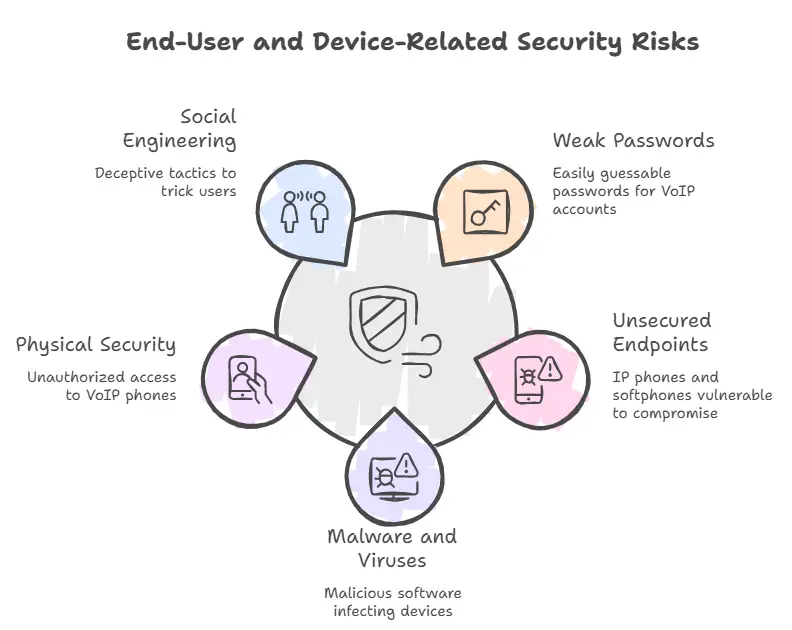
End-User and Device-Related Security Risks
The human element and the devices you use are often the weakest links in the security chain.
Weak Passwords and Authentication
This is a recurring theme across all digital security, and VoIP is no exception. Default or easily guessable passwords for VoIP accounts, voicemail systems, and administrative interfaces are an open invitation for attackers. Imagine leaving your front door unlocked – that’s essentially what a weak password represents.
Unsecured VoIP Endpoints (Softphones and IP Phones)
Your IP phones and softphone applications are essentially small computers connected to your network. Just like any computer, they can be compromised.
Malware and Viruses
A compromised softphone can become a gateway for malware to propagate throughout your network. An infected IP phone, while less common, could theoretically be used to eavesdrop on calls or even launch attacks against other network devices.
Physical Security of VoIP Phones
If an attacker gains physical access to your IP phone, they might be able to extract configuration information, bypass security controls, or even implant malicious hardware. This is particularly relevant in environments where phones are accessible to unauthorized individuals.
Social Engineering and Phishing
Attackers often target the human factor. You might receive a deceptive call purporting to be from your service provider, asking for sensitive information. You might click a malicious link in an email that installs malware designed to compromise your softphone credentials. These social engineering tactics are designed to trick you into divulging information or taking actions that compromise your security. Recognize that even the most technically robust system can be undermined by human error or deception.
Mitigating VoIP Security Risks
Now that you understand the breadth of potential threats, it’s crucial to implement robust countermeasures. Think of security as a multi-layered defense system, where each layer complements the others.
Encryption of VoIP Traffic
This is paramount. Just as you wouldn’t send a sensitive letter through the mail unsealed, you shouldn’t send voice data unencrypted.
Transport Layer Security (TLS) for SIP
TLS encrypts the signaling information, protecting the setup and teardown of your calls from eavesdropping and tampering. This ensures that your call metadata – who called whom, and when – remains confidential.
Secure Real-time Transport Protocol (SRTP) for RTP
SRTP encrypts the actual voice data packets, making it virtually impossible for an attacker to reconstruct your conversations even if they manage to intercept the packets. Implementing SRTP is like putting your voice in a secure, digital vault before it travels across the network.
Strong Authentication and Access Control
This is your first line of defense against unauthorized access.
Complex Passwords and Multi-Factor Authentication (MFA)
Enforce strong password policies that require a combination of uppercase and lowercase letters, numbers, and symbols. Even better, implement MFA, which requires a second form of verification (e.g., a code from your phone) in addition to your password. This makes it significantly harder for attackers to gain access, even if they compromise your password.
Role-Based Access Control (RBAC)
Limit access to VoIP system administration interfaces and configurations based on a “least privilege” principle. Users should only have access to the resources they absolutely need to perform their duties. This minimizes the potential damage if an account is compromised.
Network Security Best Practices
Your general network security posture directly impacts VoIP security.
Firewalls and Intrusion Detection/Prevention Systems (IDS/IPS)
Configure firewalls to restrict unauthorized access to your VoIP servers and devices. IDS/IPS systems can monitor network traffic for suspicious patterns and alert administrators or even block malicious activity in real time. Think of these as your security guards, constantly watching for intruders.
VLAN Segmentation
Isolate your VoIP network on a separate Virtual Local Area Network (VLAN). This prevents attackers who gain access to your regular data network from easily traversing to your VoIP infrastructure, and vice-versa. It’s like separating your valuable assets into different, secure rooms within your building.
Regular Security Audits and Patch Management
Periodically audit your VoIP system configuration for vulnerabilities. Furthermore, keep all your VoIP software, firmware, and operating systems patched and up-to-date. Software vendors regularly release security patches to address newly discovered vulnerabilities. Failing to apply these patches is like leaving a known security flaw unaddressed in your home.
VoIP-Specific Security Features
Many VoIP platforms offer built-in security features that you should leverage.
Anti-Fraud Mechanisms
Implement features that monitor call patterns for unusual activity, such as unusually high call volumes to international destinations, which could indicate toll fraud. Such mechanisms can automatically block suspicious calls or alert administrators.
Call Detail Record (CDR) Analysis
Regularly review CDRs for signs of unauthorized activity. Unusual call durations, frequent calls to suspicious numbers, or calls at odd hours could be indicators of compromise.
In conclusion, while VoIP offers undeniable advantages in communication, it also introduces a complex array of security challenges. By understanding the attack surface, appreciating the vulnerabilities inherent in the protocols and devices, and diligently implementing a multi-layered security strategy, you can significantly reduce your risk. Treat your VoIP system not just as a communication tool, but as a critical infrastructure component that demands continuous vigilance and proactive security measures. Your conversations, your data, and your organizational integrity depend on it.
FAQs
What are the common security risks associated with using VoIP?
Common security risks in VoIP include eavesdropping, where unauthorized parties listen to calls; phishing attacks; denial of service (DoS) attacks that disrupt service; toll fraud, where attackers make unauthorized calls; and malware infections targeting VoIP systems.
How can VoIP calls be intercepted or eavesdropped on?
VoIP calls can be intercepted through techniques like packet sniffing on unsecured networks, man-in-the-middle attacks, or exploiting vulnerabilities in VoIP protocols. Without proper encryption, voice data packets can be captured and reconstructed by attackers.
What measures can be taken to secure VoIP communications?
To secure VoIP, users should implement strong encryption protocols (such as SRTP and TLS), use secure passwords, regularly update software and firmware, employ firewalls and intrusion detection systems, and restrict access to VoIP networks.
Are VoIP systems vulnerable to denial of service (DoS) attacks?
Yes, VoIP systems can be targeted by DoS attacks that overwhelm the network or servers, causing service outages or degraded call quality. Proper network management and security measures are necessary to mitigate these risks.
How does using public Wi-Fi affect VoIP security?
Using public Wi-Fi can increase the risk of VoIP security breaches because these networks are often unsecured, making it easier for attackers to intercept calls or launch attacks. It is recommended to use VPNs or avoid sensitive VoIP communications on public networks.














Post Comment