Securing VoIP: The Protocol You Need
VoIP, or Voice over Internet Protocol, has become the primary backbone for modern communication, a ubiquitous thread weaving through businesses and homes alike. Its ability to translate voice into data packets and send them across the internet promises cost savings and enhanced flexibility. However, this very reliance on networked infrastructure, the same pathways that carry your email and cat videos, also opens VoIP systems to a spectrum of vulnerabilities. Just as a castle built on a sandy shore is susceptible to the tides, your VoIP system, without proper protection, can be eroded by malicious actors. This article will illuminate the critical protocol that stands as your bulwark against these threats: SIP, the Session Initiation Protocol.
Before delving into the solution, it is essential to grasp the nature of the problems you might encounter. Your VoIP system, much like any connected device, is a digital entity operating within a larger network. This interconnectedness, while powerful, also presents avenues for exploitation. Understanding these vulnerabilities is the first step in fortifying your digital fortress.
Eavesdropping and Wiretapping
Imagine your conversations as delicate threads being carried by a complex web of wires and wireless signals. Without encryption, those threads are plainly visible to anyone positioned to intercept them. This allows unauthorized parties to listen in on your private conversations, be they business negotiations or personal discussions.
The Risk to Confidentiality
The interception of voice traffic can lead to the loss of sensitive corporate information, competitive intelligence, and even personal privacy. The implications of such breaches can range from financial losses to reputational damage.
Passive vs. Active Interception
- Passive Interception: This often involves simply “listening in” on unencrypted traffic. It’s akin to overhearing a conversation in a public place.
- Active Interception: This is a more sophisticated form where attackers might actively manipulate or redirect traffic to intercept communications.
Denial of Service (DoS) and Distributed Denial of Service (DDoS) Attacks
Think of your VoIP system as a busy highway. DoS and DDoS attacks are akin to creating massive traffic jams, deliberately overwhelming the system with so much data that legitimate users cannot access its services. For a business, this can bring communication to a grinding halt, impacting productivity and revenue.
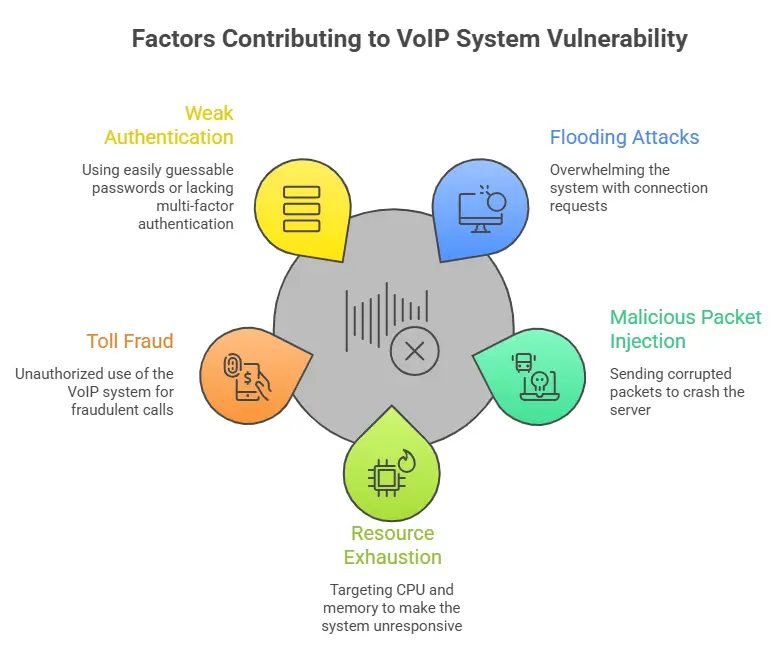
How DoS/DDoS Attacks Disrupt VoIP Services
These attacks flood your VoIP server or network infrastructure with an overwhelming volume of traffic, consuming all available bandwidth and processing power. This renders the system unresponsive, preventing calls from being made or received.
Common Attack Vectors
- Flooding attacks: Sending a massive number of connection requests.
- Malicious packet injection: Sending corrupted or malformed packets that crash the server.
- Resource exhaustion: Targeting specific server resources like CPU or memory.
Toll Fraud and Unauthorized Access
This is a particularly insidious threat, often likened to leaving your front door unlocked and inviting unknown guests to make expensive calls on your account. Attackers gain unauthorized access to your VoIP system and use it to make fraudulent calls, leaving you with the bill.
The Financial Implications of Toll Fraud
The costs associated with toll fraud can be substantial, draining company resources and potentially leading to significant financial losses. These attacks often exploit weak authentication mechanisms or known vulnerabilities in older VoIP software.
Exploiting Weak Authentication
If your VoIP system relies on simple, easily guessable passwords or lacks multi-factor authentication, it becomes an open invitation for attackers to gain unauthorized entry.
Bogus Calls and Spam Over Internet Telephony (SPIT)
Similar to email spam, SPIT involves unwanted and unsolicited calls flooding your VoIP lines. While often an annoyance, it can also consume resources and potentially mask more malicious activities.
The Annoyance Factor and Resource Drain
These unwanted calls can disrupt workflow and waste valuable employee time. On a larger scale, they can contribute to network congestion.
The Potential for Phishing and Social Engineering
SPIT messages can sometimes be used as a vector for phishing attacks, where attackers try to trick users into revealing sensitive information.
Introducing SIP: The Session Initiation Protocol, Your Guardian at the Gate
Now that you understand the potential threats, let us turn our attention to the primary protocol that governs your VoIP interactions: the Session Initiation Protocol (SIP). SIP is the architect of your voice and video calls, the conductor orchestrating the digital symphony of your communications. It is not merely a pathway; it is a set of rules and procedures that enables the establishment, modification, and termination of multimedia sessions.
The Foundation of VoIP Communication
SIP operates at the application layer of the network model, meaning it deals with the content and control of your communication sessions rather than the underlying network transport. It acts as the handshake between your device and the server, and between different VoIP servers, to initiate and manage calls.
How SIP Establishes a Session
Think of SIP as the master of ceremonies at a grand ball. It announces who wants to dance with whom, checks if both parties are ready, and then gracefully guides them through the dance. It uses messages similar to HTTP (Hypertext Transfer Protocol), the protocol that powers the World Wide Web, to request and respond to actions.
Key SIP Elements and Their Roles
- User Agents (UAs): These are the endpoints that initiate or receive SIP messages, such as your VoIP phone or softphone.
- SIP Servers: These servers process and route SIP messages, acting as intermediaries between user agents. This includes Proxy Servers, Registrar Servers, and Redirect Servers.
- SIP Messages: The core of SIP communication, these messages include Requests (like INVITE, ACK, BYE) and Responses (like OK, Not Found).
The Importance of SIP in Modern VoIP Architecture
Without SIP, the seamless and efficient functioning of most VoIP systems would be impossible. It provides the standardized framework that allows diverse devices and networks to interoperate, making your VoIP system more adaptable and scalable.
Interoperability and Standardization
SIP’s standardized nature ensures that devices from different manufacturers can communicate with each other. This avoids vendor lock-in and allows for greater flexibility in your technology choices.
Scalability and Flexibility
As your communication needs grow, SIP-based systems can scale more effectively. The protocol is designed to handle a large number of concurrent sessions, allowing your business to expand without a proportional increase in communication infrastructure costs.
Securing the SIP Conversation: TLS as Your Digital Lockbox
While SIP is the language of your VoIP calls, it doesn’t inherently provide strong security. Conversations transmitted via plain SIP are as vulnerable to eavesdropping as a whispered secret in a crowded room. This is where Transport Layer Security (TLS) steps in, acting as your impenetrable lockbox for the sensitive data within your SIP messages.
The Role of TLS in Encrypting SIP Traffic
TLS is a cryptographic protocol designed to provide communications privacy and data integrity over a computer network. When applied to SIP, it encrypts the SIP signaling messages, ensuring that only the intended recipients can understand the content of your calls.
Encrypting Signaling and Control Information
TLS scrambles the SIP messages themselves, including details like caller ID, call duration, and routing information. This prevents attackers from intercepting and interpreting these critical pieces of information.
Ensuring Data Integrity
Beyond confidentiality, TLS also ensures data integrity. This means that the messages you receive are exactly as they were sent, and have not been tampered with in transit. Imagine receiving a sealed envelope; TLS ensures the seal remains unbroken.
Implementing TLS for SIP Security
The implementation of TLS for SIP involves configuring your VoIP devices and servers to use encrypted connections. This often involves the exchange of digital certificates to verify the identity of the communicating parties.
Certificate Management: The Key to Trust
Digital certificates are like digital passports, verifying the identity of your VoIP devices and servers. Proper certificate management is crucial for ensuring that you are communicating with legitimate endpoints and not imposters.
Negotiating Secure Connections
When a TLS-secured SIP session is initiated, a handshake process occurs where both parties agree on the encryption algorithms and keys to be used. This negotiation ensures a secure and robust connection.
Benefits of TLS-Secured SIP
- Confidentiality: Prevents unauthorized eavesdropping on call setup and control.
- Integrity: Ensures that SIP messages are not tampered with in transit.
- Authentication: Verifies the identity of the SIP endpoints, preventing man-in-the-middle attacks.
SRTP: Safeguarding the Audio and Video Stream
While TLS secures the conversation about the call (the signaling), it does not directly encrypt the actual voice or video data flowing between parties. For this, you need Secure Real-time Transport Protocol (SRTP), the dedicated bodyguard for your audio and video streams. Think of SRTP as the armored transport that carries your most valuable cargo, ensuring it arrives at its destination unmolested.
Protecting the Real-time Media Flow
SRTP is an extension of the Real-time Transport Protocol (RTP), which is used to transmit audio and video data in real-time. SRTP adds encryption and authentication to this stream, making it virtually impossible for unauthorized parties to decipher or manipulate your conversations.
Encrypting Voice and Video Packets
SRTP encrypts each individual packet containing voice or video data, rendering them unreadable to anyone without the correct decryption key. This is the direct protection for the words you speak and the images you transmit.
Authentication of Media Packets
In addition to encryption, SRTP also provides authentication for media packets. This confirms that the packets originated from the legitimate sender and have not been altered during transmission, preventing malicious injection of fabricated audio or video.
Key Features of SRTP
- Symmetric Encryption: Uses a single key shared between the sender and receiver for encryption and decryption.
- Message Authentication Code (MAC): Ensures the integrity and authenticity of the media packets.
- Key Derivation: Generates unique encryption keys for each session.
Implementation Considerations for SRTP
Deploying SRTP requires compatible hardware and software on both ends of the communication. This often involves configuring your VoIP devices and servers to support SRTP and to securely exchange the necessary encryption keys.
Key Exchange Mechanisms
Securely exchanging keys between endpoints is paramount for SRTP to function effectively. Protocols like the Session Description Protocol (SDP), in conjunction with TLS, are often used for this purpose.
Performance Implications
While SRTP provides robust security, it does introduce a slight overhead due to encryption and decryption processes. For most modern systems, this performance impact is negligible.
Beyond Protocols: Holistic VoIP Security Strategies
<?xml encoding=”UTF-8″>
| Protocol | Description | Security Features | Common Usage | Encryption Type |
|---|---|---|---|---|
| SRTP (Secure Real-time Transport Protocol) | Extension of RTP to provide encryption, message authentication, and integrity | Confidentiality, message authentication, replay protection | Encrypting voice streams in VoIP calls | AES (Advanced Encryption Standard) |
| SIP-TLS (Session Initiation Protocol – Transport Layer Security) | Secures SIP signaling messages using TLS | Encryption of signaling data, server authentication | Securing call setup and teardown signaling | TLS encryption (various cipher suites) |
| ZRTP (Zimmermann Real-time Transport Protocol) | Key agreement protocol to negotiate encryption keys for RTP streams | End-to-end encryption, key agreement without prior shared secrets | Peer-to-peer encrypted VoIP calls | SRTP with keys negotiated via Diffie-Hellman |
| DTLS-SRTP (Datagram Transport Layer Security – SRTP) | Uses DTLS to negotiate keys for SRTP encryption | Encryption, authentication, integrity protection | WebRTC and other real-time communications | SRTP with DTLS key negotiation |
While protocols like SIP and SRTP, secured by TLS, form the core of your VoIP defense, they are not the only lines of protection. A truly secure VoIP system is a multi-layered fortress, with different strategies working in concert.
Hardening Your VoIP Infrastructure
Your VoIP servers and network devices are the foundation of your communication system. Securing them against unauthorized access and configuration errors is as crucial as securing the communication channels themselves.
Regular Software Updates and Patching
Vulnerabilities are discovered in software with regularity. Keeping your VoIP operating systems, firmware, and applications up-to-date is like regularly inspecting and repairing the walls of your castle to plug any discovered breaches.
Access Control and Authentication
Implementing strong password policies, multi-factor authentication, and role-based access controls ensures that only authorized personnel can manage and access your VoIP system. This is akin to having strict security checks at the gate of your fortress.
Network Segmentation and Firewalls
Isolating your VoIP traffic from less secure network segments can significantly reduce the attack surface. Firewalls act as vigilant sentinels, inspecting all incoming and outgoing traffic and blocking anything deemed suspicious.
Isolating VoIP Traffic
By placing VoIP devices and servers on a separate network segment, you can create a dedicated and controlled environment for your voice communications. This limits the potential impact of a breach in another part of your network.
Configuring Firewall Rules
Properly configured firewalls can block unauthorized access to VoIP ports, filter out malicious traffic, and enforce security policies. This is like having guards who know exactly who is allowed to pass and what they are allowed to carry.
Intrusion Detection and Prevention Systems (IDPS)
These systems act as the electronic eyes and ears of your network, constantly monitoring for suspicious activity. IDPS can detect and even automatically block attempted attacks, providing an active defense against threats.
Monitoring for Anomalous Behavior
IDPS can identify patterns of network traffic that deviate from normal behavior, which might indicate an attempted intrusion or malicious activity.
Real-time Threat Mitigation
When an attack is detected, IDPS can trigger alerts or automatically take action to block the malicious traffic, preventing it from reaching your VoIP system.
User Education and Awareness
The human element is often the weakest link in any security chain. Educating your users about phishing attempts, social engineering tactics, and secure dialing practices is a vital component of your overall security strategy. A well-informed user is a powerful security asset.
Recognizing and Reporting Phishing
Ensuring that your users understand how to identify phishing emails and calls can prevent them from inadvertently compromising the system.
Secure Password Practices
Encouraging users to create strong, unique passwords and to never share them is fundamental to preventing unauthorized access.
In conclusion, while the allure of cost savings and advanced features makes VoIP an undeniable choice for modern communication, neglecting its security is akin to leaving your valuables out in the open. By understanding the vulnerabilities and by strategically implementing protocols like SIP, TLS, and SRTP, and by adopting a holistic approach to security, you can transform your VoIP system from a potential liability into a robust and secure communication backbone, safeguarding your conversations and your business.
FAQs
What is the secure protocol commonly used for VoIP?
The secure protocol commonly used for VoIP is Secure Real-time Transport Protocol (SRTP), which encrypts voice data to ensure confidentiality and integrity during transmission.
How does SRTP enhance VoIP security?
SRTP enhances VoIP security by providing encryption, message authentication, and integrity checking for the RTP data streams, protecting against eavesdropping and tampering.
Are there other protocols involved in securing VoIP calls?
Yes, protocols like Transport Layer Security (TLS) are used to secure signaling messages in VoIP, while SRTP secures the media streams, together providing comprehensive security.
Can standard RTP be considered secure for VoIP communications?
No, standard RTP does not provide encryption or authentication, making it vulnerable to interception and attacks; therefore, SRTP or other secure protocols are recommended.
Is it necessary to use secure protocols for all VoIP communications?
Yes, using secure protocols like SRTP and TLS is essential to protect VoIP communications from eavesdropping, fraud, and other security threats, especially in sensitive or business environments.













Post Comment